Edward was baptised at St Giles, on 17 Feb 1818, the fourth son of Edward Alsop and Betty (nee Hodgetts). Their abode was shown at that time as ‘Windmill’ and his father’s occupation as miller. On 29 July 1838 FreeREG shows that Edward married Rebecca (often spelled Rebekah) Clift (also known as Parkes) at Christchurch, West Bromwich. Edward was shown as a bachelor and a farmer of Rowley, of full age and Rebecca as a spinster of Rowley, also of full age. Whether Edward was older at baptism than usual I don’t know but with a baptism in 1818, it seems likely that he was only just of full age, which was 21 in those days! Or perhaps he lied… Edward’s father’s occupation was shown as farmer and Samuel Parkes as a Nail Factor.
The man Rebekah names as her father in the marriage entry was Samuel Parkes who was a Nail Factor, business families marrying into other business families again. There were many members of the Clift family living on the Portway/Oldbury side of Rowley and it appears that Rebekah was baptised as the illegitimate daughter of Sarah Clift of Mincing Lane. Rebekah gave her own surname as Clift and the name of her father at her marriage as Samuel Parkes and her mother Sarah appears to have been living with Samuel Parkes in the Club Buildings in 1841 and in Bell End in 1851 when she was shown as his wife but I have not been able to find a marriage between Sarah and Samuel . Rebekah also gave her maiden name as Parkes when the births of her children were registered. Whether Samuel was actually her father is unclear but it appears that she considered him such.
In the 1841 Census, Edward was living at Yew Tree, with Rebecca whose age was shown as 25, so it appears that she was a little older than Edward whose age had been rounded down to 20. Also listed living with them was a daughter Mary (actually registered and baptised as Mary Ann), aged 3 and a son Joseph, aged 6 months. Edward was shown as a Ag Lab. MaryAnn was baptised on 19 October 1838 at St Giles when the abode was given as Windmill and also, apparently, 9 December 1838 when the abode was given as Mincing Lane. This seems very odd. But both entries appear in the parish register, just a few lines apart and there is no other female Alsop born in the area in that period. I suspect, though I cannot be 100% certain, that this may have been a private baptism in October, often performed at home when a baby was in danger of dying. Then, if the baby survived, another ceremony was held a little later to ‘receive the baby into the congregation’ of the church. Joseph was baptised on 14 March 1841 when his parents were living in Yew Tree where Edward was a farmer, confirmed by the 1841 census. And another son Samuel Edward was born in 1844, baptised at St Giles on 14 March 1844, but his mother Rebecca was buried the same day with a note on the burial entry in the register that she had died in childbirth.
Poor Edward’s family life seems to have been badly affected by Rebecca’s death. By the time of the 1851 Census he had moved to Barr Common, Great Barr where he was farming 39 acres with just one labourer sharing the house with him. His daughter Mary Ann appears to be in service as a house servant, aged 12, at a farm in Handsworth, Birmingham. Joseph is living with his maternal grandmother in Bell End, Rowley and Samuel Edward is living with his paternal grandparents at the Mill Farm.
In the 1861 Census Edward was still farming at Barr Common but he had re-married in 1859 in Aston, Birmingham to Eliza Paviour , a widow, nee Billingham. With that maiden surname you will probably not be surprised to hear that Eliza, although she had been living in Aston at the time of her marriage to Edward, gives her place of birth as Rowley and there is a baptism at Park Lane Presbyterian chapel in Cradley in 1814 which may relate to her. However, her age in censuses varies in each census and her estimated year of birth from those ages ranges from 1813 to 1820, with three instances of 1817! Edward and Eliza appear not to have had any children.
Also in this census his son SamuelEdward, by now aged 17, was also living with him.
By 1871Edward and Eliza were still farming at Barr Common but by 1881 Edward was described as a retired farmer and they had moved to Birmingham Road, Great Barr. Eliza died in 1889 and Edward remained in Great Barr in 1891 and 1901, dying in July 1901 and he was buried at St Margaret’s Great Barr on 27 July 1901. His substantial probate in December 1901 showed that he left more than £7,000 which was a substantial sum in those days.
Edward and Rebekah’s children:
Mary Ann (1838-1859)
As already mentioned above, Mary Ann was baptised twice and was apparently in service in Handsworth in 1851. It was not unusual for girls to go into service so young, brutal as we might find it today, and it appears that her two younger brothers were also separated and being cared for by different grandparents at that time. However, I was, at first, unable to find much trace of Mary Ann after that census.
At least one family tree on Ancestry has Mary Ann recorded as marrying a William Ward in Moxley, Staffordshire in 1864 and subsequently moving to Yorkshire but her father’s name in the FreeREG entry of that marriage record was shown as Henry so definitely not our Mary Ann.
However I did find a death and burial of a Mary Ann Alsop in Great Barr in August 1859. Great Barr was where Mary Ann’s father had moved to following her mother’s death and where he was also buried after his death. This Mary Ann was aged 20 which is the correct age. Bearing in mind that in the 1861 Census Edward’s son Samuel was also living at the farm with his father, it does not seem unlikely that the children, as they grew up, moved to live with their father, especially as Mary Ann could housekeep for him. I have not been able to find Mary Ann in any later censuses and I think that this is our Mary Ann.
Curiously the Civil Registration Death Index through FreeREG shows two entries for the death of Mary Ann Alsop in Walsall RD in this quarter, with the second entry being inserted below the first and in a different handwriting and with the page number being one different – very odd! But the GRO online search couldn’t find either of them so I couldn’t even order them to satisfy my curiosity! However, I did raise a query with the GRO, and some correction has been made and I have now been able to obtain Mary Ann’s Death Certificate.
Not easy to read but this confirms that this Mary Ann was indeed the daughter of Edward Alsop, farmer and that she died of phthisis (tuberculosis), aged 20 on 12 August 1859 at Great Barr. She had been suffering from phthisis for three years.
So two baptisms and two death registrations for this poor girl in her short and hard life.
Joseph 1841-?
Joseph was baptised at St Giles on 14 March 1841, when his parents were living at Yew Tree where Edward was farming. In the 1841 Census his age was given as 6 months and that census was taken on 6 June so presumably he was born sometime in December 1840, though his birth was not registered until the first quarter of 1841. In 1851, aged 9, he was living with his maternal grandmother Sarah Clift/Parkes in Bell End and he was still there in 1861, aged 20 when he was a warehouseman. His widowed grandmother, by then 65, was listed as a shopkeeper. This is not the first time we have found members of the Alsop family keeping a shop in Bell End, one wonders whether the tenancy was passed around the family as others moved on!
But after that, Joseph disappears. Searching for him has been difficult because he had a first cousin also named Joseph Alsop, also born in 1841, son of his father’s older brother Joseph Alsop and Sarah Eliza Dingley and who at one time also lived in Bell End…. Only by looking at the name of the groom’s father in various marriages was I able to establish that none of the marriages of Joseph Alsop in the surrounding area in following period was this Joseph. He was not with his father and brother in Great Barr in 1871 and I can find no other Joseph born in Rowley Regis in 1840/41 in any of the later censuses, all the entries I can find relate to his cousin. I cannot find a death registration for him in the UK nor a burial any where locally.
It occurs to me that Joseph may have emigrated, perhaps after his maternal grandmother died, as he was living with her in the last two censuses but I have not found any specific records of Sarah’s death or of him emigrating. There is no evidence of him living with his father in later life and his only sister died in 1859, so perhaps new adventures appealed. Certainly his brother had emigrated to Australia by the mid-1860s, perhaps they went together or one followed the other.
In the meantime, none of the other trees on Ancestry who have this Joseph on them have any information after 1861 either which probably means that there is no more information to find about him, at least at present.
Samuel Edward (1844-1933)
Samuel was baptised at St Giles on 14 March 1844, the same day that his mother was buried. This left his farmer father with three children, including a new born baby, under the age of six. It seems that he got a lot of help from his family, as the two boys were later living with grandparents, Samuel was with his paternal grandparents Edward and Betty Alsop at the Mill Farm, off Tippity Green, while his father had moved to farm in Great Barr.
By 1861 Samuel was living with his father in Great Barr and I found a newspaper report in the Walsall Free Press and General that, in June 1863, “Samuel Edward Alsop, farmer, Great Barr, pleaded guilty to carting night soil through the streets during prohibited hours . It appeared that, on Friday last, the night soil had been brought from West Bromwich, and that the waggon passed along Bridge Street during prohibited hours. Under the circumstances, the defendant was sentenced to pay a fine of 1 shilling and costs.” Which does not seem to be a very severe punishment – one cannot help thinking that if the smells associated with this work were so unpleasant that they could not be transported through the streets when people were out and about (I presume this was the restriction!), and bearing in mind that it was June and possibly quite warm, the magistrates had some sympathy for poor Samuel!
As mentioned above, Samuel’s father had remarried in March 1859, and his sister Mary Ann had died in August 1859 so perhaps Samuel Edward decided that there was not much to keep him at home. Certainly by 1867 he had been in Victoria, Australia long enough to marry his wife Matilda Blazeley. They appear to have settled in Condenand then Camperdown, Victoria and they had at least six children.
I found this obituary for his son Samuel, which gives some of the story of his father’s early life in Australia.
I was very interested, looking at some of his children on other family trees on Ancestry to see that his son Henry Alsop, born in 1871 in Victoria, was married in Australia and subsequently settled in New Zealand. The reason for my interest? His bride was a Lily Dingley – born in Wolverhampton – another Alsop/Dingley connection and one that showed that the close connectionns between these families had crossed the world, not confined to the Rowley area. And Dennis and Lily were married in the Wesleyan church by a John Adams. And the witnesses at the marriage were Lily’s mother and Grace Rose Adams, presumably related to the Wesleyan Minister. Lily’s parents were Dennis Dingley (born in Titford, Oldbury) and – wait for it… Betsy Alsop (born in Rowley Regis, the daughter of Joseph Alsop and Sarah Eliza Dingley)… So Henry married his second cousin. What a cluster of very familiar Rowley and Blackheath names – I wonder whether there was a mini-Rowley settlement there?! It must be challenging to move to the other side of the world, leaving all your loved ones behind – what could be more natural than for people to settle near to others from the same area and who had the same connections back at home?
Samuel Edward returned at least once to England, sailing back in April 1896, apparently, from passenger lists, alone and he returned to Adelaide arriving back in Albany in November of that year.
He died in July 1933 at Camperdown and is buried there.
Conclusion
So of Edward and Rebekah’s three children, the only definite issue was Samuel Edward’s children in Australia. After Edward’s death in 1901, an advertisement appeared in the Walsall Observer on 17 August, giving details of the auction of the contents of Edward’s house in Birmingham Road, at the behest of the executors of Edward’s Will so it seems likely that there were none of his children in England to take possession.
The Allsopp Genealogy website
In the course of my research on this twig of the Alsop family tree, I found the Allsopp Genealogy website (https://allsoppgenealogy.com/ ), run by Dennis Allsopp in Australia and he is also working on a One Name Study for the Allsopp family. It is an extensive and well documented website and if you have any Alsop connections, you will find it of interest. Dennis has kindly placed a link to this blog on the site as he thinks it may be of interest to some of his members, including this delightful illustration he has created about the Rowley Alsop family.
Whether Dennis has direct links to the Rowley Alsops I do not know but he has noted that Staffordshire was a ‘hotbed for the Allsop name’ and he is continuing to add names to his One Name Study.
I shall continue the story of the Rowley Regis Alsop family in my next piece, with Mary Ann and Rhoda’s stories still to come.
This very short piece looks at the next younger children of Edward and Betsey (nee Hodgetts) Alsop , having dealt with their eldest daughter Hannah in my last piece. This piece covers Sarah, John, Thomas andMary. Joseph will be looked at in the next piece, as he has turned out to have quite a lot of information available about him, and the remaining children Edward, Mary Ann and Rhoda will be in the final piece.
This picture (copyright unknown) shows the view to Turners Hill from Hawes Lane which would have been very familiar to the Alsop family, their farm was just over the wall! They must also have had good views of Turner’s Hill, and this was before the hillside quarries really ate into the hillside, and their own quarry also created a very large hole! I am not sure what the enormous heap on the right is, as I am not aware of any mining in this immediate area which would create spoil. Perhaps it was material from their quarry or perhaps it was Alsop’s Hill which appears on the 1902 OSMap. I think that the houses on the left are in Tippity Green and it is possible that by this time, the mill and farm may have disappeared.
Sarah Alsop (1805-1884)
Sarah was born early in 1805 and baptised on the 2 June 1805 at St Giles. In 1841, 1851 and 1861 censuses she was living at Mill Farm, one of several unmarried children of Edward. In 1871 she had moved to Mincing Lane where she was living with her sister-in-law, Eliza Alsop (widow ofJoseph) . In this census she is described, at the age of 69, as an ‘idiot’ which does not have quite the same meaning as it might today but implies some sort of mental condition or handicap. However, by 1881 she had moved to 93 Rowley Village where she was living with Jesse Patrick, a tailor and his wife. By now Sarah was 77 but there is no mention in this census of any health issues. Whether Sarah was suffering from dementia we cannot tell nor whether any health issues might have prevented her from marrying but it seems unlikely that she would have lived to such a great age if she had suffered from Downs Syndrome or some such disability. It is possible that she had some degree of learning difficulties and certainly she was looked after with the family until at least 1871. She never married.
Sarah died in Rowley Regis and was interred at St Giles on 27 April 1884, aged 79 and ‘of the village’.
John Alsop (1807 -?)
John Alsop, named presumably for his grandfather John Alsop, was baptised at St Giles on 4 October 1807. And that is the only definite information I can find of him. I cannot find a burial or a marriage for him in Rowley Regis or the surrounding area. The period of his younger life was before censuses, of course, so there are no clues there. There is a possible baptism for a John Alsop, son of John and Mary Alsop at Dudley St Thomas in 1839, the father being a baker who could be the right man. But I cannot find that couple in the 1841 Census so that is also inconclusive. There are three other trees on Ancestry which have John on them but none of them have any further mention. It is tempting to assume that he died in infancy but no subsequent sons were called John, as often happens when an infant dies and a later sibling is given the same name, especially when it is a family name. So John is a mystery!
Thomas Alsop (1809-1865)
Thomas was baptised at St Giles on 29 October 1809. He was living, unmarried, with his family at the Windmill Farm in 1841, in 1851 when his occupation was given as ‘Farmer’s son’ and in 1861 when, at 51, he was the farmer at Blowershill Farm (otherwise known as Mill Farm or Windmill Farm), farming 35 acres. His father had died in 1860 so Thomas had taken over the farm but there is no reference at any stage to him being involved with the milling trade, unlike two of his brothers. He was still single in 1861 and his unmarried sisters Rhoda and Sarah were also living there. John Wright, a labourer and carter born in Rous Lench , near Evesham, Worcestershire, was also living there. Another instance of labour being brought in from outside the area, even for relatively unskilled work for which one would have thought there would have been suitable local candidates.
Thomas Alsop, of Blower’s Hill, was buried at St Giles on 10 July 1865, aged 54, having outlived his father by only five years. In the next census, his sister Sarah, as related above, had moved to live with her sister-in-law in Mincing Lane which would tie in with this.
Mary Alsop (1811-1813)
Mary was baptised on 24 November 1811 at St Giles and buried there less than two years later on 17 October 1813. The entry in the Burial Register has her abode as the Windmill and the cause of death as a ‘bowel complaint’, a very common cause of death for infants, not only then but for more than a century to come, before water supplies and sewage disposal conditions were improved in the area which helped gradually to reduce the number of infant deaths.
The next brother, Joseph, turns out to have quite a lot of information available so he will probably have a post of his own, hopefully very soon.
The Alsops only just count as a family of the Lost Hamlets, as they lived at Windmill Farm from about 1764 and were there in the 1841 Census, right on the edge of the Lost Hamlets area where they originally operated the Windmill. In this first piece I will look at John Alsop and his family and his son Edward. Edward’s children will be the subject of another piece.
Windmill Farm was off Tippity Green and Hawes Lane, the windmill was between the church and Tippity Green, opposite the Bull Public House and where the Windmill is shown on this Ist Edition OS map. The quarry which developed on this land was marked on the 1892 OS Map as Alsop’s Hill Quarry so the family obviously retained control for many years.
Reprint of the 1st Edition Ordnance Survey, Copyright: David & Charles
The Role of the Miller in Society
Where there were farmers growing crops requiring milling and where there were people needing flour, not to mention bakers, Millers were important and necessary in society. Some home grinding was possible with small querns or grinding stones but later two millstones one on top of the other – the bottom one stationary and the upper rotating to grind grain between them to crush the seed, remove the husk and crush the germ inside. The Romans developed this method further by using power to drive the runner stone, at first by horse or donkey but later using water power.
The Domesday Survey records more than five thousand water mills in England, the wind mill was not introduced into England until about 1185.
During the medieval period, there was a customary law known as Mill Soke. The Mill would be built by the Lord of the Manor and his tenants were obliged to bring their corn to be ground there, by the Lord’s Miller and he retained a percentage of the ground flour as his ‘toll’, usually about one fifteenth. Millers were apparently not popular in the communities they served, often accused of taking more than their entitlement (it was noted that the Miller’s pigs were usually the fattest in the village) or adding material, such as alum, to pad out the flour which would, of course, affect the subsequent baking with the flour but would increase the profit for the miller. In 1872 Dr. Hassall, the pioneer investigator into food adulteration and the principal reformer in this vital area of health, demonstrated that half of the bread he examined had considerable quantities of alum. Alum, while not itself poisonous, by inhibiting the digestion could lower the nutritional value of other foods.
The Rowley Windmill was a manorial Mill. It occurs to me that it may have suited the Lord of the Manor to recruit his Miller from outside the community and he would certainly have needed a miller who knew the business and how to operate the machinery.
By 1750 the tradition of ‘soke’ was disappearing and millers bought grain direct from farmers and sold flour direct to his customers. White bread also became more popular so millers had to install extra equipment, more storage was needed and mills became larger. Between 1750 and 1850, the population of England tripled to nearly 17 million so more flour was needed.
Copyright: Paul Harrison. This painting shows Heage Mill, in Derbyshire, probably painted in about 1850, this mill is very similar to the remains of the windmill in Rowley Regis, shown in this photograph published by Wilson Jones.
Copyright: Wilson Jones.
By 1850, the traditional windmill or watermill had arrived at a developed state, with many operations becoming automated. The growth of canals and later railways made it possible to distribute flour more easily and quickly. But as new large automated mills with steel rollers rather than stones were built, traditional millers could not compete, particularly in urban areas. In rural areas, some diversified by milling animal feed as well as flour but by the early years of the 20th century, traditional flour milling had all but ceased.
This timeline certainly fits in very well with what we know of the Rowley windmill. In November 1860, an advertisement appeared in the Birmingham Journal, giving details of the Rowley Flour Mill to be let at a low rent, with two dwelling houses and good access to both canal and railway. The Mill was said to consist of “an 18 horse condensing engine, driving three pairs of French stones, with Dressing, Bolting and Smutting machines, Bean Mill, etc all in excellent repair.” So it was using relatively modern technology and money had been spent on equipment. But Edward Alsop had died in August of that year so perhaps no-one in the family had the skills or was prepared to continue traditional milling, especially if they were already well established in other work.
The role of the Millwright in the development of mechanical engineering
I recently read an interesting paper [i]which examined the importance of technical competence in the development of the Industrial Revolution. This suggests that the manufacturing and maintenance of relatively sophisticated devices using high quality materials (such as in mills) required top quality mechanical competence. In the early stages, this competence mattered more than schooling or literacy. The paper focuses on a particular group of craftsmen, millwrights and wheelwrights or simply known as ‘wrights’. These were originally highly skilled carpenters specialising in the planning, construction, improvement and maintenance of mainly water-powered machinery. The paper calls these the engineers of the pre-industrial era. They suggest that the agility and efficiency of the English Apprenticeship system also helped to produce high-skilled mechanics who in turn apprenticed others to pass on their knowledge. The skills developed by these ‘wrights’ later enabled them to be at the forefront of other engineering work, including steam engines – so when mines needed pumps and lifting gear and when factories began to be set up these men were the ones who knew how to install the machinery and the power sources which drove them. Was it a coincidence that many of these factories, especially those in the weaving industries, were known as ‘mills’? And although the Midlands did not have textile mills in the same way as the North-East, they certainly had many other areas of work and factories requiring similar engines and similar skills.
Some of the best-known engineers of the Industrial Revolution originally apprenticed as Millwrights, including James Brindley, the great builder of canals during the early canal era after 1750 and John Rennie the co-inventor of the breast-wheel water mill and who built the first steam driven flour mills. The millwrights were seen as all-round technically competent craftsmen and textile engineering installations categorised their equipment as either ‘millwright’s work’ or ‘clockmaker’s work’.
The report quotes John R Harris, a historian of technology during the Industrial Revolution, as saying “so much knowledge was breathed in by the workman with the sooty atmosphere in which he lived rather then ever consciously learnt”. Which I think sums up very nicely the versatility and dexterity of many of our Black Country workers, well before literacy was common. Specific skills were recognised and valued, some men described themselves as nailers or labourers but many others were more specific, many of my male Rose ancestors were rivet makers, others were furnacemen or puddlers, quarrymen were stone cutters or sett makers. I recently saw a remark that competent people in the Black Country made chains, less able made nails but I do not think it was as simple as that. Each village made a particular type of nail – Dudley folk made horse nails – whereas chains tended to be made in the Cradley area but each nailer would learn the skill from their own family so such small differences remained very local. And other skills, such as ramrod making, jew’s harp making, gun making, bladed tool makers were all present locally and usually appear to have been family based skills and very possibly keenly restricted to family!
The authors of this report urge recognition of the ‘crucial role of mechanically trained and highly competent craftsmen in the Industrial Revolution’, which they suggest correlates closely to the distribution of mills and millwrights centuries ago, even as early as the Domesday survey, as the forerunners of the mechanical engineers who enabled much of the Industrial Revolution.
Millers in Rowley Regis
So, milling as a profession required certain skills which were clearly, in the Alsop (and Mallin) families passed through the generations. Although they may not have actually built the mills or the milling machinery, so were not technically ‘millwrights’, millers required quite a high level of engineering skills to operate and maintain their mills, and were not unskilled workers but likely to be in considerable demand by the owners of manorial mills to operate them safely and efficiently. And such owners may have preferred to bring in millers from outside the immediate area whose loyalties would lie with the mill owner, rather than the local populace. From my research, the children of the Alsop family appear considerably more likely to move away from the area and settle elsewhere, than most of the core families I have examined so far in this study.
The Alsop Family
The Alsops were not a family who had been in the parish for very long (at least in contrast to some of the local families who had been there for several centuries) and they were not as prolific as some of the Hamlet families. There are only 28 Alsop entries in the whole of the printed parish registers for Rowley Regis and only 34 results for the parish in FreeREG.
John Alsop (1744-1809)
John Alsop was born in about 1744, calculated from his age at burial which may not have been very accurate, such details are only as accurate as the knowledge of the person giving the information at the time of the death so with older people unlikely to have first hand knowledge. I searched FreeREG for the period 1730-1750 for a baptism in the area around Rowley Regis. There were three John Alsops baptised in the period. The first was baptised on 30 October 1734, the son of John and Mary Alsop. The second was baptised on 7 April 1740, the son of John and Elizabeth Alsop and the third on 9 September 1748, the son of Thomas and Mary Alsop. All three were baptised in Walsall where there are other later Alsop connections. I was very interested to note, whilst I was researching John Alsop, that another John Alsop aged 70 (which tallies with the last baptism above if the age was accurate)was buried in 1818 in Walsall and that his abode was also at ‘Windmill’. Perhaps the Alsop family were Millers and the Rowley John Alsop had moved to Rowley, with his specialist skills, specifically to operate the windmill there. As to which, if any, of these is the John who moved to Rowley, we cannot be sure.
John first appears in the Rowley Parish Registers in 1764 when his daughter Elizabeth was baptised, the first of five daughters – who were baptised to John and Elizabeth (nee Gough) Alsop. Then followed Hannah in 1766, Rachael in 1768, Lucy (1770-1791) and Mary in 1773. Elizabeth Alsop died in childbirth in 1773, (which I have concluded as Mary was baptised on the same day that Elizabeth was buried). A child of John Alsop was buried in November 1773 but no name is given but this was probably the motherless Mary .
John Alsop’s daughters
There is no further clear mention of any of John Alsop’s daughters in the Rowley Registers, other than the burial of Mary in 1773 and Lucy in 1791. There are no marriages for the other daughters in Rowley Regis but I think I have found their marriages elsewhere.
Elizabeth Alsop (1764-1794)
I think that Elizabeth Alsop married widower John Cooper (1761-1797) at Harborne, on 16 July 1782. Cooper’s first wife Mary nee Smith had died in March 1782 and their daughter Sarah (1782-1793) was baptised on the day of Mary’s burial so John re-married very quickly, partly, one would think, to give Sarah a mother. Elizabeth and John Cooper had five children, all baptised in Rowley Regis: these were Joseph (1783), Esther (1785), Elizabeth (1787-1811), Edward (1790-1794) and George (1792). Elizabeth died in 1794 and was buried at St Giles, so when John died in 1797 their surviving children would have been orphans. There are numerous Coopers in the area after that, especially in the Oldbury area but I have not been able to identify what happened to the children after that, although they may have been taken in by family.
Rachel Alsop (1768-1836)
It seems likely that Rachel Alsop married John Fenton at St Martin’s (in the Bullring) in Birmingham on 7 October 1788 and it appears that this couple went on to live out their lives in Aston, Birmingham where they had at least five children: John (1791), Isaac ((1793), Charles (1800), Sarah (1803) and Henry (1806). This Rachel died in 1836 and I think JohnFenton died in 1843. If this is the correct couple, they were living in Potter Street, Aston which is just behind what is now Aston University and in the 1841 Census John is shown as a Steelworker.
Hannah Alsop (1776-1824)
Hannah married Benjamin Edge, a chain maker of Tuckies in the parish of Broseley, Shropshire in a Quaker ceremony in Worcester in April 1801 when she would have been 35, she was said to be of the City of Worcester. They lived in Coalbrookdale, certainly most of their married lives and at the time of their deaths, Hannah died in 1824 and Benjamin in 1845 and they appear to have had at least one child James Edge (1808-1887) who continued to live there for the rest of his life.
So only one of John Alsop’s daughters stayed in Rowley after her marriage, the other daughters settled in Birmingham and Coalport respectively and it appears that their children stayed in those places.
John Alsop’s second marriage
After Elizabeth’s death, John Alsop then married Sarah Bate, a widow, at Clent in 1780. Sarah’s husband John Bate had died in 1775, he and Sarah had had three sons and a daughter between 1770 and 1776. Perhaps John, with his several daughters, was keen to have a son to inherit his mill and farm. Edward Alsop was baptised at St Giles on 30 December 1781, the son of John and Sarah Alsop, he appears to have been their only child.
John Alsop died and was buried at St Giles in 1809, aged 65. Sarah Alsop, of the Windmill, died and was buried in February 1813, aged 76, of Dropsy.
Edward Alsop (1781-1860)
In 1841 John’s only son Edward Alsop, aged 60 with his wife Betty (nee Hodgetts), also 60, were living at the Mill Farm with their children Sarah aged 35, Thomas aged 30, Mary Ann aged 20 and Rhoda aged 15. There was also a Male Servant John Morteby, aged 15 who was not born in the County. Again, perhaps it suited millers to employ family members to keep their knowledge within the family or to bring in servants from outside the local community.
The 1851 Census is helpful, concerning farms and this has Edward Alsop, by then 70,as a farmer of 40 acres, employing 2 labourers. And in 1851 there were two men listed in his household, one a cowman and one a waggoner. I wonder whether Alsop was already quarrying by that time and required a waggoner to transport stone from the quarry?
EdwardAlsop had married Betty Hodgetts of Clent on 7 Jun 1801 at Clent, and his abode was also shown as Clent. It may be that there was a family connection for the Alsops in Clent as his father had also married there but there were also a large number of Alsops in Walsall.
Edward and Betty’s first daughter Hannah was baptised on 11 October 1801 at St Giles, Rowley Regis. Then followed Sarah in 1805, John in 1807, Thomas in 1809, and Mary in 1811, (who was buried aged 1 in 1813), Joseph in 1816, Edward in 1818 – in these latter two baptisms the occupations of the fathers were being shown and in these two Edward Snr’s abode was shown as Windmill and his occupation as a Miller. Next came Mary in 1820 and Rhoda in 1821 and now his occupation was shown as farmer, so perhaps the milling was becoming less important.
Betty Alsop nee Hodgetts, died in July 1854 aged 74 and her abode was given as ‘The Mill’. Her cause of death was noted as ‘old age’. Hodgetts is not an unknown name in the area. I have not yet researched Betty Hodgetts myself but other researchers who have her on their trees on Ancestry indicate that she was born in Halesowen and that her father was Timothy Hodgetts and her mother Mary Mallen – Mallen is a name which will recur later.
Edward Alsop died six years later, aged 78 in 1860 and was buried at St Giles on 7 September 1860, no cause of death noted. The Mill was being advertised for rent only a few months later so it was obviously still operational and fully equipped at that point, when milling ceased completely is not known.
The next piece will look at the children of Edward and Betty.
[i] The Wheels of Change: Technology Adoption, Millwrights, and the Persistence in Britain’s Industrialization Joel Mokyr, Assaf Sarid, and Karine van der Beek+ which I was able to download free from academia.edu
Edward Alsop, of Alsop’s Hill and Alsop’s Quarry, died, aged 78 and was buried at St Giles on 7 September 1860, his abode given in the Burial Register as Blower’s Hill. Does anyone know where this was? I didn’t! And no-one in the local Facebook page knew either when I appealed there. But clearly the name was quite unremarkable to local officials who recorded information in parish Registers, compiled Poll Books and drafted Wills. They must have known where Edward was referring to. But I was puzzled, I had seen nothing to indicate that Edward had moved anywhere else, he appeared to have lived all of his life in the Windmill Farm. But I could not find Blower’s hill on any maps or in any online archives.
So I have been exploring down a little local history and genealogical rabbit hole, trying to find out where Blower’s Hill was.
Blower’s hill
The spelling and punctuation vary slightly but usually the Alsop family appear to have spelled Blower’s with an apostrophe – making Blower’s a possessive adjective. And often they did not capitalise Hill, as if it were just a description of part of the landscape, rather than a defined area.
I considered various issues:
What had this area been called before the Alsops arrived?
First of all, although the land there was known later as Alsop’s Quarry or Alsop’s Hill, it must have been called something before the Alsops came along in the mid-1700s. And it would probably have taken a few years/decades/generations of the family living there before it became associated with their name. Even then, although many records and maps show the land they farmed as Alsop’s Hill or Alsop’s quarry, the family appear always to have called it Blower’s hill.
So perhaps the earlier local descriptive name was ‘Blower’s Hill’, either for the windmill, which was apparently a manorial mill, so long established there.
Copyright: Glenys Sykes – my artist’s impression of Blower’s Hill!
Or perhaps the land was known by the name of a previous owner, since mostly the Alsops used a possessive apostrophe in the name and it was very common in this area for places to be named after their owners, such as Gadd’s Green, Darby’s Hill, Perry’s Lake, etc, etc.
So – were there any Blower families locally?
I searched all four volumes of the Rowley Parish Registers (1539-1849)for the name Blower and found just one! In 1573. a Thomas Davies married Agnes Blowere. So at some point there was at least one person called Blower or Blowere known of in the parish even if it was 200 years earlier! But when I extended the search on FreeREG to surrounding parishes (including 100 additional places within 7.5 miles) I found that , between 1750 and 1850 there were 314 entries of baptisms, marriages and burials in surrounding parishes. There were Blowers in Harborne, Halesowen, Wombourne, many, many in Penn, others in Oldswinford, Brierley Hill, Dudley, Sedgley, and especially latterly, in Bilston and Wolverhampton. Most of those are on an arc to the west of Dudley, between Harborne and Wolverhampton.
I was especially interested to note the marriage of a Susannah Blower to Joseph Hill at Clent in 1769, Rowley was a chapelry of Clent and quite a lot of Rowley people married there. And, of course, there were lots of the Hill family in the Lost Hamlets. And I also noted the marriage of Letticia Perry to John Blower in Sedgley in 1825 – hmmm, Perry’s Lake/Blower’s Hill, are immediately adjacent to each other in Rowley – interesting, perhaps their families had property interests in common!
So although there were very few Blowers in Rowley Regis in later centuries, there were plenty in adjacent areas.
The Electoral Records
Second: Another important clue lay in the Poll Books. Edward was shown in the 1837 and later Poll Books consistently with a house and land at this address, which was described as Blower’s hill Farm. I found Poll Book entries as early as 1837 – just after electoral reform had been enacted which would have given Edward the right to vote – and all of these identify his only property in Rowley Regis Parish as Blower’s hill farm, which was a house and land occupied, implying it was being farmed.
These voting rights were an important part of political and social reform in 19th century Britain. There are interesting articles with further information here ( https://www.nationalarchives.gov.uk/education/resources/what-caused-the-1832-great-reform-act/ ) and here(https://en.wikipedia.org/wiki/Reform_Act_1832 ), and on numerous other pages. But it was not universal suffrage, the vote given to all men (and certainly no women!). The right to vote was extended to small landowners, tenant farmers, shopkeepers and all householders who paid a yearly rental of £10 or more. So the holding of property had presumably been checked before being recorded in the Poll Books.
What did the family call it?
Thirdly, at least Edward’s generation of the family were calling it ‘Blower’s hill’, rather than Alsop’s Hill or Windmill Hill, over many years.
Answering my own question!
So I have gone through again all of the records I have found for Edward Alsop, looking carefully at the descriptions in those records.
And, finally, fourthly, looking carefully at the wording of the Probate record for Edward’s Will, shown here, it actually says that he is ‘late of the Mill Farm Blowers-hill in the parish of Rowley Regis.’ And his son Thomas and daughter Rhoda, as executors, are said to be ‘of Blowers-hill aforesaid’.
Copyright: Probate Office.
Which shows, it seems, that Blowers-hill was the name by which the area of land farmed by the Alsops was previously known, and that it and the Mill farm were one and the same place.
Another old Rowley place-name detected and, I believe, placed geographically, at least on my mental map!
Over the last few weeks, I have been doing some of the basic preparation work for more possible family studies, for the Hipkiss and Whittall families. This is going to be a slow painstaking task, as they were quite prolific and, especially for the Whittalls, the spelling variations make this quite challenging. But I have done a lot of searching through censuses and parish records and made pages and pages of notes. And I am nowhere near ready to write either of them up but I needed a break from the Hipkisses and Whitalls!
So I decided to take a temporary diversion and look at something quite different, to give my brain a rest! I decided to look at the farms in the Hamlets in the 1841 census, starting with Windmill Farm at the junction of Hawes Lane and Tippity Green, the Alsops , millers and farmers, newish (by Rowley standards) to the parish, smallish family, no connections to my tree. Very refreshing.
Copyright: J Wilson Jones.
Ibberty or Tippity Mill, Wilson Jones calls it the Manorial Mill and this is presumably the Mill which the Alsops operated. This photograph appears in his book A history of the Black Country and he appears to have taken the photograph himself. There is no indication of when this was taken but the book was published in about 1950. However, the Mill does not appear on the 1902 OS map so perhaps it was a photograph he acquired from someone else.
Copyright and date unknown but I think this map is part of a copy of the map drawn up before 1800 for the Rowley Regis Enclosures. You can see that John Alsop was renting quite a bit of land here which subsequently became Alsop’s quarry. And in the middle at the bottom is a small oblong which has the name J Alsop , the word Mill and a little diagram of a windmill above the word Mill, although almost obscured by the plot number. So this shows where the Alsops were living, milling and farming. The Mill appeared to have an access road, too which has subsequently disappeared, unless, of course, it later became the site of the Club Buildings? The Alsops had arrived in the parish by 1734, possibly as Millers as there are various Alsops in nearby areas who were also millers.
But, as so often happens, when I got started on the Alsops, they turned out to be quite interesting and worthy of a post of their own to my blog (to follow soon!). And as I started to gather information on the children of Edward Alsop, who was the farmer there in 1841, I found that his second son Joseph had married a Sarah Eliza Dingley and was living in 1841 at the bottom of Rowley Village where he was a shopkeeper.
Straightforward enough so far, and I was interested to see the Dingley name, as I was at school with a Geraldine Dingley, back in the 1960s and I hadn’t come across it in other researches. Because Sarah Eliza had given her full name in the Census, I was able to find her marriage easily on FreeREG, she had married Joseph Alsop at Clent in 1832. And, as I could calculate her birth year from later censuses, I found her baptism on 25th December 1812 at Halesowen. She was the daughter of Ira Dingley (1789-1864) and Elizabeth nee Cooper (1788 -?), the eldest but one, I found, of about ten of their children baptised at Halesowen church. That sounded good, Ira is a relatively unusual name so should be easy to trace. As indeed he was. We will ignore for now that there were at least three more Ira Dingleys to follow in short order, son and grandsons which did complicate sorting them out later. But never mind…
This family all baptised their children at Halesowen, this was before Blackheath St Paul’s was built but they lived in the Hill area of Blackheath, Long Lane, Cocksheds, Gorsty Hill, Malt Mill Lane.
There are clues in these names, I think – Gorsty Hill was probably rough heathland with lots of prickly gorse bushes, the Long Lane really was a long lane leading from Rowley all the way to the King’s Highway at Quinton, there must have been some poultry business at Cocksheds and a brewer’s Malt Mill somewhere in the area – most pubs brewed their own beer but they needed Malt and therefore maltsters.
I was able to find this later Ira’s children William (1810-1842), Sarah Eliza (1812-?), Elisabeth or Betsy (1815-?), Ira (1819-1855), Henry (1822-1885), Paarai (1823-1905), Neri or Nari (1829-?), Edmund (1829-?) and Edward (1830-?). Imagine what it would have been like in that household? Two people called Ira, one called Paarai and one called Nari? Did you shout for me? Recipe for confusion…
I was particularly interested in Nari or Neri, that really is an unusual name. But I do have two other Neris on my family tree – my great-grandfather and great-great-grandfathers were both Neri or Nari Ingley or Hingley – my aunt knew her grandfather and pronounced his name ‘nar-eye’ but he usually spelled it Neri.
How about that for a coincidence? Neri Hingley/Ingley and Neri Dingley, both living within a mile of each other? They must have known each other, surely?!
Neri Ingley /Hingley
So my 2xg-grandfather Neri Ingley (1824-1901) – the spelling varied between Ingley and Hingley for quite a long time about this period – was baptised in 1824 at St Giles, the son of John Ingley and Mary nee Hackett of Old Hill. This Neri married three times – to Mary Slim (1827-1861), with whom he had eight children, then to widow Ann Aldridge nee Whitehouse ((1823-1869) with whom he had my great-grandfather Neri (1862-1934) and finally to Maria Taylor (1832-1906) with whom he had two more sons. Busy lad.
Just to complicate my family tree, Neri Ingley was my 2xgreat-grandfather through Ann Whitehouse and their son Neri, but his third wife Maria Taylor was also my 2xgreat-grandmother through her first marriage to James Hewitt and their son Joseph. Although the 1861 Census just gives the abode of James and Maria Hewitt simply as Blackheath, they were living next door to William Taylor, who was Maria’s older brother and his wife Phoebe (and his step- daughter Sarah Whittall) and next to them was William Dingley, followed by the Hadley family so it seems very likely from this juxtaposition of families that they were living in this same area around the top of Gorsty Hill as in 1881. And the enumerator, in the description of his route, states that he was starting from the market place in Blackheath and covering both sides of the road towards Halesowen, to the top of Gorsty Hill which confirms this.
Lots more to untangle there – and another Hipkiss!
Neri Dingley
Neri Dingley was born a few years after Neri Ingley, he was baptised at Halesowen in February 1829, the son of Ira Dingley and Elizabeth nee Cooper. I have been unable to find any trace of him after his baptism, he is not listed with the rest of his family in the 1841 Census, he has disappeared. After a lot of checking and head scratching, I have come to the conclusion that Edward Dingley, apparently born about 1830 and Nari may be the same person. Edward appears in the 1841 Census, aged 10, as a son of Ira and Elizabeth but there is no baptism for him, I have checked all the way through the Halesowen Registers. Ira and Elizabeth Dingley had all of their other children baptised, why would they not have Edward baptised? And when Edward marries Matilda Johnson in 1856 he gives his father’s name as Ira Dingley. And he names his second son Nari. I can’t prove it but I suspect Ira became known as Edward.
Ancestry Hints
Perhaps this dearth of information about Nari/Neri Dingley accounts for some confusion. When I started to research this Neri on Ancestry, I was pleased to see that there were 14 hints for him, as although I always check sources for these hints, they can be useful shortcuts. This number of hints is often a sign of someone who has already been fully researched by others and it is possible to check their sources to satisfy yourself that you are researching the same person.
But when I looked at the hints, they all related to Neri Hingley, not Neri Dingley. I know because most of them referred back to my original research on Neri Hingley which had been faithfully copied by someone else! But it did throw me for a little while. They were definitely not the same person. Surely the two men had no actual family connections? I had not found any in my forty years of family history research.
The Dingley family in Long Lane/Cocksheds Lane
While I was doing the basic research on the family of Sarah Eliza Dingley, which was where I first came across the Dingleys, I found myself looking at her older brother, William Dingley, (1810-1842) and filling in his family. There were a number of Dingleys living in Cocksheds Lane, Gorsty Hill, Malt Mill Lane and Long Lane, over a number of decades, another family who tended to settle near each other. One census record in 1881 caught my eye.
Ira Dingley(1836-1894)
Amongst the children of William Dingley and his wife Rebecca nee Hadley, was another Ira Dingley , Sarah Eliza’s nephew who, in the 1881 Census, was living with his wife Phebe and their daughter Eliza in Malt Mill Lane. They had had seven children between 1854 and 1873, with most of the familiar Dingley names, including yet another Ira (1869). Checking for the marriage of Ira and Phebe, I discovered that they had married in 1858 in Halesowen church and that she was a Hipkiss, the daughter of Thomas Hipkiss, nailer. I just can’t get away from Hipkisses, it seems, they lie in wait for me and leap out when I’m not expecting them.
Copyright: Mark Bryan who posted this picture of Malt Mill lane on Facebook in 2015. He thinks it was taken about 1900 and it appears to feature a Chapel Witness Procession, possibly for Whit Sunday. (I wonder whether the little building on the far right was the Malt Mill?)
And the Whittall family
The Whittalls lie in wait, too, it seems. Because by the time of the 1881 Census, Ira and Phebe were living in Malt Mill Lane, next door to a Joseph Whittall, his wife Ann and their son James, Joseph born in Gorsty Hill, Ann in Old Hill and James in Blackheath. No direct connections obvious there, I thought, though worth some more checking.
Also living with Joseph and Ann was a Hannah Taylor who was shown as Joseph’s sister-in-law and her son Joseph Taylor who was 3 years old. Joseph’s place of birth was Cocksheds, so he hadn’t moved far. His mother Hannah gave her place of birth as Chalford, Gloucestershire. That stopped me in my tracks. I already had a Hannah on my tree who was born in Chalford, Gloucestershire – that seemed a strange coincidence – was this the same Hannah? It was indeed. The name had stuck with me because I live only a few miles from Chalford now and know it well.
The Aldridge family
Hannah Aldridge had married Benjamin Taylor in 1872 and she was my great-great-aunt, the daughter of Ann Aldridge (1823-1869) who had been born in Rowley Regis but married a canal boatman David Aldridge from Chalford , Gloucestershire in Dudley in 1846 and had borne him two children, George Aldridge (1848-1908) and Hannah (1850-?) in Chalford before he died in Dudley in 1855, whereupon she had obviously moved back to the Black Country with her two children. In 1841Ann had been living with her mother Hannah (nee Hodgetts) and step-father James Bird, her mother’s second husband, and she was living with James and Hannah again in Blackheath in 1861 (having been in Chalford with her husband in 1851). Ann’s maiden name was Whitehouse, the daughter of Joseph Whitehouse (1799-1828).
So, if Hannah was the sister-in-law of Joseph Whittall, how exactly was she related to him? Well, Joseph Whittall was the step-father of Benjamin Taylor, Hannah’s husband. Joseph’s wife Ann Whittall in this census had previously been married to Samuel Taylor who had died in 1852. What was this Ann’s maiden name, I wondered? I checked my family tree again. She was AnnIngley – daughter of John Ingley and Mary nee Hackett. So … Ira Dingley was living next door to Ann nee Ingley who was the sister of Neri Hingley.
But that was not the only link in this complicated family. Ann Whitehouse, mother of Hannah, had married again, after the death of her boatman husband. In April 1862 Ann Alldridge had married – taraaah! – none other than my great-great-grandfather Neri Hingley. So HannahTaylor, nee Aldridge was Neri’s step-daughter. Hannah was living with her step-aunt in 1881. I’m not sure how that made Hannah Taylor Joseph Whittall’s sister-in-law as I reckon she was his step-niece in law but she was certainly family of some sort! And Ann Whitehouse/Aldridge/Hingley’s son Neri Hingley (1862-1934) had married Phoebe Hodgetts (1865-1922) and had five daughters including my grandmother Beatrice Hingley.
There are two pages of the 1881 Census for Malt Mill Lane which read like a list from my family tree, this seems to have been another area where, once carefully examined, everyone was related to everyone else. Margaret Thompson, your great-grandparents George Eades and Elizabeth nee Harris were on the previous page, so no doubt these families would have been well known to them.
So, I finally arrived at the conclusion that (a) my attempt to move away, for a while, from researching Hipkisses and Whittalls had not really succeeded (and may never quite succeed) and (b) Neri Dingley and Neri Hingley may not have been related by blood but their families were certainly living very close if not next door to each other in the Gorsty Hill/Cocksheds area over a period of several decades and must have been closely socially intertwined. Neri Dingley may even have been named after Neri Ingley/Hingley, as he was born a few years after him.
I think I’ve worked it all out, made all the links, for now. But I have barely started on the other Dingleys so there may be more links to come!
Having researched the Hill family of Finger-I’ the Hole (later known as Gadd’s Green) at such length in previous posts to my blog, I have been looking at what to explore next. As I concluded at the end of the Hill family study, it is now apparent that, by and large, the families in Finger-I’ the Hole especially and in the adjoining areas were so closely connected that any family I now investigate there will almost certainly link back almost immediately – in one way or another – to the Hill family.
So I have gone back to the 1841 Census to see who else was living in Finger-I’ the Hole in 1841 and whether or how they related to one another. The 1841 Census does not show relationships and adult ages are rounded down to the nearest five years (mostly, occasionally a presumably accurate full age is shown) and the origins of each person are limited to whether or not they were born in the County. So there is a certain amount of guesswork about relationships (which can sometimes be resolved by looking at the next census). I will look at the children shown here in more detail as part of further family studies but am just trying to establish how these mixed households related to each other at this point.
Copyright: The National Archives.
The image above lists the census enumerator’s route which is shown on the first page of each batch of the census. It appears that the enumerator was approaching Finger-I’ the Hole from Tippity Green and he later moved on to Turner’s Hill before returning to The Bull’s Head and Cock Green so presumably the first families listed lived in the first houses he came to as he climbed from Perry’s Lake. There is no mention of Freebodies Farm in this census so it is possible that some of the people listed under Finger-I’ the Hole were living there although none of the occupations are shown as farmers.
The occupations appear to be shown only for the Head of the Household, even though it is highly likely that older sons, the women and some of the younger children would also have been working or making nails. This is better recorded in later censuses.
In censuses, a double stroke after a group of entries indicates that the entries for that household are complete. A single stroke indicates that a sub-group is living in the same house. At the end of the subgroup a double stroke then shows the start of the next household. I am not totally convinced that these were always correctly recorded, perhaps omitted sometimes from the pages I am looking at as at times it appears that there is yet another group living in the same household but the stroke or double stroke are not shown. But I will work on the basis of what is shown. Where I have been able to find the maiden names of the married women I have added these in brackets, these were not shown in the Census.
My apologies that the correct layout for the table has not copied over from Word so some names are spread over two lines – very irritating!
In 1841 then, living in Finger-I’ the Hole, were:
First Group
The Priests, the Taylors and the Hills
Christian name
Surname
Age
Occupation
Whether bornIn County
William
Priest
45
Nail m[aker]
Y
Sarah (nee Smith)
Priest
45
Y
Elizabeth
Priest
15
Y
Sub-household 1
Joseph
Taylor
40
Nail m
Y
Margaret (nee Bagnall)
Taylor
40
N
Emma
Taylor
12
Y
Josiah
Taylor
10
Y
Thomas
Taylor
8
Y
Mariah
Taylor
6
Y
Sub-household 2
Thomas
Hill
45
Nail m
Y
Catharine (nee Taylor)
Hill
45
Y
Thomas
Hill
15
Y
Eliza
Hill
15
Y
James
Hill
12
Y
Elizabeth
Hill
9
Y
Joseph
Hill
7
Y
John
Hill
5
Y
Catharine
Hill
5m
Y
So were there really three families living in one house here? Three adult men, nailmakers, with their families of one, four and 7 children respectively? It seems there were. Or perhaps this was a once larger house sub-divided, as discussed previously in my blog.
Were they related to each other? Yes, certainly in at least some of the cases.
William Priest had married Sarah Smith at Harborne on 3 October 1813. The parish boundary of Harborne at this time covered all of the Hill part of what later became the town of Blackheath and also included much of Whiteheath. So, although this couple had not been living in the Lost Hamlets at the time of their marriage, they were probably close by.
I have not yet identified how or whether William Priest and David Priest, the husband of Ann Hill and living just a few doors away, were related but I have not yet researched the Priest family in detail so that may yet emerge. They do not appear to have been brothers but I have more work to do on David Priest’s family.
Nor have I yet discovered whether Sarah Smith was a Rowley girl but again, that may become known. Sarah’s age, given as rounded down to 45 in the 1841 Census seems to be given ten years later in the 1851 Census as 43 but it is possible that this is not the same Sarah so more research is needed. There were 17 Sarah Smiths baptised in Rowley Regis St Giles alone, between 1790 and 1810 and another 21 at Dudley St Thomas, so it is not going to be a quick process to identify her with any certainty and for these marriages before Civil Registration started in 1837, family details are not given so I do not know who her parents were!
However, looking at the marriage of the next couple listed – Joseph Taylor to Margaret Bagnall, – I was interested to find that this took place at Kingswinford on 19 May 1823. And on the same day, Thomas Hill married Catherine Taylor, also at Kingswinford – a double wedding of the Taylor siblings, presumably. So finding those two families living together now makes more sense.
So there were connections between at least part of this household and their neighbours but more to be investigated.
Second Group
The Hipkisses, the Whitehalls & the Taylors
Christian Name
Surname
Age
Occupation
Whether bornIn County
John
Hipkiss
70
Nail m
Y
Ann (previously Nock, Nee?)
Hipkiss
60
Y
Paul
Hipkiss
20
Y
Sub-household
Solomon
Hipkiss
30
Nail m
Y
Sarah (nee Brookes)
Hipkiss
30
Y
Thomas
Hipkiss
9
Y
Hannah
Hipkiss
7
Y
Maria
Hipkiss
5
Y
Ann
Hipkiss
3
Y
(N/k in this census, actually Solomon Jnr)
5m
Y
John
Hipkiss Jnr
30
Nail m
Y
Priscilla (nee Guest)
Hipkiss
25
Y
Selena
Hipkiss
8
N
Henry
Hipkiss
3
N
William
Hipkiss
7m
N
Sub-household 1
Joseph
Whitehall
59
Nail m
Y
Sarah (prev.Taylor, nee Hipkiss)
Whitehall
69
Y
Sub-household 2
Elijah
Whitehall
25
Nail m
Y
Ruth(nee Priest)
Whitehall
25
Y
Sarah
Whitehall
6
Y
Tabitha
Whitehall
4
Y
Emanuel
Whitehall
2
Y
Philiss
Taylor
35
Y
Mary
Taylor
12
Y
Joseph
Taylor
9
Y
Samuel
Taylor
7
Y
William
Taylor
5
Y
Another interconnecting group –
Looking at John’s history, John Hipkiss Senior, from his age in the 1841 Census and at the time of his death in 1850, was born in about 1770. There were three possible John Hipkisses baptised about this time, two at Dudley St Thomas and one at Harborne. Only one was actually born in 1770, John, son of George and Margaret Hipkiss who was baptised on 25 Feb 1770. Another John, son of Edward and Mary was baptised at Dudley on 29 April 1764, which is a little early. The third John was baptised at Dudley on 5 December 1773, the son of John and Sarah. None of these seem to have died in infancy so it is not really possible to know for sure which was this John. However, none of this John’s numerous children was called Edward, George or Margaret so it is possibly the son of John and Sarah that we are looking at.
A Rowley killing
I noted an intriguing burial entry in the St Giles Register on 18 December 1792 when a William Richards was buried with a note that he had been “killed by Jno. Hipkiss”. Sadly I have been quite unable to find out any more about this event, whether or not there was an inquest or a trial, no mentions in the Press and whether this is the same John Hipkiss.
Military Service
Whilst researching, I also came across an entry in the Royal Hospital Chelsea Records for a Sgt. John Hipkiss who was discharged from the 37th Regiment of Foot in August 1808 suffering from ‘diseased viscera and broken constitution’. I looked up viscera and it apparently refers to the soft internal organs of the body, including the lungs, heart, and the digestive and reproductive systems. Quite a poorly man, then. His age was given as 32 (so born in 1776) and his place of birth as Rowley, Staffs so it is possible that this is the same John. Interestingly there was another Hipkiss from Rowley on the same page of hospital records, a Corporal Joseph Hipkiss who had been discharged in October 1806, following a severe fracture at what looks like Trinidad – although the writing is not good and it may be that this is an obscure medical term I do not recognise. This Joseph was 36 then, so born in 1770. This was during the Napoleonic Wars when Britain was at war with France, which continued until 1815, and 1/6th of all British men served in the army or navy during this period. They may have been brothers or cousins but Rowley was a large parish. There were probably a lot of Rowley men who served in the army during this time.
John’s marriages and offspring
However, it may have been this JohnHipkiss who married an Ann Shaw in Dudley St Thomas in 1794, when he was about 24, the marriage witnessed by Sarah Hipkiss and J Bond. And it may have been this Ann, the wife of a Hipkiss who was buried at St Giles on 26 July 1798. An unnamed child of John Hipkiss was buried at St Giles on 19 August 1798, less than a month later and it is tempting to think that Ann may have died in childbirth and her baby a few weeks later. I cannot be sure but it is possible.
Certainly a John Hipkiss, a widower, married a Sarah Day, a spinster at Dudley St Thomas on 15 January 1799, just a few months later. Joseph Hipkiss, the son of John and Sarah was baptised at St Giles on the 5 January 1800, possibly or possibly not the Joseph Hipkiss buried at St Giles on 20 July 1802. Mary, daughter of John and Sarah Hipkiss was baptised at St Giles on 12 February 1804. On the 14 September 1806, Sarah, wife of John Hipkiss was buried at St Giles and only three weeks later, John, son of John Hipkiss was also buried there. Draw your own conclusions, but sadly I suspect that John had lost another wife and child in childbirth. And it seems possible that John had at least one living child to care for and would need another wife.
In addition to the birth of Solomon to Ann Nock, there is a baptism on 25December 1807 of a John Hipkiss, son of Jno. and Ann Hipkiss at St Giles. Where does he fit into the picture? – I really don’t know since Ann Nock and John Hipkiss were not married until 25 November 1811. Perhaps John Snr managed to fit in yet another marriage in between which I have not yet found!
So I think it is fair to say that John Hipkiss Senior, as he appears in the 1841 Census, had a fairly complicated marital history. But it appears that he had at least one son – Solomon Nock– born before he married Ann Nock and that this Solomon was still living in his house with his own family and who continued to use the name Solomon Hipkiss for the rest of his life. Next door to them was John Hipkiss Jnr, born to John and Ann in 1807. There had also been twin sons James and Daniel born to John and Ann, and baptised on 8 December 1811, just a month after their marriage. I wonder whether the curate had realised that John and Ann were not actually married and put pressure on them to marry before the twins were born? Little Daniel’s burial on 1 January 1818 has a note that he, aged 3 weeks, had been found dead in bed with his mother. His twin James was buried a few months later on 29 April 1812, aged 20 weeks, of a bowel complaint.
Solomon Hipkiss and his family are in the household of John Hipkiss who appears to be the right age to be his father. However, I can find no trace of a baptism for a Solomon Hipkiss anywhere in the area. He is very consistent in the 1841 Census, later censuses and his age given at the time of his death in 1884 that he was born in about 1810 in Rowley Regis and, since he was living with John Hipkiss it seems likely that he was John’s son.
So I looked at children called Solomon who were baptised in Rowley Regis at about that time and there were three.
Solomon Priest was baptised on 26 October 1806, the son of Mark and Rosanna Priest. But this Solomon died in 1808 so that rules him out.
Solomon Trowman was baptised at Rowley on 28 April 1811, the son of Thomas and Mary Trowman. But this Solomon appears to be alive and living in Cradley Heath in 1841 so not our Solomon.
The third Solomon was Solomon Nock who was baptised at Rowley on 24 December 1810, so exactly the right date. He was the ‘base born son’ of Ann Nock. Aha! And – oh look – I see from FreeREG that John Hipkiss, widower, married Ann Nock, widow at St Giles, Rowley Regis on 25 November 1811, less than a year after Solomon’s birth, their marriage witnessed by none other than Timothy Hill and also Richard Gaunt who was the Parish Clerk and probably frequently acted as a witness to marriages. Timothy’s wife Maria had been a Hipkiss until her marriage. Was John Hipkiss related to her? Very probably! So this was presumably the Ann who was living in the household of John Hipkiss in the 1841 Census and it seems likely that Solomon was John’s son, as he subsequently used that name.
Also in the house in 1841 was Paul Hipkiss, who had been baptised at St Giles on 5 September 1819, the son of John and Ann Hipkiss of Finger-I’ the Hole, John’s occupation given as a labourer. In later censuses Paul is shown as Ann’s son (John’s son too, presumably, but he was deceased by that time).
It seems that the John HipkissJunior who appears next in the census is the John who was born in 1807. He died, aged 40 and of Gadd’s Green, in 1847 and was buried at St Giles on 28 December 1847 so from the age and date it seems likely this is the same person. Poor chap was noted as having died, on 23 December 1840, of rheumatism which seems unusual as a cause of death but medical diagnoses were somewhat inexact at that time. His death was registered by John Hipkiss of Gadd’s Green, his father and his death certificate was uncertified so that there is no knowing what a medical practitioner might have put. His death was followed in 1850 by that of his father, who died of old age, aged 80, also of Gadd’s Green and who was buried on 21 July 1850 so both of these Johns were gone before the next census.
John Hipkiss Jnr was living in 1841 with his wife Priscilla nee Guest. They had married at Dudley St Thomas on 26 March 1832. The witnesses at the marriage were Thomas Allen and Thomas Whitehall, a name which will recur in this family. Their children Selina, aged 8, Henry aged 3 and William, aged 7 months were, unusually for this hamlet, noted as not having been born in Staffordshire. It took a while to find out more about Selina since she was born in 1832, before the start of Civil Registration but I eventually found her baptism at Christchurch West Bromwich where she was baptised as Ann Selina on 31 Jul 1836 with an incomplete note of her birth date as 19 ? 1832, with no month shown. I found a birth registration for a Henry Hipkiss on 1 July 1838 when the family were at Rood End, near Oldbury and Henry was also baptised there on 12 Aug 1838. In both baptisms the family were living at Rood End and his father was noted as a collier. The birth of William Hipkis was registered in the Kings Norton Registration District, William was born on 31 October 1840 in Streetly Street, Kings Norton and his father’s occupation was shown as a miner. He was baptised on 22 November 1840 at St Nicolas Kings Norton when his father was still shown as a Coal Miner.
However, by 1841, only a few months after William’s baptism, the whole family had moved back to Gadd’s Green, possibly because of his illness and so that his family could support them.
Sub-household:
The Whittalls
Also, apparently living in the household of John Jnr, was Joseph Whitehall, aged 59, as his name was shown in this census with his family. Elsewhere he is shown as Whittall and there are several other variations of this name in use around the area! There is only one likely marriage for Joseph and his wife Sarah, (aged 69) going by ages of themselves and their children’s ages and that marriage took place at Dudley St Thomas on 11 April 1813, both Joseph Whittall and Sarah Taylor being widowed.
Sarah Taylor’s previous husband was Josiah Taylor and they had been married on 13 September 1795 at St Giles. She had eight children with him, from SarahTaylor in 1796, Mary in 1796, Catherine in 1799, Joseph in 1799, Elizabeth in 1803, Benjamin in 1803, Phillis in 1805, to Ann in 1806.
Joseph and Sarah remained in Finger-I’ the Hole, or Gadd’s Green as it was subsequently known until their deaths, Joseph died in 1855, aged 75 and Sarah in 1863, aged 93 (according to the Burial Register entry, although I make her age 88), both were buried at St Giles.
More connections:
Hmm, some of those names ring bells. When I look back to the first group, living in the household of William Priest, there are the two Taylor siblings, Catherine and Joseph who had a double wedding in 1823 in Kingswinford. And the ages of those two siblings match, given the five year variance in the 1841, with Sarah’s children. And it appears that this is who they were. Their re-married mother was living next door to them in Finger-I’ the Hole, in the household of John Hipkiss. And, guess what Sarah’s maiden name turns out to be, when I find the marriage of Sarah and Josiah Taylor? Yes, Sarah was a Hipkiss… And Sarah’s sister was Maria who was married to Timothy Hill, also living in Finger-I’ the Hole, whose family was the subject of my last family study.
Joseph and Sarah’s son ElijahWhitehall was also living with them in 1841 and he had been baptised at St Giles on 10 November 1813. By 1841 Elijah had married Ruth Priest at Dudley St Thomas on 1 June 1836, a first marriage for both of them, and their three children Sarah aged 6, Tabitha (sometimes known as Sabia or Sabiah), aged 4 and Emanuel aged 2 had been born. I cannot find baptisms for any of the children at present. The family were great users of biblical names and it is interesting to speculate that they were early Dissenters who had their children baptised by Methodist or Presbyterian ministers. Their use of unusual biblical names implies a good knowledge of the Old Testament. In later years, Elijah and Ruth had added Paarai (later known as Pharoah) in 1841, Mabel in 1844, Mary in 1846, Charity in 1848, Priscilla in 1851, Abraham in 1854 and Ruth in 1857. Elijah and Ruth remained in Gadd’s Green and Tippity Green for the rest of their lives, Elijah died in 1874 and Ruth in 1883, both were buried at St Giles. I will do some more work on the Whittalls in more detail at some point.
Phillis Taylor: Also with Joseph and Sarah was a Phillis Taylor, born in about 1805 – probably Sarah’s daughter from her first marriage, as the age is correct. Along with four Taylor children – Mary aged 12, Joseph aged 9, Samuel aged 7 and William aged 5. In the 1851 Census, Phillis is still living in Gadd’s Green with Sarah and Joseph Whittall and is described as a widow. It is possible, of course, that Phillis Taylor married a Taylor so did not change her surname but I cannot find a marriage for Phillis anywhere in the area. I found a baptism on 16 August 1829 for a Mary Ann Taylor at Dudley St Thomas, daughter of Phillis Taylor of Rowley, also a baptism for a Joseph Taylor, also at Dudley St Thomas, on 12 August 1832 when Joseph was described as the son of Samuel and Phillis Taylor of Rowley Regis, Samuel’s occupation given as a nailer. Phillis continued to live in Gadd’s Green, with various members of the Whittall/Priest/Taylor families but no husband, until her death in 1882.
Curiously I have found a Samuel Taylor, living in Rowley Village in 1861, aged 57 who might be about the right age to be this Samuel . He is a nailer, married to a Mary and has three children – Edward aged 18, Hannah, aged 12 and James aged 9. I was also interested to see that this Samuel was living next door to an Issachar Hipkiss (later known as Hezekiah) who was the son of James Hipkiss and Phebe Moreton – Phebe was the sister of Thomas Moreton who was married to Elizabeth Hill. This may be a coincidence but there do seem to be a lot of links between the Hipkiss/Hill/Taylor families, to say the least.
3rd Group
Christian name
Surname
Age
Occupation
Whether born in county
William
Woodall
45
Nail M
Y
Elizabeth (nee Whithall)
Woodall
40
Y
Edward
Woodall
15
Y
Pheby
Whitehall
30
Nail M
Y
Mary
Whitehall
10
Y
Samuel
Whitehall
7
Y
Goodness, what a small household, only 6 people, but still two families.
To look at the second part of this household first, Pheby Whitall was the daughter of Joseph Whittall/Whitehall, living next door in this census, by his first wife Mary Worton who had died in 1810 a few months after Pheby’s birth. Mary and Samuel appear to be Pheby’s illegitimate children, had been baptised at Dudley St Thomas, Mary Ann on 12 September 1830, and Samuel on 4 May 1834, both described as children of Phebe Whittall of Rowley and both noted as illegitimate. So these three fit easily into the web of family relationships in Finger-I’ the Hole.
Woodall, however, is not a common name in the Lost Hamlets area, although there were Woodalls in the Rowley Parish Registers as early as 1611 and a William Woodall as early as 1626 when Elizabeth, daughter of William Woodall was baptised. In later times, the Woodalls tended to be in the Old Hill/Cradley Heath area or Dudley/Tipton/Sedgley. In fact I find that William is definitely a favourite Woodall name, it recurs constantly through the generations.
The age of 45 in the 1841 census means that William was aged between 40 and 44 so that indicates a birth year of between 1796 and 1801 and he was born in Staffordshire. When I searched FreeREG for the baptism of a William Woodall in this period in Rowley and the surrounding area, there were only two baptisms, one at Dudley St Thomas on 6 March 1796 of William, son of John and Mary Woodall, and the other at Tipton, for William, son of Thomas and Ann Woodall. The latter William appears still to be in Tipton in the 1851 Census so it may well be that the William in Rowley was the son of John and Mary baptised at Dudley St Thomas, remember that residents of Turner’s Hill and often Finger-I’ the Hole/Gadd’s Green frequently used Dudley rather than Rowley church.
The only marriage I found for a William Woodall marrying an Elizabeth was on 23 April 1821 at Dudley St Thomas when he married Elizabeth Wythall, both of Dudley. Wythall is not a common Rowley name either. This stymied me for a while. ( I can be quite dense at times!) Until it dawned on me… Hmm, was this a corruption of Whittall/Whithall? And sure enough, Elizabeth Whithall, the daughter of James and Phebe (nee Downing)Whitehall was baptised on 1796, so a good fit for this Elizabeth. And Elizabeth’s brother Henry Whittall was married to Mary Hill, eldest daughter of Timothy and Maria Hill. So that would account for this couple living in the Hill stronghold – Hill family connection firmly established!
I found a baptism at the Old Hill Primitive Methodist church, dated 9 April 1851 for an Edward Woodall which stated that he was born on 3 August 1823, that is, baptised as an adult, and that he was the son of William (a nailer) and Elizabeth Woodall, his abode given as Old Hill. And sure enough, William and Elizabeth are living in Garratts Lane, Old Hill in the 1851Census and Edward, now a nailmaker and aged 26, is living at the ‘Back of Garratts Lane’, with his wife Ann and three children, Elizabeth aged 6, Jane, aged 3 and Edward aged 1month.
So, as I suspected at the end of my Hill family study, the Woodall family is also closely linked to the Hill/Whittall tribe!
The Priest household
Next along the row is the household of David and Ann (nee Hill) Priest which also includes Ann’s brother Joseph Hill and his family: I list them here for completeness but both families were covered in detail in my study of the Hill family.
Christian name
Surname
Age
Occupation
Whether born in county
David
Priest
35
Labourer
Y
Ann (nee Hill)
Priest
35
Y
Timothy
Priest
10
Y
William
Priest
9
Y
Mary
Priest
7
Y
Elizabeth
Priest
5
Y
Sub-household
Joseph
Hill
20
Coal Miner
Y
Betsey (nee Jones)
Hill
20
Y
John
Hill
5
Y
Cathrine
Hill
2
Y
The Moreton Household
The final household in Finger-I’ the Hole is that of the widow Elizabeth or Betsey Moreton, nee Hill. Again, this family was covered in detail in the Hill family study so they are included here just for completeness.
Christian name
Surname
Age
Occupation
Whether born in county
Elizabeth
Moreton (nee Hill)
35
Mail M
Y
Emma
Moreton
15
Y
Mary
Moreton
12
Y
Thomas
Moreton
8
Y
William
Moreton
5
Y
Elizabeth
Moreton
2
Y
Maria
Moreton
10
Y
Sub-household
John
Simpson
20
Y
Fanny
Simpson (nee Hill)
20
Y
The sub-household consists of John and Fanny Simpson. John and Fanny were married on 12 Apr 1841 at Dudley St Thomas. JohnSimpson was a minor, a bachelor and a Miner, with his abode given as Dudley Wood. Frances or Fanny, his wife, was Frances Hill, of full age, also of Dudley Wood. John’s father was Joseph Simpson, a potter and the bride’s father was Thomas Hill, a miner. Interestingly, the witnesses at the marriage were Thomas Hill and Elizabeth Moreton – and here they are, living with Elizabeth on 6th June when the Census was taken. Was this Thomas Hill the same Thomas Hill who is listed in the very first household in Finger-I’ the Hole in this census? Well, it seems not as that Thomas and Catherine were not married until 1823 but there was another Thomas and Catherine Hill pairing who baptised other children, mainly in the Handsworth area at about that time. It is intriguing, though, that Elizabeth Moreton was clearly closely involved. I have not yet been able to link the Thomas Hill in the first group to the rest of the Hill family but will continue to work on this.
Summary
So there we have it, as I suspected at the conclusion of my Hill family study, it transpires that everyone living in the hamlet of Finger-I’ the Hole in 1841 was closely related to the Hill family. It seems extraordinary to me that the entire hamlet was inhabited by one family but it appears that this was the case.
I do not know the logistics of this, how ownerships or tenancies of the various parts of the family passed between members of the family, how it was decided who would live here and who would live just down the road in Perry’s Lake or Hawes Lane. But we already know that there were members of the Hill family living there for hundreds of years…
So, who owned the properties in Finger-I’ the Hole?
The Enclosure Act and Award 1807-08
About 300 acres of common pasture in Rowley in 228 separate holdings were ‘enclosed’ under this Act and various freeholders were mentioned in this. Richard Bate, a farmer bought some additional land adjoining his existing holdings at Tippity Green, Isaac Downing did the same at Turner’s Hill. Richard Gaunt acquired land at Portway Hall. Some of these names recur in later records.
The 1841 Poll Book
On Ancestry, there is a Poll Book for 1841 which gives the names and abodes of those qualified to vote in the Parish of Rowley Regis, the nature of the qualification to vote – ie. the land or property held – and where this property was. Interestingly, there are no Hills listed as voters in the Parish, so presumably they did not own land in the area but there are various other familiar local names.
A William Bennitt owned a freehold house and land in Oakham;
Benjamin Bate held freehold houses in Tippity Green; Ferdinando Smith of the Grange at Halesowen also owned freehold land and premises there. (I have a feeling that Ferdinando Smith may have been connected with the Earl of Dudley but I may be wrong!) I am slightly puzzled that the Earl of Dudley does not appear in this list as I suspect he owned a great deal of property in the area but I cannot find his name or title in the list, perhaps nobility were not permitted to vote in elections for the House of Commons, although no doubt they made their preferences known to their tenants.
Joseph Bowater is listed as the owner of a house and land at the Bull’s Head;
Other owners are listed as holding property –
John Bate lived in Garratt’s Lane, but owned one third of a house and land in Cock Green, the Bate family were in the licensed trade and owned the Cock Inn and Benjamin Bate, mentioned above, also had houses at Perry’s Lake.
Joseph Cookes, of a local farming family, had a house and land in the Knoll (Knowle), and Edward Fletcher of Netherton owned a freehold house and land there.
Charles Cox lived in Hall Street, Dudley but owned a house and land in Oakham, William Cox owned freehold land in Portway. Other voters in Portway included Joseph Green Bourne who lived in Dudley, the Rev. William Lewis who lived in Sedgley, John Mallin who also lived in Portway, John Taylor who lived in Birmingham, Joseph Woodhouse and John Williams who each owned a house and land and also lived on Portway.
Owners of land on Turner’s Hill included Joseph Downing who also lived there, Jeremiah Detheridge and Edward Foster who both lived on Portway Road, Benjamin Thompson who lived in West Bromwich, William Woodhouse who owned and lived in a house there and William Jewkes who lived in Dudley but let his house on Turner’s Hill to James Hipkiss (who is not listed as living in Finger-I’ the Hole in 1841but is listed as living just up the hill on Turner’s Hill). As might be expected John Levett had a house and land at Brickhouse and James Adshead Levett owned houses at Perry’s Lake.
Two members of the Hipkiss family appear on this Poll Book list: Joseph Hipkiss is listed as owning freehold houses at Springfield, William Hipkiss also owned a house and land at Springfield Colliery.
The Woodhouse family are also well represented: William Woodhouse owned and occupied a house and land at Oakham, Joseph Woodhouse lived in Kidderminster but owned a freehold house and garden at Portway, let to Joseph Lowe. Benjamin and Thomas Woodhouse, publican at the Wheatsheaf and farmer respectively are both listed as owning houses at Lye Cross.
Samuel Whitehouse is listed as occupying a house and land at Lye Cross Farm and John Whitehouse as owning a freehold house at Causeway Green.
There are dozens of entries in the Poll Book relating to other parts of Rowley village and the wider parish but I have concentrated on the owners of land in the immediate area of the Lost Hamlets.
There are only two specific references to Finger-I’ the Hole in the list, Samuel Partridge who lived at Long Lane, Halesowen owned a freehold house and garden there and William Partridge of Oldbury also owned a freehold house and garden, which was let to John Hipkiss.Partridge is a name I associate with the Long Lane/Quinton area (a dear life-long friend of my mother named Partridge lived off the top end of Long Lane until well into the 1980s and many of her family were from Quinton) which is indeed where Samuel Partridge was living. Perhaps their two houses were adjoining and let to various connections of the Hill family.
Or perhaps some properties in the area were under the direct control of the Earl of Dudley who was the Lord of the Manor, and were rented direct from him, which might account for the apparent continuing occupancy over such a long period of time.
But there were no Hills, no Moretons, no Whittall/Whitehalls, appearing in the Poll Lists for the Lost Hamlets area. Two members of the Hipkiss family appear to have owned houses in the Springfield area and there are members of the Priest family listed but they are all based in the Cradley Heath area where the Priests had a strong association with the Presbyterianchapel there. Some of the houses described as Turner’s Hill might also have been around Finger-I’ the Hole. So it is clear that the Hills and their immediate family were tenants of some sort and not land owners, which ties in with their apparently fairly humble status generally. This would have been the case for most ordinary people in those days, home ownership was not a common experience for humble folk.
What next? Further research on-going!
It seems possible that there were also family connections between the Hill and also the Hipkiss, Priest and Taylor families with Cradley Heath, Old Swinford and Kingswinford so there is more digging to be done there. Interestingly, whilst looking at members of the Hill family, I notice that a Thomas Hill was at one stage the curate at Oldswinford so that may help to explain family connections in that area!
I am also now working on the Priest and Hipkiss families to work out how or whether they interrelated and I will also be doing more work on the Whitehall/Whitall/Witall/Wytall families so more family studies are in the pipeline.
And I confess to being tempted to do a similar exercise as this for Perry’s Lake/Tippity Green in the 1841 Census and, perhaps, in due course, Turner’s Hill to further track the close contacts between these communities. But it is painstaking work, made even slower these days as I am finding that I must check that people are not duplicated on my own family tree, having arrived there through different connections. Knowing now, as a result of this research, how interrelated the local populace were, the ‘Merge with duplicate’ button on my family tree on Ancestry is coming into use more often! And, having merged duplicated individuals, the same exercise then has to be undertaken for their immediate relatives! I have eleven Edward Coles, ten Thomas Hills, ten Joseph Priests, for example, all with sufficiently different year of birth to make it likely that they are separate individuals but needing to be checked- So updates may take a little time.
Yes, I am a glutton for punishment but I hope that my faithful readers will find something here of interest!
In all, Timothy Hill (1763-1831) and Maria Hill nee Hipkiss (1782-1855) had seven children between 1800 and 1823, including Benjamin who may or may not have been the son of Timothy’s first wife Ann Priest or of Maria, his second wife. I have been aware of the number of children they had almost since I started my family history research but until now I had not realised how closely they all remained in their community.
Perhaps unusually for that period, it seems that all seven survived into adulthood and childbearing age. Although it is possible that there were other children that I have not found who lived only short periods or were stillborn.
Timothy was about 68 when he died. Two of the Hill sons died relatively young – Benjamin aged 44 in a colliery explosion and Joseph aged 49. Joseph was also a miner but the burial record contains no clues about his death. Samuel lived the longest of all the children, to the ripe old age of 90, very unusual for those days.
And the four girls also all lived long lives, most of them staying within the close neighbourhood of the Lost Hamlets. Maria, their mother, had lived to be 73. Mary Hill was 81, Ann and her sister Elizabeth (Betsey) were both 86 and Jane was 77 when they died. These were unusually long lives for those times, these girls must have inherited some strong genes!
Perhaps living up on the hill above the main settlements meant that they had space to grow some of their food, fresh air, free mostly of much pollution and similarly their water supplies from local springs were probably purer than water in wells lower in the valleys. Whereas many of the men were in quite hazardous occupations, their lungs subjected to constant exposure to coal dust, furnace fumes and quarry dust, with no safety equipment which may have impacted their health, not to mention the hazards of explosions in mines and quarries. But the women and children nail makers would also have worked in the dusty polluted air inside poorly ventilated nailshops.
Grandchildren
So how many grandchildren and great-grandchildren did Timothy and Maria leave?
Child No of children No. of grandchildren
Benjamin 4 27
Mary 9 53
Ann 6 28
Elizabeth 8 64
Jane 10 68
Joseph 5 27
Samuel 4 3
Total: 46 270
So, from their seven children, Timothy and Maria had about 46 grandchildren and the extraordinary total of about 270 great-grandchildren, 213 of these through their daughters so not bearing the Hill surname. Many of these stayed in the immediate area of the Lost Hamlets. So, I think it is fair to say that the Lost Hamlets were well populated with this family and their close connections.
I say about 46 and 270 grandchildren and because there are a couple of instances of people marrying their cousins so Timothy and Maria would be their grandparents twice over and there are also some children whose exact parentage is unclear. There may also have been some children who died in infancy who I have no information about. And a few people simply could not be traced after a certain point and they may have had more children wherever they were.
The Hill children married mostly local people, usually very local. Surnames of spouses in that generation include Whittall, Priest, Moreton, Taylor/Bridgwater, Hackett, Williams, Jones, Bate and Smith.
In the 1841 Census there are twelve households listed under Gadd’s Green or Finger-i-the-Hole, as it was known then, but I can only see one family listed there which is not named either Hill or one of the first four of these names – he was William Woodall. And even then, I suspect I will tie him into the Hill family at some point as he has a Pheby Hipkiss living in his household. So it appears to me that this hamlet was essentially a Hill family enclave. There were certainly Hills in Rowley as early as 1604, as mentioned in the Parish Register and it is likely that they were in the Lost Hamlets area then.
Timothy and Maria’s grandchildren married spouses called Tibbetts, Pearson, Worton, Pritchard, Steadman, Lowe, Whitmore, Blakeway, Jarvis, Parish, Cole, Hemmings, Bowater, Ingram, Leech, Homer, Slater, Priest, Redfern, Siviter, Beet, Parsons, Stokes, Nock, While, Payne, Westwood, Cox, Perry, Raybould, Pockett, Allen, Barnsley, Groves, Ennis, Fellows, Hadley, almost all of these familiar Rowley names.
The next generation linked with Bastable, Gazey, Horton, Harvey – and I have barely looked at that generation, there will be more names.
And yet there are other Rowley names which do not appear – no Parkes, Darbys, Rustons, Levetts, who were all farmers or business people. It appears generally that the Hill family married into families like themselves, nailers, labourers, miners, foundrymen, quarrymen – not many rags to riches stories but plenty of hard working people.
Family life for this part of the Hill tribe essentially centred – literally for centuries – around Gadd’s Green, on the Hill above Perrys Lake and Tippety Green which also provided homes for many of the overspill, which then edged along into Hawes Lane and Siviters Lane.
As I related in a previous post (Tales of Old Portway – https://rowleyregislosthamlets.uk/2023/10/15/tales-of-old-portway/) in a newspaper report about Portway, the reporter noted that “The cottage is said to be over 300 years old and one family – that of Hill, members of which reside in an adjacent cottage – lived there for nearly 200 years.” That 300 year old cottage was built then in about 1600, which ties in neatly with the first mention of John Hill in 1604.
Copyright: Alan Godfrey Maps:
This map shows Gadds Green in 1902 and there are only perhaps twelve cottages shown, none of them of any great size but as I set out in a previous post, (A Hall House at Gadd’s Green?) I think that the group of buildings shown on the right of the green circle on this map was where the Hill’s, in all their nomenclatures, lived and that it is likely that their house started as a hall house and was later sub-divided.
And when these descendants moved away they often stayed in close proximity to other members of the family, little colonies of Hills. And there were other Hill families in the area, these articles relate only to Timothy and Maria’s descendants.
Overcrowding
And the crowded conditions in which many of them lived and on which I have commented several times in these posts, were recognised by officialdom. In his 1875 report on living and sanitary conditions in Rowley Regis, Dr Edward Ballard (who prepared similar reports for many surrounding areas for the government) noted specifically:-
“Overcrowding of cottages, although, of course, not universal, nor perhaps very general, must, from my observation in this matter, be pretty common in many parts. Some of the worst cases I chanced to fall upon during my inspection were at a group of cottages at Gadd’s Green; in Mrs Siviter’s cottage at Hawes Lane, Rowley, and in one of the old cottages opposite the gas-works at Old Hill. In some of the instances of overcrowding which came under my observation, lodgers were taken in; in others the occupants belonged to the same family, but were grown-up sons and daughters of the tenant of the cottage with (in the worst case of all) a number of illegitimate children of two of the girls.”
I remember reading that paragraph for the first time, sitting in The National Archives in October 2023 and mentally noting the specific reference to Gadd’s Green. But it was only re-reading this section of the report last week that the penny dropped and, having done those detailed reports on each of the Hill children, I knew exactly which family Dr Ballard was referring to!
Improvements to Housing
The general overcrowding in the parish and the poor conditions of many cottages was to lead in the 20th century to a huge programme of house building which led to the local council setting out big new estates around Britannia Road, below Britannia Park and below Rowley village in the Throne estates. Houses in poor condition were regularly inspected, condemned and either improved or demolished and the tenants were offered new houses.
The detailed inspections which were undertaken, to meet the obligations increasingly imposed on local councils by various housing legislation, can be seen free online in the Annual Health Reports which were made by the Medical Officer and Sanitary Inspectors to the Rowley Regis Council. Some of these are available at The National Archives and others can be downloaded from the Wellcome Foundation. If you search online for Wellcome Foundation and then search their site for Rowley Regis Health reports there are three pages listing reports, and you can download any of them to read later. They date from the early 1890s to the 1960s and make very interesting reading, dealing with all aspects of health, births and deaths, housing, sanitation, water supply and refuse disposal, many reports listing all the staff by name. And there were remarkably few staff with a lot of duties, especially in the earlier years! I have not found the reports for every year but enough to be able to observe the changes that came over the area.
What a contrast it must have been to move from a poorly maintained damp possibly subsiding two up two down cottage with no damp courses, earthern floors, poor water supply and little or no sanitation, into a newly built house with generously sized accommodation and front and large back gardens, a three or four bedroom house with a separate kitchen and bathroom, all on spaciously laid out and designed estates, not just long straight rows of cottages as had sprung up in Blackheath in the mid-late 1800s, all within easy walking access of Blackheath town, shops, churches and chapels, schools and all the facilities they needed. And very often with familiar faces living nearby as the worst areas were cleared.
Conclusion – Kith and Kin in the Lost Hamlets
I hope that my readers have found this long and detailed account of one family in the Lost Hamlets interesting and that it may have been helpful to anyone with Hill ancestors. I am seriously considering combining all these articles into an e-book to keep all the information together.
It seems likely to me that, for centuries, these small communities in these hamlets were very insular and did not really regard themselves as part even of Rowley village proper, until the growth of Blackheath, better housing and opportunities in industry enticed later generations away from the hill.
This family study has, for me, illustrated very clearly the intrinsic web of kith andkinship which existed in the area of the Lost Hamlets and the extent to which people in the Hamlets married the boy or girl next door. (Originally, “kith” meant one’s native land or country, then broadened to include friends and neighbours, kin meant immediate and wider family.)
I follow the blog of another One Placer who is working on a OPS of a village where his ancestors lived. Over the past couple of posts he has been describing how he now has one large tree which covers most of the people which he refers to as a ‘forest’, rather than a tree. I think there is something in that analogy but in my case I do not think the Lost Hamlets or even the Hill family amount to a forest. So I looked up other words for a group of trees and I decided that the word to describe the kinship in the Lost Hamlets is a ‘spinney’ which is apparently defined as “A thicket or small wood, often on higher ground”, a thicket by the way is “a dense, tangled mass of shrubs and small trees” which seems very appropriate. So my Lost Hamlets families are all part of the Lost Hamlets Spinney!
A ‘spinney’ on a hill! Copyright Mark Schofield and Glenys Sykes
It is now apparent that as I research for more family studies in this area that I will keep finding they were also kith andkin and will link back to this research and the work I have done on other families, more trees and shrubs within the Spinney! And I observe that such webs of kinship were the norm in many small places and in small places within larger places. Tribes might be another description, although that can have sinister connotations these days. But tribes looked after their own and protected them. This, albeit a long time later, is my tribe.
How astonished these people would be, I suspect, to stand in Tippity Green today and see that almost all of the places in which they, their ancestors and many of their descendants lived their lives have completely disappeared. More astonished still, perhaps, to know how much information about them we are able to put together two hundred years later, how could they have imagined such interest in them and their lives?
But these small hamlets and the people who lived in them will not be forgotten, at least by me!
On to the last two children of Timothy and Maria Hill
Joseph Hill 1817-1866
Joseph was Timothy’s second son, born (or at least baptised) 17 years after his older brother Benjamin and after four girls. Timothy named him after his own father but Joseph was, in any case, one of the favourite names in the Hill family. Joseph was baptised on 6 April 1817 at St Giles and was already married by the time of the 1841 census.
Joseph married Elizabeth Jones on 7 November 1836 at Dudley St Thomas. They had five children: John (1836), Caroline (1840), Honor (1847), Sarah Jane (1851), and Amelia (1856). In 1841 and 1851 the family were living at Gadd’s Green, by 1861 they had moved to Perry’s Lake. Joseph was a coal miner.
Joseph died in 1866, aged only 49 and was buried at St Giles on 27 March.
In 1871 the widowed Elizabeth was living in Siviters Lane, along with the two youngest girls Sarah Jane and Amelia, with her daughter Honor and her husband Joseph Westwood and their two sons. And they are all living in the household of James Whittall who was the second husband of Elizabeth and Joseph’s daughter Caroline. Three families in one small house!
Joseph and Elizabeth’s children:
John Hill (1836-1845)
John is shown in the 1841 Census, aged 5 which would mean that he was born in about 1836, the year his parents married in November. So it is possible that he was born before they were married. This was just before the start of Civil Registration so there are no hints there and he was not baptised until 9 March 1845 when the entry in the baptismal register said that he was eight years old. He was still only eight when he died of measles in September of that year and was buried at St Giles.
Caroline Hill (1840-1911)
Caroline was born in about 1840 but no Christian name is recorded in her birth registration so perhaps her name had not been finally agreed? She was baptised as Caroline on 27 September 1840 at Dudley St Thomas. Her name is indistinct and over written in the 1841 Census but appears to be recorded as Catherine. However, for the rest of her life, she appears as Caroline in most records. In 1841 and 1851 she is with her family in Gadd’s Green as Caroline. In 1856, when she was about 16, Caroline had an illegitimate daughter whose birth was registered in the intriguing name of Joyce Taylor Siviter Hill – make of that what you will, there may well be clues to the father’s identity there! But when Joyce was baptised on 11 January 1857, she was just named Joyce Hill, daughter of Caroline Hill of Tippity Green. It appears that the priest was not prepared to go along with Caroline’s name choices as the Registrar did!
On 23 May 1858 when she was about twenty, Caroline married nailer Joseph While (1833-1861) at Dudley St Thomas and their daughter Patience was born in 1859. I think that another daughter Ellen was born and died in the first quarter of 1861 but cannot find a baptism or burial to confirm this. Joseph was a Rowley boy, he had grown up in Tippity Green which is where he and Caroline were living in the 1861 Census, with Joyce and Patience and a few doors from his family. Sadly JosephWhile died later that year, aged 29 and he was buried at St Giles on 24 November 1861.
Four years later, Caroline married her first cousin James Whittall at Dudley St Thomas on 15 May 1865. James was the son of Henry Whittall and Mary Hill and was a miner. In the 1871 Census, Caroline once again becomes Catherine – was it a family alternative to Caroline?
James and Caroline had seven children: Joseph (1866-1866), Alice (1867-1867), Mary Jane (1868-1868), Abraham (1869-1870), Eliza (1870 – ), John Fred (1875- and James 1879-1879. It appears that only Eliza and John Fred survived early infancy, so sad but by no means exceptional. And then James himself died in June 1879 and was buried at St Giles on 15 Jun, aged 47. So Caroline was a widow for the second time.
In the 1881 Census, Caroline, Patience, Eliza and John Frederick were living in 5 Siviters Lane, with Caroline’s illegitimate daughter Joyce, by now married to Thomas Southall with their two children Kate, aged 4 and Samuel aged 2, plus Caroline’s grandson Joseph Hill, aged 6. Caroline, Joyce and Patience were all nailmakers and Eliza and the other children were scholars.
On 6th November 1881, Caroline married her third husband John Payne at Dudley and by 1891 they had moved to 23 Hackett Street, Blackheath. By this time, only John Frederick remained at home. Caroline was 50 by this time and John Payne about five years her junior. They had no children of their own. Caroline and John were still in Hackett Street in 1901, now at number 40. Whether they had actually moved along the street or whether the houses had been renumbered is unknown. By 1911, John and Caroline had moved to 12 Powke Lane.
Caroline died in December 1911, aged 72. She was buried at St Giles on 28 December 1911. I have been unable to find a death or burial for John Payne after the 1911 Census.
Caroline had lived a long life with three husbands and ten children, of whom six had died in infancy. What a hard time that must have been for parents. Blackheath was expanding rapidly with streets of houses which we now know had inadequate sanitary provision and poor water supply. It must have been very hard to keep living conditions suitable for small babies, especially as the causes of cholera and similar diseases were not known or understood by most people. My own great-grandmother, living in Beeches Road, lost six of her eight babies in infancy in this period and mains drainage was still being installed in many areas of Rowley Regis. Matilda Hackett was not the only mother to lose babies like this, but perhaps with very different causes.
Honor Hill (1847-1901)
Honor was born in the third quarter of 1846 and was baptised on the 17 September 1848 at St Giles. In 1851 she was in Gadds Green with her family and in 1861 in Perrys Lake.
On 27 December 1864 she married Joseph Westwood (1848-1910) at Dudley St Thomas. Joseph was a Miner and had been born in Tippity Green in 1848, according to the 1911 Census which he completed. By 1851 he and his parents Caleb and Rosannah (nee Hipkiss) were living in Blackheath with their three sons William, Joseph and David, all born in Rowley.
Joseph and Honor had two sons William, born in 1865 and Joseph, born in 1866. They were all were living in Siviter’s Lane, with Honor’s widowed mother and other family in 1871, but by 1881 they had moved north to ‘Company Terrace’ in Darfield, Yorkshire where Joseph was working as a coal miner. They remained in that area for the rest of their lives and both died there, Honor in 1901, aged 55 and Joseph in 1910, aged 62.
Sarah Jane Hill (1851-1901)
Sarah Jane was born in the last quarter of 1851, just missing the 1851 Census. In 1861 she was living in Perrys Lake with her family and in 1871 she was again with family and her mother in Siviters Lane.
On the 14 September 1873Sarah Jane married Jonathan Lowe at Dudley St Thomas. Jonathan, a rivet maker, was from a Rowley family and grew up in Rowley Village. They were another family who lost several babies. They had six children – Henry (1873-1874), Frank (1875), Joseph (1876-1876), Sarah Ann (1880-1880), James (1881-1881) and Jonathan (1884). The last of these, Jonathan was born on 25 January 1884, (according to the 1939 Register) just a few days after his father’s death.
Jonathan Lowe died on 7 January 1884 at 15 Siviters Lane of Anaemia and Syncope, certified by his neighbour Dr Beasley. He was buried on 13 January 1884. I can trace Frank after his father’s death and also Jonathan but these were the only surviving children of this marriage.
On 15 Sep 1886, Sarah Jane married again to William Blakeway, a bricklayer, of Powke Lane. William’s wife Phoebe had died in childbirth in March 1885, leaving him with several children. William Blakeway was a great-grandson of Timothy and Maria Hill, descended from Mary Hill, their eldest daughter born in 1801 and Henry Whittall, through Sarah Maria Whittall who had married John Blakeway. Sarah Jane was a granddaughter descended from Joseph, Timothy and Maria’s youngest but one child born in 1817, so a generational gap! So they were first cousins, once removed.
In 1891 William, Sarah Jane and their blended family were living at Powke Lane and also in 1901 by which time only Joseph Blakeway, 18 and working at the quarry and Jonathan Lowe 17 and working as a nut and bolt dresser, remained at home with them. It is possible that William and Sarah Jane had children together, there are three births locally to Blakeway/Hill parents – Mary Jane in 1889 , Elizabeth in 1890 and Sarah in 1892 but in each case there are also deaths for babies of those names under the age of one and none of them appear with the family in later records. But Sarah Jane was about forty by this time and it is also possible that there was another Blakeway/Hill marriage of which I am not aware!
Sarah Jane died in 1901 and was buried on 6 June at St Giles, aged 49, of Powke Lane. William married again to Ellen Jeavons at Quinton on 21 December 1901. They appear to be living in Oldbury in the 1911 Census. William died there in 1918, aged 70, of Rood End Road and was buried at St Giles on 28 May 1918.
Amelia Hill (1856-1877)
Amelia, the last of Joseph’s children was born in the first quarter of 1856 and baptised at St Giles, on 16 March 1856. She was with her family in Perry’s Lake in the 1861 Census and with her mother in Siviters Lane in 1871.
On 25 December 1874, when she was 18, Amelia married Thomas Cox at Dudley St Thomas.
Thomas Cox was born in 1856, the illegitimate son of Sarah Cox. His mother had later married James Daniels in 1858, so Thomas appears in the 1861 Census as Thomas Daniels, also in 1871, living in Siviters Lane, a few doors away from Amelia. Thomas’s mother Sarah had died in January 1871 but James Daniels obviously continued to look after Thomas. He is described as the ‘son-in-law’ of James Daniels which meant step-son, so it appears that Thomas was not his son.
Amelia and ThomasCox had a son William, born in the second quarter of 1876 and a daughter Sarah Ann who was born in 1877 but died, aged 5 months in January 1878 and was buried at St Giles. Amelia died of typhoid fever on 29 December 1877 at 8 Tump Road (later known as Beeches Road) and was buried at St Giles on 1 January 1878, aged 21, of Blackheath. The death was registered by James Daniels of Siviters Lane, ‘father-in-law’.
James Daniels had re-married after Sarah Cox’s death and in the 1881 Census little William Cox, aged 6, son of Thomas Cox and Amelia nee Hill, was living with James Daniels and his wife Martha nee Hadley and family at 13 Siviters Lane, described as ‘grandson’. Thomas Cox was not living there. James and Martha clearly brought William up as he was still there in the Daniels household in 1891 and in 1901, when he was working as a stonebreaker. Yet again, James Daniels was shown to be a kind man, he had reared his stepson and then he had brought up Amelia’s son little William Cox as his grandson when it seems very probable that he was no blood relation at all. I think that Thomas Cox had also remarried and moved away from Rowley village but have not yet confirmed this.
Samuel Hill (1823-1913)
Samuel, the last of Timothy and Maria’s children, was born in 1823 and baptised at Dudley St Thomas on 17 August 1823, son of Timothy and Maria Hill of Rowley. In 1841 he was living with his widowed mother in Blackberry Town (in the Springfield area but exact location unknown). No occupation was shown for Samuel who was then15 but his mother was a nailer and he may well also have been nailing.
On 26 February 1843, Samuel married Amelia Smith at Christ Church, West Bromwich, both bride and groom gave their address as Bromford Lane and Samuel gave his occupation as an engineer. This may have meant that he operated the stationary pumping engines which were used to drain mines, rather than an engineer as we think of them today.
By 1851 they were living in Springfield (possibly in the same houseas he and his mother had lived in in 1841) with his wife Amelia, and he was listed as an engineer. In 1861 he and Elizabeth were living in Perrys Lake, (three doors away from his brother Joseph) and he was working as a coal miner. With them were their children Harriet Maria (1846-) , Elizabeth Maria (1849-), and Enoch, (1851-1858), then aged 1 month.
Amelia died, of consumption, or what we now know as tuberculosis, according to a note in the Burial Register, in 1852 and was buried at St Giles on 29 August 1852 aged 29 and of Perry’s Lake.
Samuel married again to Elizabeth Bate on 28 December 1856 at Christ Church, West Bromwich. They had a daughter Anne Eliza in 1857.
Samuel’s children:
Harriet Maria Hill
Harriet was baptised on 2 June 1846 at St Giles but her birth was registered in the last quarter of 1845. In 1851 she was with her parents in Springfield but her mother died in 1852 and in 1861she was living in Tippity Green with her father and stepmother and her sister Elizabeth and half-sister Ann.
Both her birth registration and her baptism record her name as just Harriet but at her marriage to Richard Pockett in 1866, she was recorded as Harriet Maria. I have noticed that a large number of the Hill granddaughters and great-granddaughters bore the name Maria, presumably after Maria Hill, nee Hipkiss, the matriarch!
Richard Pockett (1846-1872) and Tewkesbury connections
Unlike most Hill spouses, Richard Pockett was not a local boy. He had been born in Tewkesbury, Gloucestershire in 1846 where his father was a Toll House Keeper on the Toll Road to Gloucester. In the 1851 census the family was in a Toll House at Tutnall and Cobley, near Bromsgrove and by 1861 his father had become a labourer in the Railway Carriage Works in Oldbury – the railways led to the end of most toll-roads, so that was rather a case of ‘if you can’t beat them, join them’!
Richard was a carpenter. Carpenter, Tewkesbury – bells were ringing in my head, at this point.
I was interested to reflect that my Hopkins ancestors were also in Tewkesbury and later Gloucester at about this time and my 2xg-grandfather Edwin/Edward Hopkins had been born there in 1839, about five years before Richard. Edwin’s father James was a carpenter, too. It seems almost certain to me that my Hopkins family members must have passed through that Tollgate on many occasions to visit James’s family in Gloucester, a tollgate manned by Richard’s father.
How weird it is then, that these two Tewkesbury born boys, with carpentry connections – my Edwin/EdwardHopkins and this Richard Pockett, both of whom moved away from Tewkesbury in early childhood, should have ended up marrying such closely connected girls from the same tiny hamlet on consecutive days? Edwin/Edward married (his second wife, his first wife had been her first cousin Ann!) Elizabeth Cole on 25 December 1866 at Dudley St Thomas and Richard married Harriet Hill on 26 December 1866 at Dudley St Edmund. Elizabeth, born in 1844, grew up in Perry’s Lake,Harriet, born in 1845, in Tippity Green. It is probably pure coincidence for the boys but the girls at least must have known each other all their lives. Harriet’s first cousin Thomas Whittall had married Elizabeth Cole’s sister Phoebe (b.1843) in 1861. Yet another example of how close-knit these families were!
Harriet and Richard lived on the Oldbury/Rounds Green/Portway side of Rowley and they had three children, Annie (1867-1881), John (1870-?) and Elizabeth (1872-?). Richard, who had been working at the Railway carriage Works, died of meningitis in 1872, aged only 26 and was buried in the Oldbury Public Cemetery on 10 April 1872. So Elizabeth, whose birth was registered in the last quarter of 1872, was a posthumous baby. The family were living in Shidas Lane, off Portway Road and later in Brades Road, Oldbury and on 23 May 1875Harriet re-married to John Allen, (who had also been born in Gloucester – another Gloucestershire connection – is it coincidence or might John and Richard have been friends?) and they continued to live in the Rounds Green area for the rest of their lives. Harriet was a widow in the 1901 Census and so John must have died between 1891 and 1901 but I have not identified his death for certain and cannot find a burial for him.
Harriet’s children:
Annie Pockett died in December 1881, aged 14.
John Pockett, baptised on 15 June 1870 at Oldbury, married Emma Dutton on 24 June 1894 at Christ Church, West Bromwich. They had six children: John (1895), Annie Eliza (1897), Samuel Wilfred (1899), and Elizabeth Maria (Lizzie) (1902). Twins Joseph and Maria were born and died in the second quarter of 1905. John and Emma lived at 2 Shidas Lane in 1901 and 4 Rounds Green in 1911, John working as a Boiler stoker in 1901 and 1911 at the Railway carriage works in Oldbury. His mother Harriet was living with them in both censuses. John was admitted to Barnsley Hall Asylum on 6 November 1912, suffering from General Paralysis of the Insane (late stage untreated syphilis), and died there on 5 April 1915, aged 44, of that and pneumonia. I now know of at least two people on my tree who died of this, in about this period, both of them, strangely, living in Oldbury. It is also possible that this disease affected their children,
Elizabeth Pockett, the posthumous baby, lived with her mother until her marriage to Joseph Harvey, at St Giles, Rowley Regis on 25 December 1895. One of the witnesses was Reuben Ingram, who has appeared so often linked to the Hill family.
Joseph, son of John Harvey and Keziah Hill had been born and grew up in Oldbury (and no, I haven’t established a link between Keziah and the Rowley Hills yet, she was also an Oldbury girl).
A short diversion to the Harvey family of Oldbury/Langley/Rounds Green
All of the Hill family on my family tree are on my dad’s side, the Hopkinses. Looking at Joseph Harvey’s family, I remembered that my 2xg-grandfather on my mum’s side was a Thomas Harvey who had also come from Oldbury. Anyone on my family tree from outside Rowley and Blackheath in this period is somewhat unusual so I wondered whether they were the same family, this Oldbury connection was worth investigating.
There was no immediately obvious connection and my research revealed that many family trees on Ancestry had assigned the wrong father to John Harvey which led to serial errors. Fortunately FreeREG had transcribed the marriage at Handsworth between John Harvey, a boat loader and son of John Harvey, also a boat loader and Keziah Hill, Keziah is a helpfully unusual name! The boatloader information helped to identify the families in the censuses.
Oldbury was surrounded by canals, the Birmingham Canal, opened in 1722, passed round the centre of Oldbury. With the opening of the loop bypass in 1858 it became impossible to enter the town without crossing a canal. So the Harvey men may have loaded boats in numerous places. But the Harvey family lived in Summer Row, Rounds Green and it seems very likely that they may have worked loading stone and coal, from Rowley, at the canal wharf and basin at Titford, Whiteheath.
This photograph, copyright Anthony Page, is somewhat later than my Harveys but the work and working conditions would have been much the same.
So I plodded through the various Harveys, building up the tree with siblings and marriages and looking for common ancestors. And eventually, after two or three days of meticulous cross-referencing, and tantalising recurring names such as Esther, John,Joseph and Thomas generation after generation and the link finally dropped into place! Joseph Harvey is my 3rd cousin 3xremoved on my dad’s side, Thomas Harvey is my 2xg-grandfather on my mum’s side. Their common ancestors were Job Harvey (1733-1808) of Oldbury, married to Esther Jones (1733-1796). Job and Esther Harvey were great-grandparents to Thomas Harvey (1832-1894) and great-great-grandparents to Joseph (1871-). So Joseph and Thomas were second cousins, once removed. Would they have known each other? Probably not, it seems to me. They were different generations. Thomas had been born in Oldbury but lived in Blackheath most of his life, Joseph stayed in the Shidas Lane/Portway area between Oldbury and Rowley all his life so they were unlikely to have been close.
I cannot tell you how ridiculously satisfying it was to me to to establish that connection, connections between the Rowley families are very common in my research but it was very pleasing to detail the connection between these Oldbury Harveys on different sides of my family tree about whom I had not been able to find much in my original research forty years ago. The advent of computers, online resources such as Ancestry and Find My Past, the availability of Bishop’s Transcripts online and above all, FreeREG have transformed the research situation. The benefits I derive from FreeREG in particular make my many hours of transcribing Parish Registers for them worth every moment. Perhaps it is time I revisited some of my early research!
This week, the Staffordshire Co-ordinator told me that every register in the Rowley Regis Parish (that can be found, some Methodist Registers have not yet been found) has now been transcribed and added to FreeREG, except one twentieth century burial register for St Luke in Cradley Heath and that is currently being transcribed. Staffordshire researchers are especially fortunate to have this resource. It is hoped now to extend transcribing to some of the nearby Worcestershire parishes not yey transcribed, notably St Paul’s in Blackheath and Dudley St Thomas which was used by many Rowley people.
So… Back to
Joseph Harvey and Elizabeth who had six children – Joseph (1895), William (1900), Ada (1902), John (1907), Alfred (1909) and Cissie (1910). So, adding a few more to the descendants of Timothy and Maria Hill!
Harriet appears to have had no more children after Richard Pockett died and she appears to have lived with her son and, after his death, her daughter-in-law in Rounds Green, Harriet died in 1922, although I have not yet found details of her burial.
Elizabeth Maria Hill (1848-1932)
Elizabeth appears not to have married and I have not been able to trace her in some censuses. However, it appears that she went into service so may have been living elsewhere and her name is not distinctive enough for me to trace her in the wider area. In 1871 she was a servant to Richard Bate and his family in Tippity Green (who may well have been connected with Elizabeth Bate, the second wife of Elizabeth’s father. I was next able to find Elizabeth in 1901 when she and her father were living with her half-sister Anne Eliza in Malt Mill Lane, Blackheath, described as a Domestic Housekeeper which tallies with the domestic servant status in 1871. In 1911 she was living with her father in Beaumont Road, Blackheath and she continued to live there after his death, and was still there, according to her probate record, when she died in 1932. I have not been able to find burials for either Elizabeth or her father and it seems possible to me that they were buried in St Paul’s graveyard in Blackheath which would have been their nearest church. The burial records for St Paul’s may be transcribed for FreeREG over the next few months so I will check again at some point.
Enoch Hill (1851-1858)
Sadly Samuel and Amelia’s son Enoch died, aged 7, in March 1858 and he was buried at St Giles on 11 March 1858.
Annie Eliza Hill (1857-1906)
Annie Eliza was Samuel Hill’s daughter by his second wife Elizabeth Bate. The Bates were another long-term established family in the hamlets and were often in business of one sort or another, keeping pubs and in at least one case described in the census as a ‘nail manufacturer’ which implies employing others and being rather more than a simple nailer. However Richard Bate, this manufacturer, still lived in Tippity Green so was not too grand!
Elizabeth herself was born in Withymoor, or Darby Hand, near Netherton and her father was described as a scythe smith, later an engineer and an ‘Inspector of Engines’. There were a number of scythe smiths around, this was obviously a particular set of skills to produce a long bladed item, much in demand for farm work and for export and from what I have seen of some scythe smiths in Clent village, it was a skill often passed from father to son. In 1861 Elizabeth was with her father and mother in Perry’s Lake and in 1871, they had moved to Northfield Road, Netherton.
On 17 June 1879, Annie married David Raybould at St John’s, Kates Hill. In 1881 and 1891, they were living in Terrace Street, Blackheath and in 1901, they were in Malt Mill Lane with Annie’s parents also living with them. They appear not to have had any children.
Annie Eliza died in 1906, aged 48. She was buried at St Paul’s, Blackheath on 13 January 1906.
David Raybould appears to have remarried in 1910 to Eliza Haden, at Quinton Church and the couple were living at 9, Edward Road, off Long Lane in 1911 and in 1921, they were living at 5, Holt Road, Blackheath. He died in 1928. I have been unable to find details of his burial or any Probate Record.
So Annie Eliza Hill is the last of the grandchildren of Timothy Hill and Maria Hipkiss of Gadd’s Green, the last of my more than 200 fourth cousins, in what has turned out to be a much longer and more involved research project than I had originally anticipated. I shall make one last piece on this family summing up what I have learned about them. The end is in sight! I think…
Mary Hill was the oldest daughter of Timothy and Maria Hill. She was baptised on 12 January 1804, at St Giles on the same day as her next sister Ann. The Register entry notes that she was 2 years and 6 months old so must have been born in mid 1801. It appears that this branch of the Hills could be a little haphazard about getting their babies baptised!
The next event of note in her life was her marriage on 17 November 1823 to Henry Whittall, which took place at Tipton St Martin church. It was quite a grand building, erected in 1795-1797, so probably quite a contrast with the already dilapidated St Giles.
Henry was a Rowley Regis man, too and was baptised at St Giles on 24 March 1805, the son of James Whitehall and Phebe Downing, both good Rowley surnames. Whitehall and Whittall along with several variations seem to be interchangeable in records at this period. There were several weddings at Tipton involving the Hill family at about this time and HenryWhittall is named in many family weddings of the Hill family as a witness.
The Whittall name, I know, has persisted in the village. There was a Rita Whittall in my year at primary and secondary school so Whittalls were certainly still around in the 1960s and may well still be. This is perhaps not surprising as by my reckoning Henry had many male descendants who remained in the village and immediate area.
Henry and Mary Whittall had nine children: Frederick (1825-1915), Sarah (1825-1893), Eliza (1828-1829), Emma (1831-1896), James (1832-1879), Eliza (1835-1883), Thomas (1837-1903), Mary (1840-1853) and Fanny (1844-1913).
The family lived in Perry’s Lake in the 1841 Census where Henry was listed as a nailer. Alas, in 1848, Henry died, of dropsy according to a note in the Burial Register, and he was buried at St Giles on 19 November 1848, aged only 48, leaving Mary to raise their children. Mary continued to live in Perry’s Lake until her own death in 1882.
Of their children:
Frederick Whittall (1824-1915)
Frederick was born in late in 1824 or very early in1825, he was baptised on 16 January 1825 at Dudley St Thomas. He married Mary Ann Whitmore in Oldbury in 1846 and they had six children Ann (1848), Henry (1850), Eliza (1853), Joseph (1857, Mary (1863 and William (1866). They lived in Gadd’s Green at first but by had moved to Blackheath by 1861, living in 1871 in the Causeway and then in in Powke Lane for the next three censuses. Mary Ann died in 1895 and was buried at St Giles. Frederick re-married in 1897at Holy Trinity, Old Hill to widow Sarah Adams, nee Lowe. Sarah had been married three times before Frederick and had several children with each of her previous husbands, though none with Frederick – her family tree is, shall I say, very complicated… Frederick Whittall died in 1915 and was buried at St Giles on 6 April 1915, at the age of 91, his abode given as 46 Oldbury Road..
Sarah Maria Whittall
Sarah was born in 1826, or at least baptised on 26 March 1826 at Dudley St Thomas. She married John Blakeway, on 10 August1845 when she was just 20, at Christ Church Oldbury, in 1851 they were living in Hawes Lane. They had five children, William (1848), Sarah Ann (1850), James (1857), Henry (1860) and Samuel (1861). John Blakeway was a Boiler Maker or Boiler Smith and this may have been why the family moved to Ross by 1861 and later to High Street Blackheath to be nearer his employment. Sarah died in 1894, John in 1906, both were buried at St Giles.
Eliza Whittall
Poor little Eliza was baptised on 1 Feb 1829, at Dudley St Thomas. She died of ‘chin cough’ (whooping cough) and was buried at St Giles on 2 August 1829, aged 1.
EmmaWhittall
Emma was baptised on 12 Sep 1830, at Dudley St Thomas. She married William Jarvis, a widower, on 28 June 1852 , also at Dudley. They had seven children: James (1853), Henry (1854), William (1856-1861), Thomas (1859), Caroline (1861), Mary (or Polly) (1863), and David (1872). The family lived with Emma’s mother in Perry’s Lake in 1861. In 1871 William Jarvis appears to have been living in a lodging house in Dudley. He does not appear again in censuses with his family and must have died between the 1881 and 1891census, as Emma was described as a widow in the latter but I have not been able to identify an exact date for his death. So it seems likely that Emma and William were separated. Emma continued to live in Perry’s Lake until her death in 1896. I have not been able to find burial details for either Emma or William.
James Whittall 1832-1879
James was baptised on 12 August 1832 at Dudley St Thomas. He married Caroline Hill, his first cousin by his mother’s brother Joseph Hill, on 15 May 1865 at Dudley St Thomas. They lived in Siviters Lane where they had two children ElizaWhittall (1870) and John Fred Whittall (1875). Caroline had also had an illegitimate child Joyce before her first marriage in 1857, and a daughter Patience in 1859 by her first husband Joseph While (1833-1861). JamesWhittall died in 1879, aged 47 and was buried at St Giles. He had not moved beyond Rowley Village. Caroline subsequently married John Payne in 1881when she moved to Hackett Street, Blackheath, and later Powke Lane.
Eliza Whittall
Eliza was baptised on 29 March 1835 at Dudley St Thomas. She married Abraham Parish at Dudley St Thomas on 13 November 1853 and in 1861 they were still living in Tippity Green. They had seven children George (1855), Alice (1857), Sarah (1859), CharlesThomas (1860), Eliza (1864), Abraham (1866) and Mary Maria (1871). By 1871 the Parishes had moved to Grout Street, West Bromwich where they kept a pub and they remained there until Eliza’s death in 1883, aged 49. She was buried in West Bromwich.
Thomas Whittall (1837-1903)
Thomas was baptised on 24 January 1836 at St Giles. He married Phoebe Cole (also from Perry’s Lake) in 1861 and they had ten children: Kate or Katherine (1862), James (1863), Elizabeth (1866), Mary J (1869), John (1871), Edward (1874), Alice (1877), William (1878), George (1881) and Isaac (1884). In 1871 they were living in Siviters Lane, until 1891 when they were at 89 Rowley Village. In 1901, their address was shown as 87 The Village, so they may have moved one door along or the houses may have been re-numbered. Or the enumerator may have made a mistake! Phoebe died in 1900 and was buried at St Giles on 10 January 1900, having just seen in the new century. She was 57. Thomas died in 1903 and was buried at St Giles on 16 December 1903, aged 64, his address still given as 87 Rowley village. Another branch of the family who did not move beyond Rowley village.
Mary Whittall
Mary was baptised on 6 December 1840 at St Giles. In 1841 and in 1851 Censuses she was at home with her family, in 1851 at the age of 10, already listed as a nail maker, no doubt supporting her by then widowed mother. So there would have been six of them nailmaking, a crowded workshop if they were all working together at home. Mary died and was buried on 8 May 1853 at St Giles, aged 13 and Perry’s Lake, according to the Burial Register which added that hers was an ‘Accidental Death’. Curiously her death was registered in the West Bromwich Registration area, not Dudley so she did not die at home. The West Bromwich Registration area covered Oldbury so her death may not have been in West Bromwich itself. I have not been able to find any reports of an Inquest or details of this accident and am resisting the temptation to buy her death certificate!
But if anyone knows what happened to poor Mary, I would love to hear about it!
Fanny Whittall
Fanny was the youngest child of Henry Whittall and Mary Hill. She was baptised on 19 July 1846 at St Giles and would have been only two years old when her father died in 1848. In 1841 and in 1851 Censuses she was at home with her family, in 1851 when she was six, she was the only member of the family who was not listed as nail making but nor was she listed as a scholar so presumably she was not attending school. By 1861, still living at home in Perry’s Lake, Fanny was listed as a nailer although her older brothers James and Thomas had now become miners, rather than nailers.
On the 25 Dec 1863 Fanny married Henry Thomas Hemmings (later known as Thomas) at Dudley St Thomas. Their first three children Sarah Ann Hemmings (1864), Martha Susannah (1867) and Harry (1870) were born in Rowley Regis but by 1871 the family were living in Bordesley, Birmingham and their next two children Eliza J (1872) and John T (1875) were born there. The family remained in Birmingham, in Deritend and later Aston for the rest of their lives, Fanny dying there in 1913 and Henry Thomas in 1919.
Later years of Mary Whittall, nee Hill
Mary’s age is correctly stated in the censuses in 1841, 1851, and 1861. But in 1871, when her daughter Emma and her family were living with her, Emma was shown as the Head of the household and Mary’s age as 74. So a few years had been added. In 1881, Mary was now listed as the head of the household, although Emma was still living in the house and this time Mary’s age was shown as 84. Which was at least consistent with the previous census.
It seems to me that these small changes merely reflect the fluid living arrangements which seem to have been a theme of the Hill family in the hamlets. In the following year, when Mary was buried at StGiles, the Burial Register lists her age as 88 so she had acquired yet another four years in only one year! But the truth is that in those days people did not generally keep such accurate records of their age and some may not have known their exact age. In fact Mary was 81. But she was one of the several Hill sisters who lived long lives.
So Mary and Henry Whittall gave Timothy and Maria Hill nine grandchildren, the vast majority of whom stayed very close to home, in the hamlets, in Rowley or Blackheath. And of those seven grandchildren who lived to child-bearing age, they in turn gave Timothy and Maria forty two great grandchildren, the majority again staying in the area.
ANN HILL (1804-1890)
Ann Hill was baptised (and probably born) in 1804.
Ann had an illegitimate son John in 1826 and another, Timothy in about 1830. They are the subject of a separate article.
She married David Priest on 30 November 1830 at Old Swinford. At first I had my doubts about whether this was the right Ann Hill but checking the entry on FreeREG I saw that one of the witnesses was her brother-in-law Henry Whittall, popping up again, and by 1841 David and Ann were living in Gadd’s Green, in what appears to have been an extended family group of various Hills and in-laws.
Copyright unknown, old postcard.
David Priest gives his place of birth as Rowley Regis but he is another whose age varies from one record to another. In the 1841 Census, his age was shown as 35 which means that, since adult ages were rounded down in that census to the nearest 5 years, that he could have been anything from 36-39, giving a birth year between 1802 and 1805. In the 1851 Census his age is given as 40 which points to 1811but this is very much the outrider and may have been a recording error. In 1861 his age is shown as 58 which gives a birth year of about 1803. His death registration and burial record in 1869 show his age as 65 which brings us back to 1804.
There is only one baptism for a David Priest in this period that I have been able to find and this was for a David who was baptised at the Park Lane Chapel, Cradley Heath in 1807, the son of Joseph and Elizabeth Priest of Rowley Regis, Elizabeth nee Sidaway. Entries in this nonconformist register include people from Dudley and Kingswinford so it seems that either people travelled to Cradley to worship or the Minister travelled around the area, baptising children when he visited, rather than immediately after their birth, as tended to happen in the Church of England. Another child of Joseph and Elizabeth, Abraham, was baptised in 1814 and recorded in the same register, with, again, the abode of the parents given as Rowley Regis. To add to the confusion, it appears that there was another Joseph and Elizabeth Priest couple in Rowley Regis one or perhaps two generations earlier. And, of course, they all used the same names for their children…
Ann and DavidPriest had five children listed in censuses: Timothy –see separate article- (1830-1873), William (1832-1907), Mary Maria (1834-1925), Elizabeth (1836-1858), and Ann (1841-1926). As described in a separate article Timothy was Ann’s son but almost certainly not David’s.
DavidPriest died in 1869 and was buried at St Giles on 28 July 1869, aged 65 and of Gadd’s Green. Ann lived in Gadd’s Green her whole life, until her death in 1890. She was buried on 16 February 1890, the burial register entry says that she was 88 and her abode Gadd’s Green.
Of their children:
William Priest(1832-1907)
William married Mary Bowater (1831-) on 28 November 1864 at Dudley St Thomas, and then moved to Dog Lane (later known as Doulton Road) where they lived with his in-laws. Mary had already had an illegitimate son William in 1855 and a daughter Elizabeth in 1860, father or fathers unknown. William remained living in this road until his death in May 1907, when he was buried at St Giles, aged 75. He and Mary had four children – Sarah Jane (1865), John (1867), Ellen (1869) and Sarah (1872).
Mary Maria Priest (1834-1925)
Mary who is also been mentioned in the article about John and Timothy Hill, married Reuben Ingram, on 18 December 1853, a marriage witnessed by her half-brother Timothy Hill and Hannah, whose marriage Mary and Reuben had witnessed in the same church just three months earlier. Reuben and Mary had eight children: Elizabeth (1859), Jane (1860), John (1861), Mary (1864), Robert (1867), Reuben (1868), Hannah (1873) and Ann (1875).
In 1861 Reuben and Mary were living with their children Elizabeth and John, with Mary’s parents David and Ann Priest in Gadd’s Green. They were still in Gadd’s Green in 1871, though no longer with Mary’s parents. In 1881 they were in Perry’s Lake, as they were in 1891 and 1901. In 1911 their address is shown as 15 Tippity Green but as the previous address shows in census returns as the first house in Perry’s Lake, it may well have been the same house! That was also the address shown in the Burial Register when Reuben was buried on 30 May 1919, aged 86. Mary Maria outlived Reuben by a few years and was buried at St Giles on 20 November 1925, ‘aged 92, of Tippity Green’ (the Burial Register actually has Perry’s Lake added in brackets so their house was apparently right on the border, I suspect that there was no gap between the two settlements!).
Elizabeth Priest(1836-1858)
Elizabeth was one of the few Hill girls not to live to a great age. She died of Typhus Fever in March 1858, of Gadd’s Green, aged 22 and was buried at St Giles on 7th March.
Ann Priest (1841-1926)
Ann had a daughter Sarah Ann who was baptised on 24th August 1862 and another daughter Phoebe who was baptised on 16th November 1865, at St Giles with their abode given as Gadd’s Green. Both daughters appear in the 1871 Census, living with Ann and her mother at Gadd’s Green. Also in the house as a lodger is Joseph Leech, a farm labourerwhose place of birth was shown as Cheltenham in Gloucestershire. Ann married Joseph Leech on 15th February 1874 at Dudley St Thomas.
Ann’s illegitimate daughter Sarah Ann Priest married Joseph Westwood Smith in 1885 (witnesses Reuben Ingram and Phoebe Priest, just in case I was wondering whether this was the right Sarah Ann!) and they had five children, living in Perry’s Lake and Tippity Green thereafter, within the Hill stronghold.
Her other illegitimate daughter Phoebe Priest married Edward Hopewell or or Oakwell or Brooks in 1890 at Reddal Hill. They had four daughters. They lived in Gadds Green, (with Phoebe’s mother Ann and her husband Joseph Leech) and Tippity Green until Phoebe’s death, at the age of 50 in 1916. They lived in Ross and Shepherds Fold. Readers of previous posts may remember that I did a piece on the Hopewells/Oakwells in the early days of this blog. At that time, I did not think that I had any connection with this family – but I was wrong.
After her marriage, Ann and Joseph Leech had two sons Joseph Richard in 1875 and David in 1878. Sadly they both died and were buried at St Giles on the same day 10th February 1878, aged 3 and 1.
Without buying the death certificates it is not possible to know why these infants died at the same time although there are various possibilities, including childhood illnesses such as measles, diphtheria and whooping cough which frequently proved fatal in those days.
Ann and Joseph Leech’s daughter Ellen was born shortly afterwards in the July/Aug/Sept quarter of 1878. Fortunately she survived infancy but I see that on the 1911 Census there is a note that she had a ‘crippled leg’ which she had had all her life. Perhaps this was why Ellen never married and she died quite young at the age of 35 and was buried at St Giles on the 13th December 1913, when her abode was given as Tippity Green.
The grandchildren and great-grandchildren tally again
So Ann and DavidPriest gave Timothy and Maria Hill five grandchildren, the vast majority of whom stayed very close to home, in the hamlets, in Rowley or Blackheath. And of those five grandchildren who lived to child-bearing age, they in turn gave Timothy and Maria twenty-eight great grandchildren, the majority again staying in the area. Making seventy great-grandchildren from these two sisters and more to come! I wonder how they were able to keep track…
The Hill family in the Lost Hamlets – so far!
I think these figures show why tracing and documenting even this one branch of the Hill family is such an undertaking and how very close to the area of the Lost Hamlets most of them stayed – the grandchildren may not have borne the name of Hill if they were descended from the girls but it becomes ever clearer to me as I research that apparently unconnected neighbours and family groups were quite often siblings and cousins, once the web is untangled. Essentially it appears that a majority of the residents of Gadd’s Green in the mid and late 1800s were related in some way to the Hill family! And other descendants clustered in Siviters Lane and Ross in later years, again living next door to cousins or siblings.
I have still to post on Timothy and Maria Hill’s other children Elizabeth, Jane, Joseph and Samuel Hill, all of whom also had children. But these two sisters have provided enough material for one article so the story will be continued in the next instalment, on Ann’s illegitimate sons John and Timothy!
I have been working recently on another family study for my blog, this time about the Hill family, one of the core families who lived in the hamlets for centuries, mainly at Finger-i’the-hole and Gadd’s Green. As usual, it has proved more complex than I had anticipated and I have got sidetracked into considering where exactly the branch of the family I am looking at lived in the village. Many of them, it appears, lived for centuries in a group of houses in Finger-i’the-hole or Fingeryhole , or Gadd’s Green.
Regular readers may recall that I have posted previously in this blog about the whereabouts in Rowley village of Finger-i’the-hole or Fingeryhole[i].
And, in a separate post [ii] I wrote last year about a newspaper article I had found, in the Dudley Chronicle in 1925, about the delights of what the writer called Portway but which clearly included the wider area of Perry’s Lake and Gadd’s Green. The article referred to the dilapidated cottage in Gadd’s Green as “Finger o’the hole cottage” which the author had visited in 1925, a cottage where the front wall had collapsed in a storm some time before and never been rebuilt.
As a reminder, and for new readers, the name Finger-i’the-hole originates from a very old local story – but which was subject to several variations in later years. A lonely old widow, the story goes, lived alone in a small cottage on Turner’s Hill. A thief or rent collector, depending on which version of the story you look at, knowing that she was unprotected, put his finger into the hole in the door to lift the latch, with a view to robbing her- or perhaps collecting the rent! – only to discover that the feisty widow, hearing his approach, had picked up her axe and chopped off the offending digit as it was poked through the hole. Though there are no names attached to this tale, there is a locality and I believe that it is likely that some incident of this sort actually happened.
The date of this event is unclear but must have been before 1727, as Christopher Chambers of “Ye ffinger I’the hole” was buried then, according to the Parish Burial Register. And the name of Finger-i’the-hole for the area persisted until the 1841 Census but had dropped from official use by 1851 when the area , with exactly the same families, was called Gadds Green.
The Chambers family appear, although I have not done any detailed research on them, to have been well-to-do, they appear in the Parish Registers as living also in 1724 at ‘the Brickhouse’ and in 1723 and in 1744 as ‘of Freebodies’ so were perhaps brothers as tenant or yeoman farmers. At that time ‘the Brickhouse’ appears to have been at Cock Green, with land extending down towards Powke Lane which later was developed in the 20th century as the Brickhouse housing estate. Brick was not a commonly used building material at this earlier date and the use of bricks for a whole house was obviously distinctive and worthy of a special name.
Photograph copyright: Glenys Sykes
This is an illustration shown in Wilson Jones’s book of what the barn of the ‘Brickhouse’ farmhouse might have looked like. Note the ragstone wall and what appear to be large chunks of ragstone lying around. I took a photograph recently of the pieces of ragstone still in Tippity Green/Perry’s Lake, at the entrance to the former Hailstone quarry, they have a familiar rugged shape.
Ragstone blocks at Tippity Green November 2024, photograph taken at the entrance to the former Hailstone Quarry. Copyright Glenys Sykes.
There were lots of the Chambers family in the village throughout the parish registers. An entry in 1723 refers to a Thomas Chambers of Portway and in 1732 an Edward Chambers of Tividale so they did seem to live at this end of Rowley. There was an Edward Chambers at Freebodies Farm in the 1841 Census, albeit described as a farm servant but there were no Chambers that I can find listed in the later censuses in the Lost Hamlets and it appears that they dispersed around a wider area, including Oldbury and Birmingham.
Picturesque Portway
In the newspaper article on Old Portway, which had been written in 1926, I remembered a comment in that article about the cottages at Finger-i’the-hole and this is what it said:
“Our representative visited the now dilapidated cottage where the incident is reputed to have taken place. The cottage is the fourth of a row, and is known in the neighbourhood as “Finger ‘o the hole cottage. “, The article continues “The front of the building was blown out one winter’s night many years ago when the occupant was a Mrs Cox, now of Gornal, and it has never since been repaired. The cottage is said to be over 300 years old and one family – that of Hill, members of which reside in an adjacent cottage – lived there for nearly 200 years.
It is constructed of rough grey sandstone, and originally had two rooms, one up and one down. A stout roughly hewn oak beam, crossing the building from gable to gable, indicates where the first floor once rested, and shows that the height of the living room was under six feet. Occupying one-half of the building is a spacious old-fashioned fire-place, with a large open chimney and contiguous bake ovens.”
This description of the house known as “Finger ‘o the hole cottage. ” is very interesting.
“The cottage is the fourth of a row.” So it could originally have been the end of a much older hall house.
“The cottage is said to be over 300 years old” – which takes it back to about 1600 or even earlier.
“It is constructed of rough grey sandstone.” Would this have been Rowley Rag? Something substantial to last more than 300 years, unlikely to have been simple wattle and daub.
“A stout roughly hewn oak beam, crossing the building from gable to gable, indicates where the first floor once rested and shows that the height of the living room was under six feet.” Was this beam a later addition to divide the hall and add extra accommodation?
“one-half of the building is a spacious old-fashioned fire-place, with a large open chimney and contiguous bake ovens”. I can remember when I first read that description, something jarred with me. The original article goes on “No fewer than ten men can comfortably stand in the aperture once occupied by the grate and its side seats.”
A humble cottage in a terrace does not have half of the single living space taken up by a fireplace big enough for ten men to stand inside it and nor does it have ‘contiguous bake ovens’, it was unusual for small cottages to have even one oven, certainly not two. There may have been an external bakehouse or oven for a farmhouse or larger dwelling and with large fireplaces in bigger buildings an oven was sometimes built into it. There is an interesting piece with a brief history of baking here – https://www.historyextra.com/period/medieval/a-brief-history-of-baking/
So something is out of the ordinary here. Perhaps there are more clues in the rest of the description of the cottage.
“it originally had two rooms, one up and one down.”
Was this a Hall house? Hall houses had one great room which might well have had a great fireplace installed at some stage – I knew that originally such halls had a central hearth and the smoke floated up into the roof. Later fireplaces and chimney breasts were added. But why the need for such a big one?
But if it was a hall house occupied by a large family or was a busy farmhouse with farmhands to feed, two ovens might well have been provided.
And at a time after the original construction the hall might have been divided into more rooms or cottages and even divided into an upper and lower floor, although if it had been designed to have two floors surely the ground floor would have been higher than six feet when it was first built?
Hall houses
So I began to suspect that this may well have been a very old hall house, perhaps the home of a farming family but that later it was divided and subdivided. And that the Hill family lived there for centuries.
I decided to research a little more about ‘Hall houses’, to see whether my thoughts seemed reasonable. This information is taken from Wikipedia:
“The hall house is a type of vernacular house traditional in many parts of England.
Origins
In Old English, a “hall” is simply a large room enclosed by a roof and walls, and in Anglo-Saxon England simple one-room buildings, with a single hearth in the middle of the floor for cooking and warmth, were the usual residence of a lord of the manor and his retainers. The whole community was used to eating and sleeping in the hall. Over several centuries the hall developed into a building which provided more than one room, giving some privacy to its more important residents.
By about 1400, in lowland Britain, with changes in settlement patterns and agriculture, people were thinking of houses as permanent structures rather than temporary shelter. According to the locality, they built stone or timber-framed houses with wattle and daub or clay infill. The designs were copied by their neighbours and descendants in the tradition of vernacular architecture. [a] They were sturdy and some have survived over five hundred years. Hall houses built after 1570 are rare.”
When considering this house I was slightly concerned that I cannot find any mention in other records of a substantial house at Gadd’s Green, although Wilson Jones in his book[iii] lists all the other significant manors or large houses.
However, David Hay, in his book The Grass Roots of English History[iv], says that although it was once believed that all timber framed houses had been built by the wealthier inhabitants of local societies and that medieval peasant houses were so insubstantial that they could not survive for more than a generation, more recent systematic recording of houses by members of the Vernacular Architecture Group and the new technological advances in dendrochronology, have overturned these views and it is now known that of the thousands of medieval houses, some of which are still standing in many parts of rural England [though not in the Lost Hamlets!] belonged to ordinary farming families. Hey states that “The sheer numbers of cruck [timber framed] houses in the Midlands confirms that they must be peasant dwellings, some villages have ten or even twenty such houses.” So it seems quite possible that there would well have been such a house in Gadds Green inhabited by a farming or working family, rather than a more aristocratic one.
Cruck framed houses
Many larger houses at this time were ‘cruck-framed’, that is the central frame, the load bearing members that supported the weight of the roof of the building was made from suitable trees – often oak, which carpenters could split lengthways into two identical ‘blades’ which were set either side of the building and then joined at the top with techniques varying from place to place to support a ridge-piece, the crucks sometimes resting on stone bases to protect them from damp and rot. Half way down the roof, between the ridge-piece and the wall plate other long timbers, known as purlins, were fixed to the outer part of the blades in order to carry the rafters which supported the roofing material, often thatch in earlier times. Because the crucks, and not the walls carried the weight of the roof, the walls could be filled in with whatever material was most easily available to them locally. This could easily be replaced in later centuries without endangering the roof.
The frames were constructed in the carpenter’s workshop or in the wood where the trees were felled before they were assembled at the site according to the sequence of the marks the carpenter had made with his chisel or gouge. Different types of marks can still be seen on timbers in old buildings and it appears that each carpenter had their own marks and systems; some buildings had several hundred pieces of timber and hundreds of joints so carpenters needed a way of sorting these efficiently when they arrived at the construction site. This construction method was a skilled job and not to be undertaken by home builders!
Copyright Wikipedia. This is a cruck house in Worcestershire where the cruck frame can be clearly seen, along with other timbering, in this case infilled with what is probably wattle and daub. In Rowley, with the abundance of local stone, the walls would have been infilled with stone and quite possibly the timbers clad with stone to protect them from the weather so that the cruck frame would not be obvious from the outside.
If the house at Gadd’s Green was constructed in this way, with a cruck frame, this might account for why the front wall of one section could be blown or fall down in a storm but the remainder of the structure remain apparently quite stable for many years afterwards, as mentioned in the article, especially if the inhabitants did not have the skills required to make the repairs.
Peasant Houses
Note: Hey suggests that “peasant” is still a convenient term to describe a small-scale farmer, the type of person who would have been the head of household in most of the surviving timber frames houses. I have continued his usage so this is not intended as a derogatory term. There is an interesting article on this here: https://archaeology.co.uk/articles/peasant-houses-in-midland-england.htm
Houses were typically arranged around a central hall that was open to the rafters. These halls could be lengthened by the addition of an extra bay or two but their almost standard width was regulated by the roof span. A wood fire in a central hearth originally provided the heating, with most of the smoke escaping through the roof but timber and plaster smokehoods attached to an internal wall were starting to replace central hearths in the wealthier districts. Sometimes later refinements, ceilings, floors, partitions, etc completely conceal this original use and it is only when the smoke darkened timbers are seen in the attic at a much later date that it is realised that the building started life as a hall house.
The lower end of the building may have housed a workshop or a kitchen, dairy or buttery. And a very large fireplace in a cottage at Gadd’s Green may have been a remnant of this earlier use.
“At the other side of the hall, larger peasant houses had a private parlour, sometimes with an upstairs room known as a solar.” Is this what the family memory of the Hills referred to when they talked about the house originally having one room downstairs and one upstairs?
Poor families had to build with whatever materials were to hand, such as clay and wattles for wall panels or earth for mud walls, as in Devon, probably ragstone in Rowley. The many timbered buildings surviving in small towns in Herefordshire, Hey notes as an example, were in well-wooded areas and where woods were managed to produce suitable crops of timber over a long period. And in poor areas, solid houses would not have been readily replaced with more modern structures. So if a substantial house had been built which lasted for centuries at Gadd’s Green, why would the family expend money to replace it? Some of the Hill family later were nail factors or nail ironmongers and relatively well-to-do but others showed no sign of great wealth.
House layouts
In Midland villages, Hey suggests, “each house was separate and protected from unwelcome intrusions. The whole property, including a garden or yard, was surrounded by a fence, hedge or wall, and accessed through a gate leading on to the street and a door with a lock, (finger hole?). Excavations on village sites show that barns, stables, cowsheds and other outbuildings usually stood close together around a yard, kitchens and bakehouses were often detached, to reduce the risk of fire”.
In the view of Hey and other scholars, “the idea of separate living and working spaces would probably not have seemed a meaningful concept to member of a peasant household. There is plenty of documentary evidence for the conversion of bakehouses, carthouses and stables into dwellings for retired peasants”, indeed barn conversions and such continue to this day!
Why and where?
There were many cruck buildings in some parts of the country and none in others for reasons not fully understood. It is possible that the native pendiculate oak trees, whose shape is ideal for cruck construction, predominate in areas such as parts of Yorkshire, Lancashire and Cheshire, along the river Severn in parts of Wales and in other Midland Counties. In eastern England, where cruck framing is conspicuously absent, the less suitable sessile oaks are the major type.
Hey notes that the medieval houses of Midland England are predominantly cruck framed and three bays in length. The chief limitations of cruck framed buildings are in their height and width, because their dimensions were dependent on the size of the blades that could be cut from suitable local trees.
“When it became fashionable to insert a ceiling into a hall that had previously been open to the rafters, the space in the upper storey was very constricted “- or perhaps sometimes the lower storey which might account for the low ceiling mentioned in the 1925 article.
This restriction did not apply to the other main construction method which was where posts and beams were made to create a box like frame and where the roof was supported throughout the frame and the walls. It is possible to find both methods of construction in one house, perhaps with a cruck framed hall having additional wings built with box frames.
These are other things that Wikipedia has to say about hall houses.
“The vast majority of those hall houses which have survived changed significantly over the centuries. In almost all cases the open hearth of the hall house was abandoned during the early modern period and a chimney built which reached from the new hearth to above the roof.
Fireplaces and chimney stacks could be fitted into existing buildings against the passage, or against the side walls or even at the upper end of the hall.
Once the clearance within the hall was no longer needed for smoke from the central hearth, the hall itself would often be divided, with a floor being inserted which connected all the upper rooms.
In smaller hall houses, where heat efficiency and cooking were the prime concern, fireplaces became the principal source of heat earlier.
In the earliest houses combustion of wood was helped by increasing the airflow by placing the logs on iron firedogs. In smaller houses the fire was used for cooking. Andirons provided a rack for spit roasting, and trivets for pots. Later an iron or stone fireback reflected the heat forward and controlled the unwelcome side draughts. Unsurprisingly the hearth migrated to a central wall and became enclosed at the sides.”
So it does seem to me that all of these points, both from Wiki and Hey, tie in with my theory of the house at Gadds Green having been, at one time, one large dwelling, later subdivided into two storeys and into separate cottages.
On the ground
We cannot look at the house or the site now, it has literally been obliterated.
There are no detailed maps before the mid-1800s.
Photograph copyright Glenys Sykes, apologies for the poor quality. Map Copyright: https://maps.nls.uk/
Maps of the area on the NLS website include this OS Map, at six inches to the mile, which was apparently surveyed in 1881-83 and published in 1887. This shows a row of dwellings at Gadd’s Green, with what may have been a yard or fold at the North end.
Incidentally this map also shows a stretch of water at Perry’s Lake which presumably gave this area its name. I have seen suggestions that this may originally been a fish pond for the Manor farm at Cock Green.
This second map is at 25” to the mile, was originally surveyed in 1881, revised in 1937 and published in 1947. This shows a row of four dwellings and a further one at the rear, plus an additional block of buildings. But the shape of the site including the fold or yard remains. There are also springs marked just along a lane which would have provided the essential water supply for a farmhouse. On both maps, this is the last building in Gadd’s Green before the road continues up Turner’s Hill, and that is where the home of the Hill family always appears in censuses.
There is no sign of water at Perry’s Lake on this later map. Although there is a mysterious building halfway between Perry’s Lake and Gadd’s Green which I suspect may be the Methodist chapel which appears in various records but later disappears. It appears to be a square building with an entrance porch at one corner and a small room at the back, perhaps a vestry or schoolroom.
And farm houses in the area do appear to have survived better than most other buildings in the Rowley area. They were probably bigger to accommodate some farm workers as well as family and it is also possible that an undercroft or part of the building could also have been used to shelter animals. There may also have been buttery or cheese stores, as well as outbuildings, barns for the storage of crops, stables for horses and vehicles and tools, plus workshops on the site any of which may have been incorporated into the farmhouse in later years.
A Will I have recently been transcribing relates to a farmer who was related to the Hills and who owned farms in Hagley and Belbroughton. The description of the Hagley Farm reads: “my Capital Messuage or dwelling house wherein I now reside with the Brewhouse, stable, Coachhouse, cowhouse and other outbuildings, Courtyard ,fold yard, Garden Ground and orchard thereunto adjoining and belonging (comprising all the buildings and the Courtyards Garden rounds Orchard and premises adjoining together on that side of the road.
Which illustrates the number of additional buildings and grounds a substantial farm might have. But even a smaller farm, like the one in Rowley village described in the Will of Ambrose Crowley, had outbuildings of a barn, workshop and yard. Thinking about this, it is clear from even later maps that the Grange site and the Portway Tavern site at Perry’s Lake were arranged in a very similar way and may also have been on an older sites and originally used as a farm.
Old Buildings in Rowley
There has been an interesting discussion this week on the “I remember Blackheath and Rowley Regis” Facebook page, after I asked where the oldest buildings in Rowley were now. The answer appears to be – several pubs, more than one farmhouse, a few well built cottages still survive. It would be fascinating to see the rafters in the roof of some of these houses to see whether any of them were cruck buildings and whether they were once blackened by the smoke from a central hearth!
So the long gone ancestral home of the Hill family in the Lost Hamlets is the rabbit hole I have been exploring for the past few days. Perhaps, – although I shall never know for sure since the house is one of those which disappeared when the quarry expanded – possibly a Hall house, probably a farm house, later four cottages – including the famous Fingeryhole cottage – which I think I have identified on the map. A fascinating – for me, anyway – glimpse of how the local families lived in centuries gone by, and how local legends may have an element of truth and a thread reaching back through the centuries.

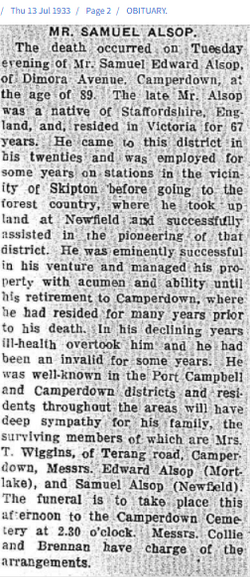
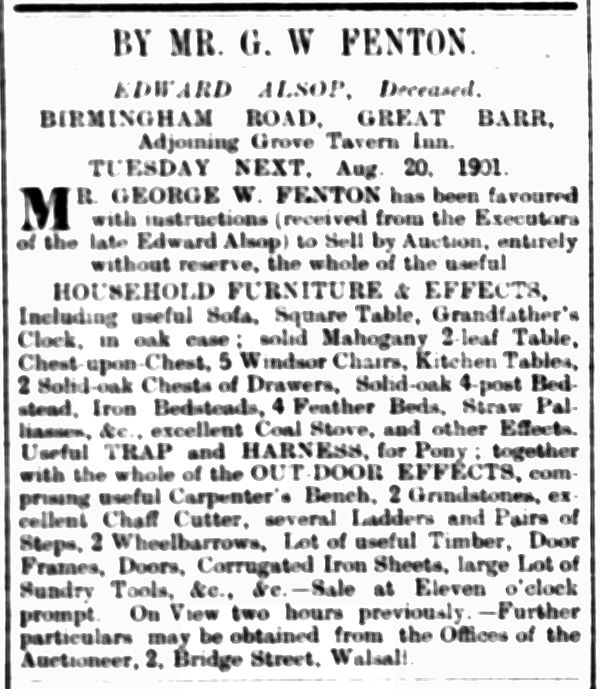
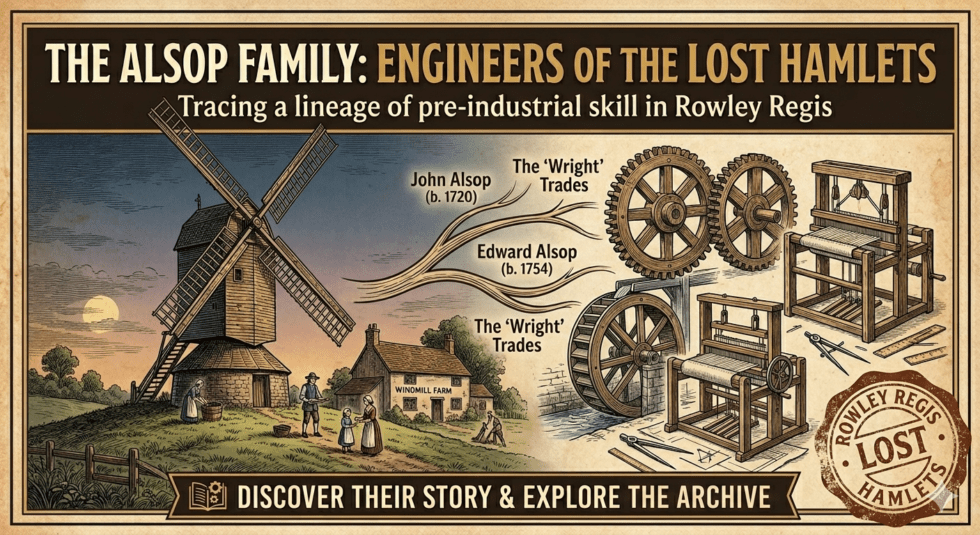
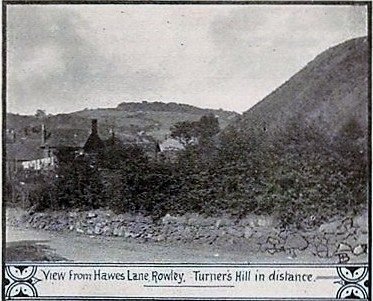
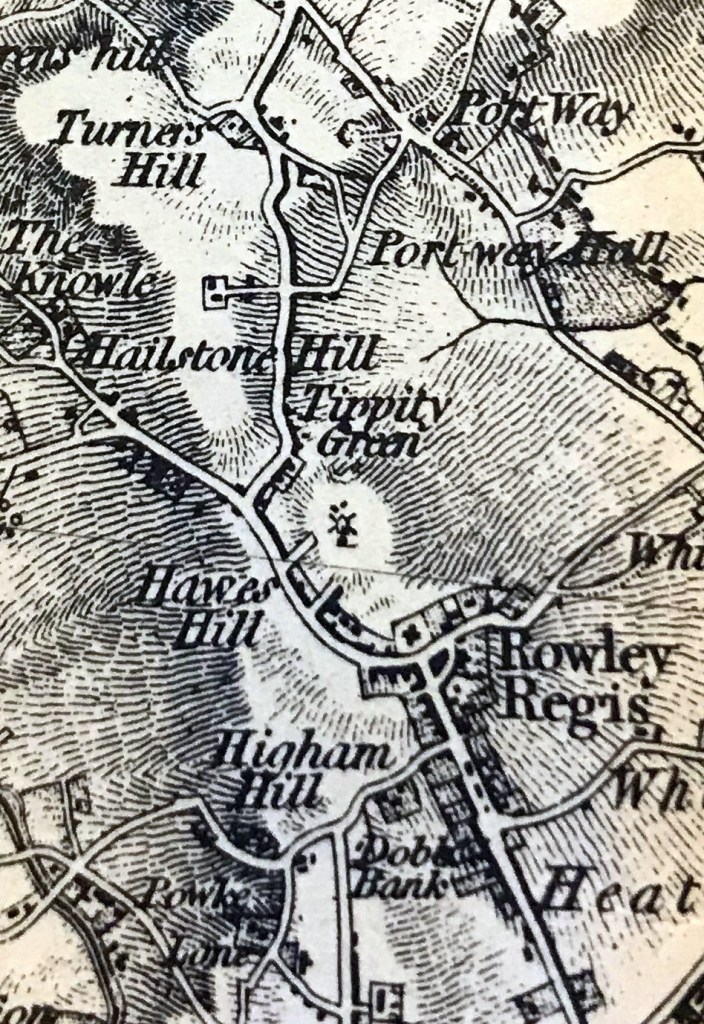
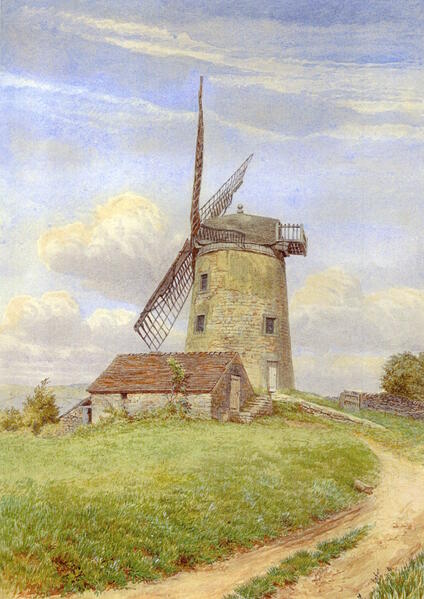
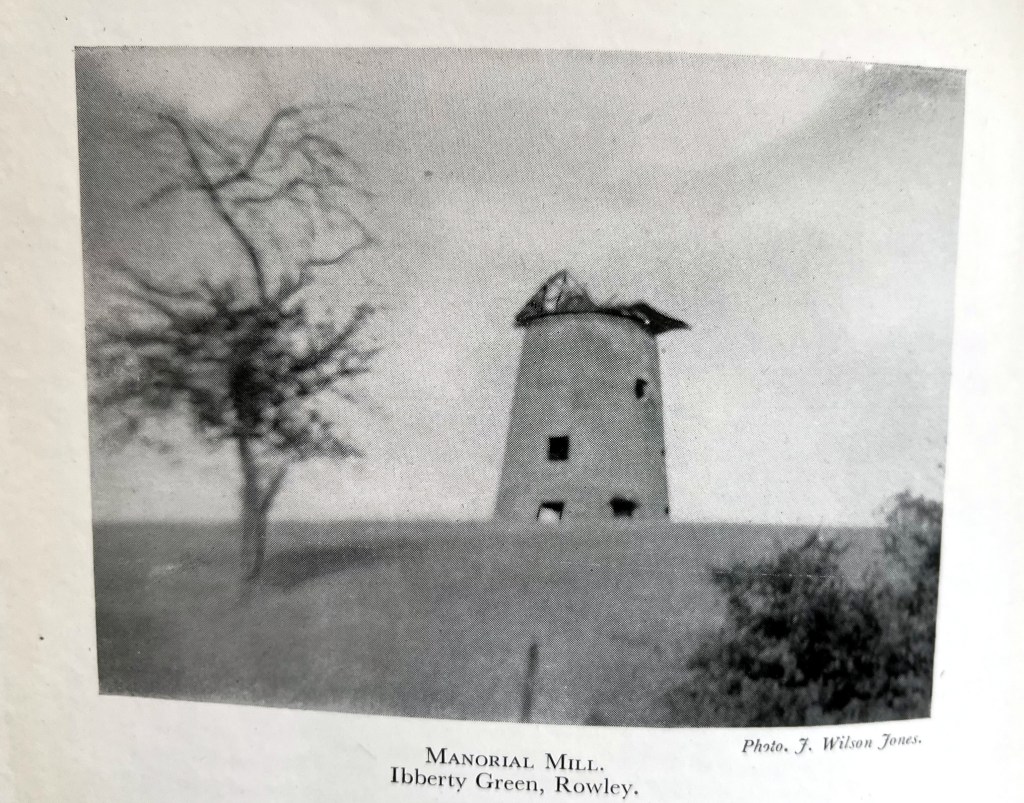


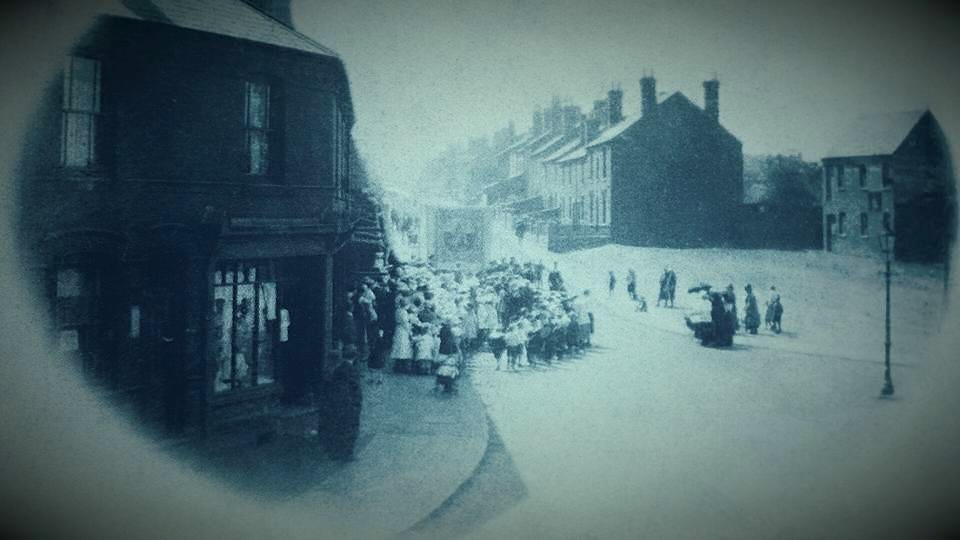

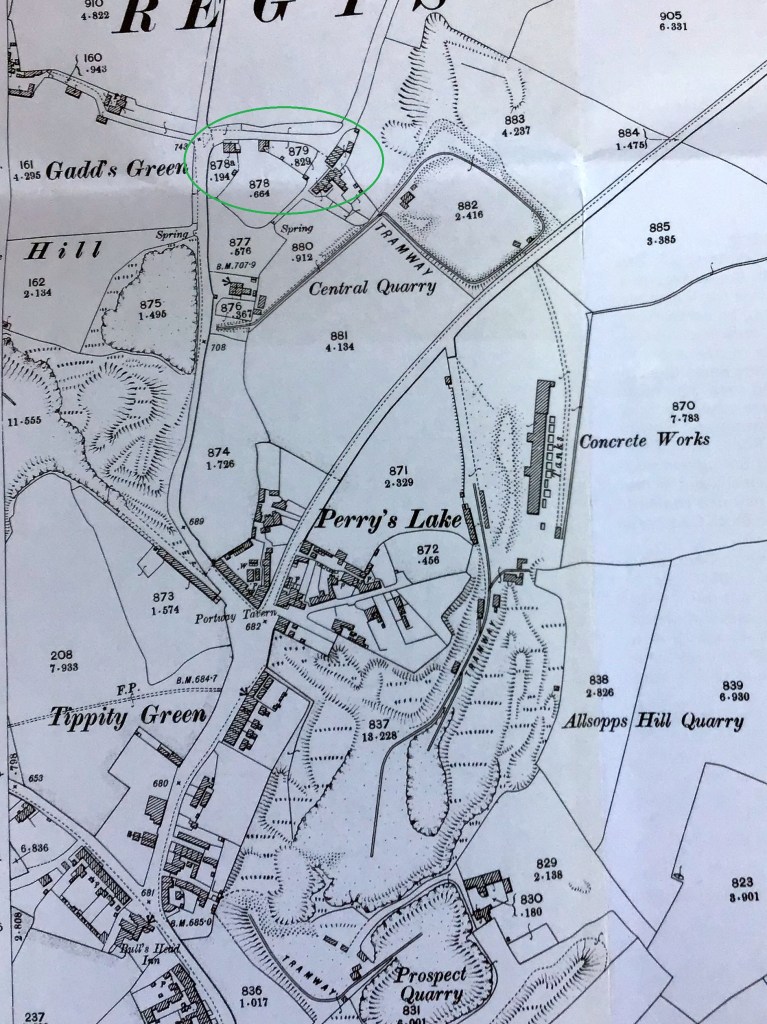


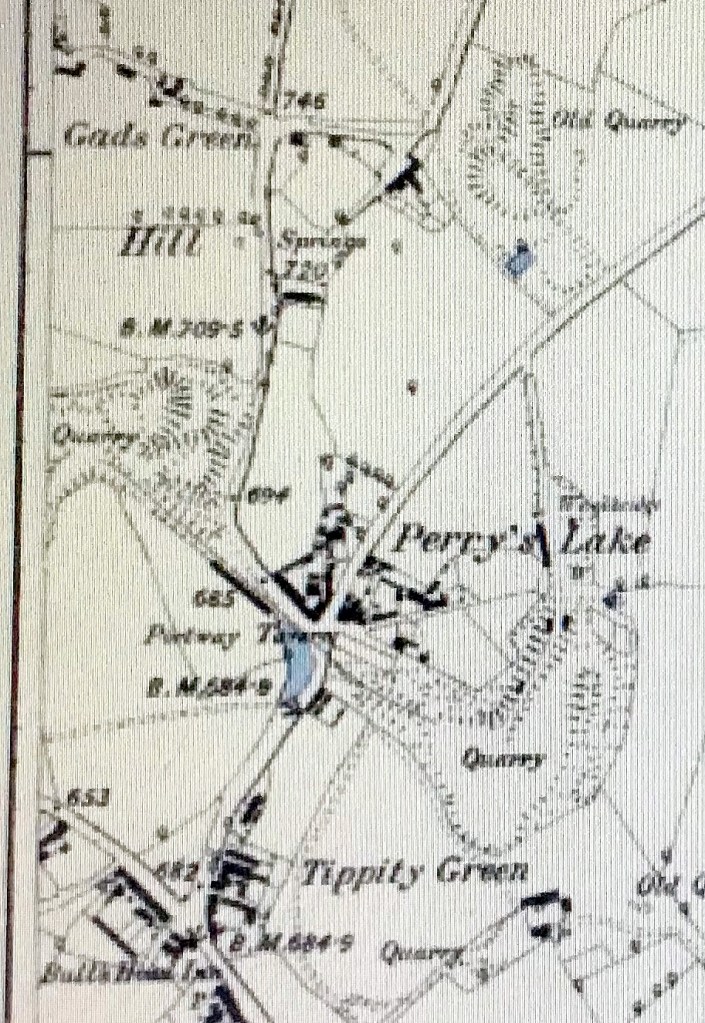
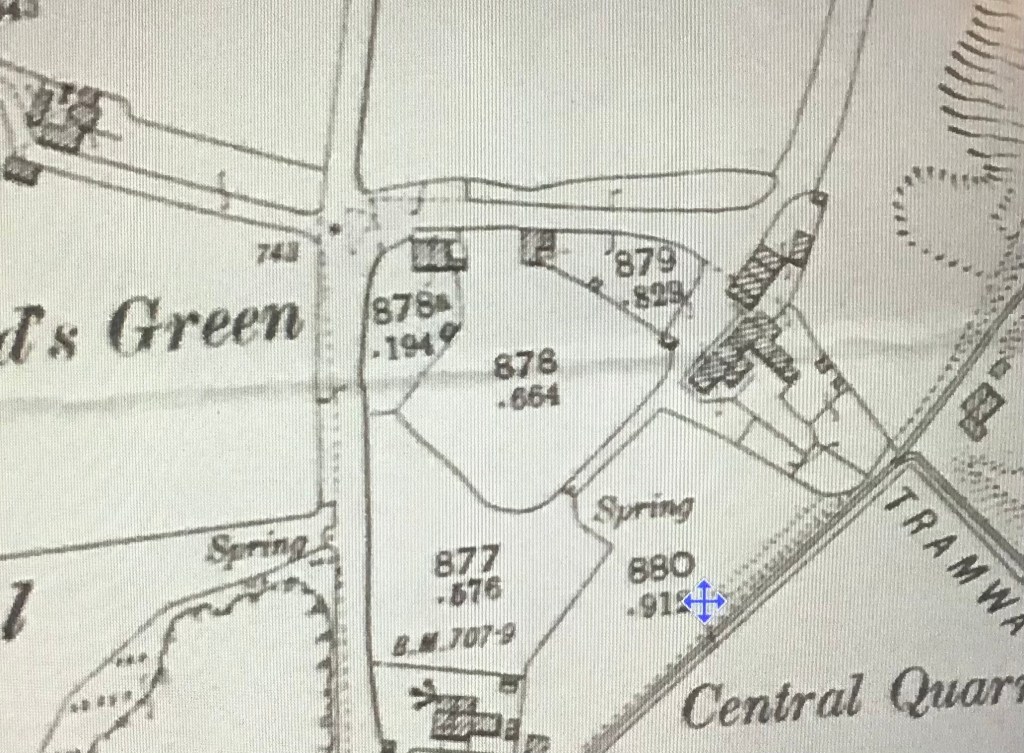
 rowleyregislosthamlets.co.uk