Families of the Lost Hamlets –The Alsops 9 – Rhoda

Wilful Trespassers

Life at Windmill Farm and the village of Rowley may not always have been as peaceful as one imagines. In August 1830 a group of Rowley Regis land owners and occupiers had placed an advertisement in Aris’s Birmingham Gazette, addressed to ‘all qualified and unqualified Gentlemen’ and requiring them to refrain from sporting or trespassing on the Lands in their respective occupations, as they would be deemed ‘wilful trespassers’ after the notice. The signatories were Joseph Downing, Joseph Cooks, Josiah Parkes Jnr, Benjamin Woodhouse, William Clift, Joseph Merries, William Bridgwater, Thomas Smart, Mark Pitt, Benjamin Hadley, William Woodhouse, Benjamin Davis, Edward Alsop, Samuel Smith and John Hodgetts. (There is a useful list of major local landowners! )

I do not know what gave rise to this advertisement, as I have noticed similar notices for other areas. After a long period of war which ended in 1815 with the Battle of Waterloo, demobilisation of the army had led to mass unemployment. At the same time the first of the Corn Laws had been passed, helping farmers but with a disastrous impact on the poor. This was followed by dire harvests due to bad weather in 1816, causing widespread hunger in what was described as a ‘Year without a summer’.  This led to a steep rise in the numbers of people who left Britain for good, by the 1830s, in particular those who had been affected by the agricultural depression. So perhaps men were poaching to feed their families.

Or perhaps, now that not so many young men were away with the army, there were more ‘gentlemen’ with the time and inclination to go out hunting and who may not have been particular about trespassing on land belonging to other people. None of the landowners or occupiers listed were gentry so perhaps they had more of a need to assert their rights. And there was no police force to address bad behaviour.

The killing of Richard Hunt

But certainly it appears that of those men, Mary Ann’s father Edward Alsop at least was prepared to defend his property to the death. In December of 1841 and January of 1842, reports appeared in the local papers, of an inquest on a man called Richard Hunt which showed that on 12 December 1841, he had been killed by Edward Alsop of Rowley Regis, a farmer, when he was caught in the act of committing a robbery in an outhouse of the premises. The jury returned a verdict of ‘justifiable homicide’. (This is not a formal verdict now at least in England and Wales, self-defense is now the preferred option). The deceased, it was noted, was about sixty years of age, and “had long been known as a most profligate and notorious thief”.  His accomplice Edward Steward pleaded guilty in court in early January 1842 to a charge of stealing three iron punches and a peck of potatoes, the property of Edward Alsop. He was imprisoned for four calendar months. So clearly Edward Alsop was not a man to cross!

So looking at the story of Rhoda, it begins in much the same way as for her siblings. Rhoda was born on 18 November 1821 at the Windmill Farm and was baptised at St Giles on 18 November 1821. For the next three censuses – 1841, 1851 and 1861 she continued to live at the Windmill Farm, with her family, aged 39 and single in the last one.

But life had not been easy for Rhoda over that period. As I noted earlier, Rhoda’s father Edward Alsop was not one to tolerate offence easily and it appears that Rhoda may have been of a similar mindset. I found a whole series of press reports when Rhoda sued a former swain for breach of promise.

Fortunately for us, the newspapers reported in great details on the circumstances of the case. A report in the Staffordshire Advertiser on 21 July 1855 (subsequently similar accounts appearing in newspapers across the country) explained that Thomas Sergeant had broken a promise to marry her. She stated that there had been an engagement between them for two or three years, tht she was always ready and willing to marry him and that he had married another person.

She was, the report said, a “young lady of some 31 or 32 years of age, the daughter of a farmer of considerable respectability, a gentleman whose ancestors had been tenants of Lord Ward for more than a century, of the Mill Farm, at Rowley Regis. Mr Sergeant was a builder, and a person of considerable landed property, living at North Fields, about four miles from Mr Alsop’s house; and was a person of a suitable age for Rhoda, being some 37 or 38 years old. He met Miss Alsop in the autumn of 1852, and paid great attention to her; was received in her father’s house, introduced to her friends, and acknowledged in every way as her suitor. As he lived at so small a distance from her father’s he used to pay continual visits to her and proposed for her to her father, an old gentleman of about 70 who referred her to Miss Alsop, with whom he had already settled matters. For more than two years this engagement continued, and letters passed between them, the only impediment to their union being the illness of Rhoda’s mother.

Matters went so far that a church was fixed upon for the performance of the ceremony, Mr Sergeant insisting that it should take place at North-field church, where his fathers before him had been married. He also made arrangements for the festivities that should take place on the occasion; the children at the school were to be treated; there was to be a balloon ascent, and other festivities of a rustic character. He also took from her a ring she usually wore, in order to get one of the same size; in fact every preparation was made for the marriage.”

Quotations from various letters from Thomas Sergeant, referring to his affection for her and many of a religious tone, including one which recommended that Rhoda should read Dr.Hook’s Meditations and put her trust in God.

In July 1854 Rhoda’s mother died “and then that which up to that moment had been all tender affection on the part of Mr Sergeant gradually cooled. He was less frequent  in his visits and Miss Alsop was astonished to receive, on the 4th September, the following letter. It had been up to this time ‘My dear Rhoda’ or ‘My dearest Rhoda’ and terms of fond endearment; now the letter came without any heading whatever; it ran thus:

“I assure you I sympathise with you in your troubles, for I have felt the same myself. One above knows how great mine have been the last month, and then, after all anxiety, loss of time and rest, and through that finding my health giving way, to be accused of dishonour and deception and trifling with your feelings, it is certainly very hard. For I must declare, it was never my intention to act dishonourably. Your dear mother’s death caused me to weigh matters over very carefully, and I found that, after all my efforts, I was acting against the will of God. I could no longer stand against the will of Him who sees farther than us sinful creatures, with all our bright hopes of worldly happiness. In all our troubles, we may be sure all things work together for good to them that love him. I would have you to weigh all future affairs now, and I have no doubt you will come to the same conclusion, that I have to appreciate your own home rather than risk your happiness elsewhere. I thank you for all acts of kindness, and shall be happy to reward you, and see you as a friend at any time. Sincerely, T Sergeant”

Oh dear. Poor Rhoda, she was apparently distraught and even sent a cousin to speak to Mr Sergeant and to ask him why he had abandoned her but the only reason he would give was that it was the will of God. He had wept and said that he would never marry anyone else and that if he was to marry at all it should be Miss Alsop. Then he visited her at home and again, wept bitterly and again declaring that it was the will of God, leaving her in ‘a state of despair’.

Mr Alsop, Rhoda’s father, had then written a letter to Mr Sergeant which ran thus:

“In consequence of not seeing you personally for some time, I have taken the liberty of writing to you on a subject, as much as I feel dissatisfied that you have been keeping company with my daughter for about two years, and you do not say what offence any of us have given you, as you stop and slight her. She has fixed her affections on you, and from what you have told her she expected you to be quite a different person and not false. I myself always endeavoured to make you welcome at my house, not expecting that you would treat her in this way. She has not had a day or night’s comfort since, crying and lamenting continually, night and day. She is very ill from your false behaviour, and you have done that you ought not to have done.

I have plenty of living witnesses of your courtship and correspondence and promises of marriage, and so forth, and if you do assign some just reason for your false treatment of conspiracy and delusion against my dear daughter, whom I much adore, my full determination is to enter an action at law of conspiracy and delusion against you, Mr Thomas Sergeant; if you have any defence to make you had better say what you mean to do in this case as you have played the same game with  others, and leave them to bear the rubs without defence.

But it will not be so in this case, for Rhoda Alsop has a very close friend that will see her righted.”

Mr Sergeant responded to the allegation that he had ‘played the same game with  others’ by saying “I truly say it is the second unfortunate affair of the kind with which I have been concerned’. Hmmm, as Lady Bracknell would say, “to lose one fiancé  is unfortunate, to lose two looks like carelessness.” (Oscar Wilde).

More evidence of trifling gifts given to Rhoda by Thomas, commencing with  ‘damsons’ and ‘port pies’ and ending with a ‘book with gilt letters’.  Evidence was also given by her father, her cousin Miss bates and Mr Alsop’s housekeeper, Mrs Farnell.

However, despite his promises about not marrying anyone else, Mr Sergeant had married Ann Ayre, a spinster aged 33, in February 1855. This had prompted the court action.

The case seemed to cause some amusement in court, and it appears that the counsel for the defendant tried to pass this off as a frivolous matter.

In his summing up, the Judge made it fairly clear that he did not approve of this case, saying that an action for breach of promise was not one upon which, as a lawyer, he looked with remarkable favour but it was part of the law of the land and they must deal with it. He also noted that such cases were rarely brought by parties above a certain rank in society; sensitive persons naturally shrank from bringing such an action; but when the action was brought they must bear with it and do justice between the parties. Well, that makes it fairly clear what the Judge thought about the standing of the Alsop family!

However, despite this, the jury took only a few minutes to find for Rhoda and awarded her £50 damages, worth about £7,000 today so not an inconsiderable sum.

Edward Alsop died five years later in 1860 and Rhoda was still at the farm in 1861 with her brother Thomas who had taken over the farm and her eldest sister Sarah. However, following the death of Thomas in 1865, things changed a lot. Sarah, described in the 1871 census as an ‘idiot’ was living with her sister-in-law Eliza in Mincing Lane. So where was Rhoda?

Rhoda had set up in business as a pawnbroker. Had she used her damages? Possibly. She was living in Lichfield Road, Aston and had two unmarried women described as her cousins, Emma Bates, aged 44, also described as a pawnbroker so perhaps they had gone into business together , and Marian O’Donellan, (also described as a cousin, although I cannot work out how she could be a cousin), a pawnbroker’s assistant.

Well ,well! Two years later the same Marian O’Donellan married Rhoda’s nephew Joseph Vaughan, son of Rhoda’s sister Mary Ann. When I was writing about Joseph and Marian in my previous piece, I had not been able to find Marian in the 1871 Census because, I now realise, her surname had been wrongly transcribed and was therefore not turning up in my searches. And comparing dates, I see that Marian’s father Michael was also a pawnbroker at this time – he is listed as such in trade directories in 1868. So perhaps Marian was getting some experience by working for another pawnbroker. Or perhaps the pawnbroking business was a tight knit community.

Although Rhoda describes Emma Bate as a cousin, (and her father did have Bate half-siblings) and the story of Rhoda’s cousin Emma Bate visiting Thomas Sergeant on behalf of Rhoda, was mentioned in the court reports,  I have not been able to find out much more about Emma Bate so far. However, I suspect that it was this Emma Bate who died in 1880 and was buried at Northfield Church.

There is a newspaper report in 1877 that Rhoda Alsop was charged with “taking pledges from a person under 12 years of age” after her assistant Eliza Ann Jones had lent a lad 1s6d, on a pair of boots. The boy, aged 11 years and 2 months, was charged with stealing the boots, valued at 10s, from his employer Mr Oakley  and, on the instructions of his stepmother, had pawned them and destroyed the pawn ticket. Rhoda said that the lad had claimed to be 12 and her assistant confirmed that he had told her on a previous occasion that he was over 12, so Rhoda was discharged with a caution. The stepmother who was charged with receiving stolen goods, claimed that she had not known that the boots were stolen but she was committed to the Winter Assizes for trial. The boy was very fortunate that the magistrates considered that he had been led astray by his stepmother and that his employer was willing to take him back provided that the stepmother kept away from him. As a result, the magistrates did not send him away for five years, as they would otherwise have done, but found him guilty and sentenced him to one day’s imprisonment. He was then allowed to leave with Mrs Oakley with the hope expressed by the magistrate that he would be suitably grateful for this kindness.
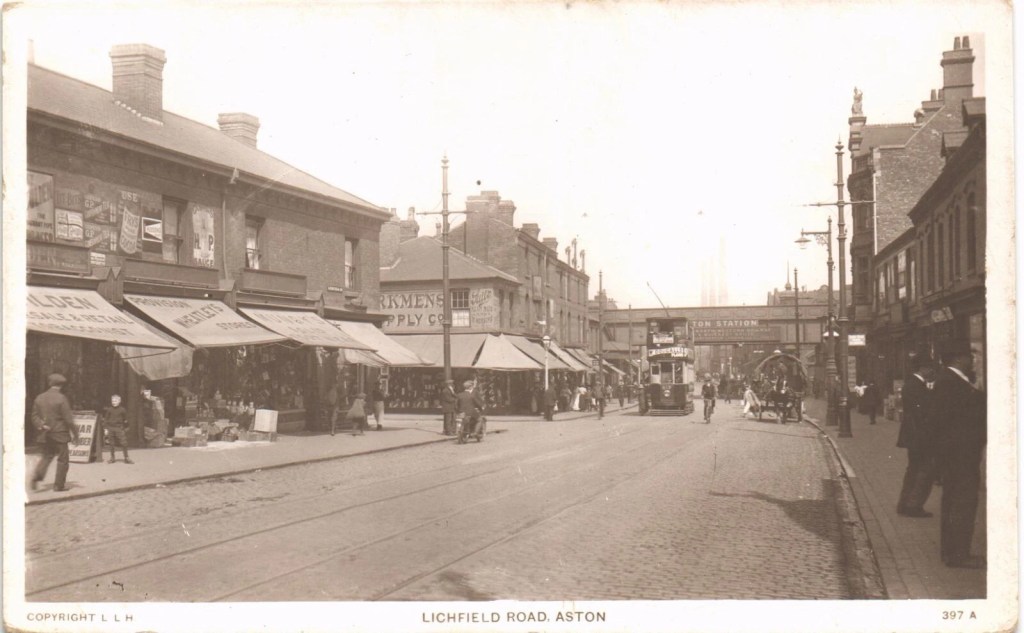
Lichfield Road, Aston. Copyright unknown. Date also unclear but possibly early 1900s.

In 1881, Rhoda was still at 36 Lichfield Road, Aston, still a pawnbroker, this time with a new assistant boarding with her, Caroline Kent. Rhoda was also shown as a pawnbroker in trade directories at this address in 1876, 1879 and 1884. But, after that, things changed considerably for her.

In the first quarter of 1886, at last, Rhoda got married! At the age of 59, Rhoda married widower David Round who was also a pawnbroker, in Netherton. He had two sons and four daughters by two previous marriages. Rhoda moved to Netherton where the wider Round family had several businesses, including the pawnbroker’s shop at 14 High Street.  This was where David and Rhoda were living at the time of the census in 1891. They had one pawnbroker’s assistant (Ada Mitchell, aged 21, born in Birmingham) and a servant in the household. Both David and Rhoda were described as pawnbrokers so Rhoda had clearly not retired from the pawnbroking business on her marriage.

David Round died in December 1891, with probate being granted to his son James, leaving a modest estate of £1203 7s 1d. so poor Rhoda only had five years of  marriage.

The census in 1901 shows Rhoda still living in Netherton in St Thomas Street, although she is no longer described as a pawnbroker,  her age being given as 79 when she was living with one boarder, Sarah Gill who was 81.

Rhoda died on 28th January 1903 and was buried at Witton Cemetery, the resting place of her sister Mary Ann, and much of her family.  Probate was granted to her executors Charles Vaughan, iron-caster – her nephew, son of her sister Mary Ann – and Henry Strange, brass caster. I do not know who Henry was or whether he was related to her. But, as ever, it appeared that the Alsop family had remained close through the years.

So Rhoda was the last of the children of Edward Alsop and Betty Hodgetts. Rhoda was clearly an independent woman who set up and ran a business for a number of years, in what must have been a challenging trade and in a busy and poor area of Birmingham.

Pawn Broking

By what is perhaps a curious coincidence, Rhoda ‘s brother Edward Alsop was living next to the Bennett/Collard family who had a draper’s business next to the Alsop boot and shoe business in Blackheath Market Place for some years and the Bennetts had pawnbrokers in their family  too. There is no apparent direct connection but it is interesting that both families were involved in pawnbroking in this period.

But the pawnbroking connection does not end there. When I researched Lucy Bennett, I was interested to note that she had been born in Chipping Sodbury, Gloucestershire (which is about eight miles from where I live now!) and she had arrived in Blackheath by 1871 when she was Lucy Roberts.

 At that time she was 18 and living in High Street, Blackheath with her uncle William Dudley who was – oh, look! – a Pawnbroker but also a draper and a Local Preacher – interesting combination, but I can see that his near neighbour Benjamin Shaw was also listed as a Stationer and Local Preacher in the same census. Another neighbour was a miner and ironmonger and yet another – William Darby – was a Grocer and Maltster. On the following page is a Benjamin Hadley, also a stationer and Methodist Local Preacher while Zachariah Willetts was a Carter and Greengrocer. Multiple occupations seemed to be quite common but clearly being a Local Preacher was a matter of some pride.  

William Dudley had previously had a pawnbroker’s shop in Church Street, Oldbury but moved to High Street, Blackheath after his  marriage to Mary Collard. Lucy, Mary’s niece, was an assistant in the drapery in 1871. Also living with them was William Roberts, Lucy’s brother, also born in Chipping Sodbury and also a Constantine Lovell, aged 23, born, the census says, either in Gloucester or Somerset –he was a first cousin to Lucy, their mothers were Collard sisters and poor Constantine apparently wasn’t even sure where he had been born. He was actually born in Clifton in Bristol, I was able to confirm with today’s searching resources available to me but later in life he gave his place of birth as various parts of Somerset and Gloucestershire.

Several of the Collards and their extended family appeared to combine pawnbroking with their outfitter’s trade.

Lucy’s brother William Roberts, by 1881, was a pawnbroker in Halesowen Road, Netherton and appears to have stayed in Netherton until his death in 1918, but he was buried in Chipping Sodbury, his birthplace. Was it possible that this business was tied in somehow with David Round who married Rhoda Alsop and who was also a pawnbroker in Netherton? Perhaps or perhaps there was sufficient pawnbroking business in the town to support more than one pawnbroker.

Constantine Lovell was also William Dudley’s nephew, also became a pawnbroker and shipping agent in Harborne. But by the time of his son Frederick’s marriage in 1908, both Constantine and Frederick were shown as tailors, so back to the drapery/outfitters/pawnbrokers connection, it seems. Perhaps unredeemed pawned items were sold on in the drapers or outfitter’s shop? But it seems that pawnbroking could be combined with various other trades.

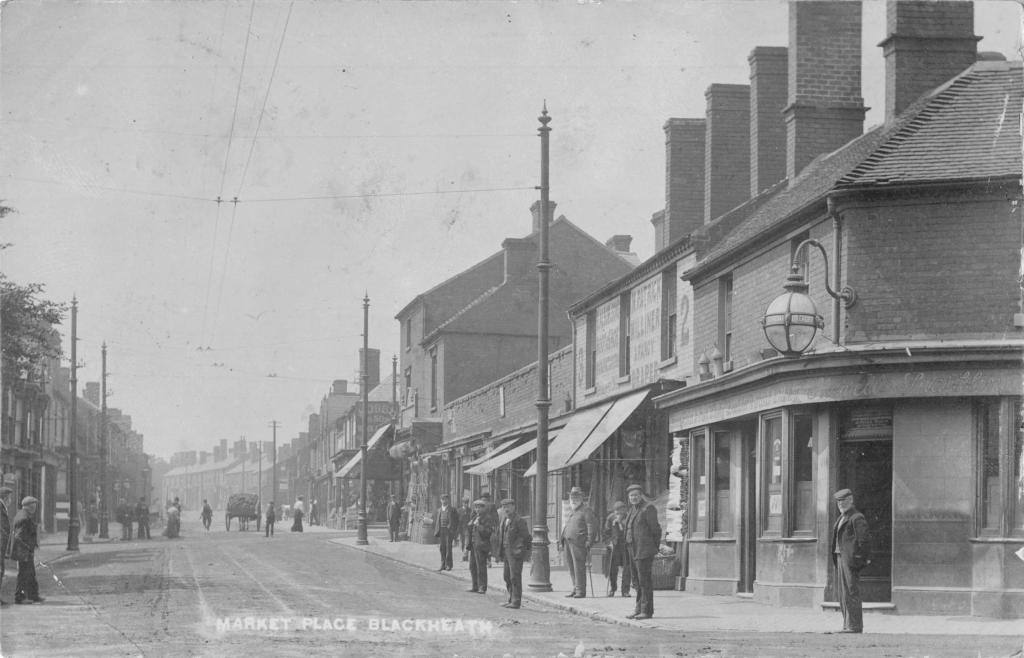
I had never been aware of any pawnbrokers in Blackheath and they were probably no longer around by the time I was growing up there. But only a couple of weeks ago, I was very interested to see a photograph of Blackheath High Street in 1915,  posted on Facebook and there, above the Loan Office, were the three balls which denoted a pawnbroker! Not Rhoda’s shop but definitely in Blackheath so that may at one time have been where William Dudley originally had his shop.
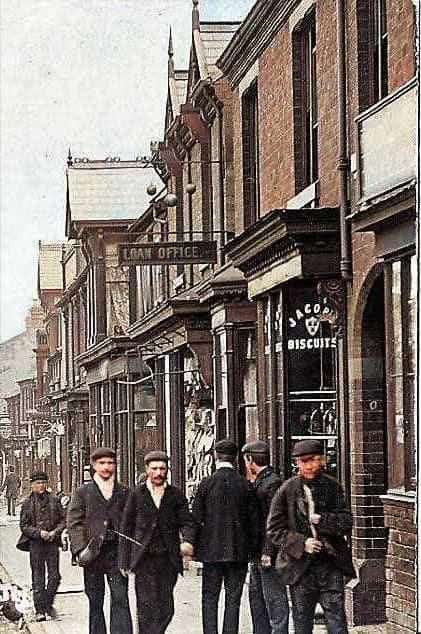
High Street, Blackheath, 1915. Copyright unknown.

Conclusion

So – at considerably greater length than I had originally expected – this concludes the family study for the Alsop family, one time millers of Tippity Green. Like so many local business families, their children took up similar or complementary occupations to their parents and siblings and married into the same sort of families, several of them becoming very prosperous indeed in the fullness of time. But few of them seem to have remained in Rowley Regis and mostly made their lives elsewhere.

The Alsop family was very different from most of the core families who made nails or worked in the quarry or in local foundries and who had lived in the hamlets for so many centuries but it has been interesting to me to explore their ventures through these posts. I hope in particular that these stories will be of interest to Dennis Allsopp and the members of the Allsopp One Name Study.
Families not quite of the Lost Hamlets – The Vaughans

The Vaughan family, into whom Mary Ann Alsop married, were – at least in 1841 – jobbing-smiths living – presumably fairly humbly – in Rounds Green and my presumption has been that they were employed making edge tools at the Brades Works.

I have mentioned earlier Joseph Vaughan (1795-1851) and his wives Amelia Page and Lucy Nixon.

Joseph’s children were:                                                                William James (3rd  son of Joseph) had:

Charles Vaughan (1816-1892)                                     Joseph Edward (1845-1909)

Sampson Vaughan (1818-1837)                                  William James (1846-1928)

William James Vaughan (1820-1869)                        Charles (1849-1912)

Betsy Vaughan (1825-1859)                                         Richard Henry (1851-1928)

Emma Vaughan (1826-1908)                                        Thomas (1853-1886)

Richard Vaughan (1827-1885)                                     Amelia Page (1855-1939)

Mary Anne Vaughan (1828-                                         Mary Anne (1856-1928)

Selina Vaughan (1830-1882)                                        Emma Eugenie (1858-1932)

Joseph Vaughan (1832-1882)                                      Lewis Ralph (1861-1931)

John Vaughan (1833-1896)                                           Septimus (1863-1938)

Septimus Vaughan (1836-1907)

Octavius Vaughan (1837-1838)

As you can see, there is a large crossover of family names with the children of William James, who we have already looked at in great detail, so that has led to ample opportunities for confusion, in researching the family, especially as most of them moved to the Aston area, including their father Joseph. But I suspect, from his second marriage to Lucy Nixon, in 1843, that the family already had links, in the business community at least, there.  Also there is a considerable overlap in dates so extra care has been required to check which generation any given piece of information relates to. And I won’t go into all the other brothers in both generations and what they named their children…

Of these brothers, Dix’s General and Commercial Directory of Birmingham dated 1858, lists a generic ‘Vaughan Brothers’ as manufacturers of hoes, rakes, forks, ladies’ fancy garden tools in sets, ship scrapers etc, at the Garden Tool Works, Dartmouth Street which was in the Duddeston/Aston area. But below that, there are entries for the various brothers which appears to show that – in various combinations – they ran factories specialising in various tools – hoes and rakes, etc.

A list in the Birmingham Daily Gazette dated 13 February 1868, shows Charles, of Victoria Road, Acocks Green, as an Edge Tool maker; Septimus, of Birchfields, also an Edge Tool maker. Was that the Birchfields at Oldbury? I suspect it was.

Did they all leave the Black Country?

But, as I worked through the sons of Joseph and the businesses that some of the brothers set up in Birmingham, which tended to result in their children, brought up mostly in Aston and Duddeston eventually  settling in the greener suburbs around Sutton Coldfield, there were clues that some of the family had stayed in the Oldbury and West Bromwich area.

There was a newspaper report of an insolvency hearing in March 1846 for a ‘Sampson Vaughan, late of Dudley, Worcestershire, journeyman smith’.  My first thought was that this was the Sampson, son of Joseph but he had died in Birmingham in June 1837, buried at St Martin’s, Birmingham and described in the burial entry as ‘son of Joseph and Amelia’, aged 20, although his abode was shown as Oldbury. So there was another Sampson Vaughan not far away, also in the smithing trade!

The Vaughans were certainly active in the local community in Oldbury in 1835 when Joseph Vaughan was listed as the Treasurer of the Oldbury Co-operative Society and Charles Vaughan as the Secretary, so they must have had some public spirited intentions.

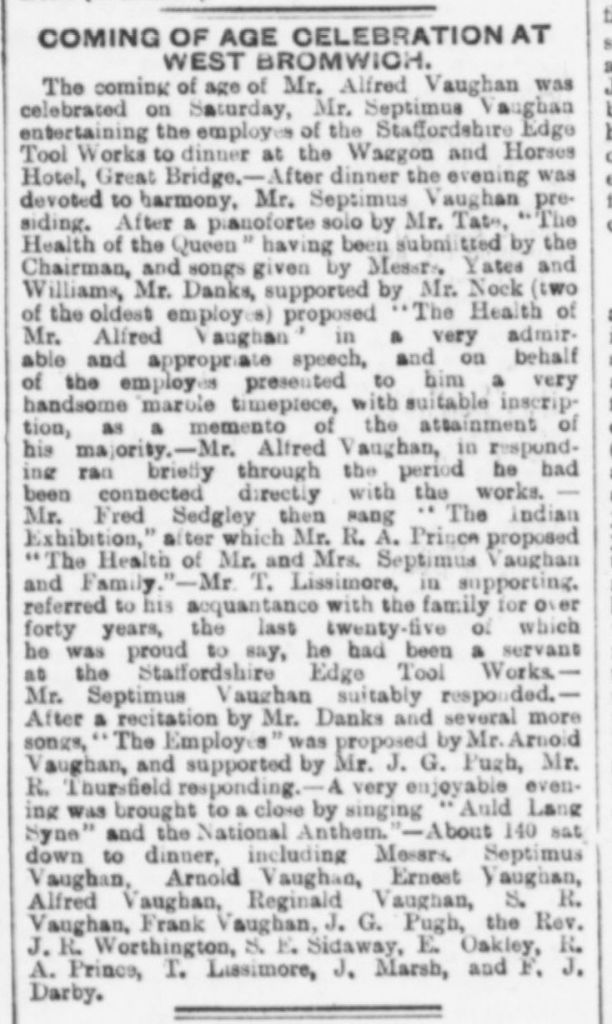
And there was a most interesting report of a party for the coming of age of Alfred Vaughan, son of Septimus,  in 1896 when ‘Mr Septimus’ hosted a dinner at the Waggon and Horses at Great Bridge for employees of the Staffordshire  Edge Tool Works, where 140 employees and family sat down to dinner. The article gives an account of the entertainments and the speeches and shows a family deeply embedded in their company and their employees.  So clearly there was still at least one substantial Vaughan edge too-making company in the area, not all of the Vaughan interests were in Aston.

Copyright: Uncertain but gladly acknowledged if known.

Some random searches and what they revealed

Much of my research for this study is done via the usual family history sources with which most family historians are familiar, with plenty of cross checking across sources, plus newspaper articles which often reveal small items of interest. But sometimes I will just type the name I am interested in into a general search engine with a date or a profession to narrow the results and often this brings up some matter of interest.

So when I searched google for Vaughan tool  makers 1800s UK, I was fascinated to see that the first result was for Vaughan Brothers (Drop Forgings) Limited at Willenhall, founded in 1874. willenhallhistory.co.uk lists H&T Vaughan amongst the most important lockmaking firms in the town by the end of the 19th century. I had not previously known of any connection with the family and Willenhall and indeed this may not have been the same branch. But they were in a similar metal based industry.

Another article revealed that the firm of Vaughan & Bushnell was founded in Chicago, USA in 1869 by an Alexander Vaughan, who patented an improved auger and who made various hand tools. More edge tool makers, more innovations, more patents! I know this because there is a Vaughan & Bushnell All Metal Hay Hook for sale on ebay!

A Philip Vaughan, I learned, who was an ironmaster in Carmarthen, Wales, invented the Ball Bearing and obtained a patent for it in 1794, to improve ‘axle trees, axle arms and boxes for light and heavy wheel carriages’  Obtaining such a patent in 1794 was a laborious and expensive process costing around £100-120 with no guarantee of success and only covered England and Wales. But this decision to protect and innovative process was repeated by several later Vaughans. There is also a note in the article I found which says that in 1800, Vaughan formalised his business interests through a co-partnership deed with four partners including John Morgan and William Morgan. Morgan is, of course, a common name in Wales but I do wonder whether this is the origin of the Vaughan Morgans I note below.  

Septimus Vaughan (1836-1907)

A search for Septimus Vaughan brings up a huge number of results, including information about the company of Septimus Vaughan Limited of Henry Street, West Bromwich which, during the Great War, made trenching tools, pickaxes, Stokes’ bomb heads and horseshoes.  There are any number of trenching tools made by this company for WW1 on eBay, too!

There are numerous other Septimus Vaughans popping up in America and in other places – were they all related? Very possibly!

There was a Septimus Vaughan Morgan (1832-1913), the son of a hostel keeper of Abergavenny, who was one of four brothers (including Walter, William and Octavius Vaughan Morgan) who founded  the Morgan Crucible Company (more hot metal working!) – and also –lest he be thought single minded, he joined his brothers in a drug and hardware factors business in London (he had qualified as a medical doctor) and also published newspapers ‘The Chemist and Druggist’ and ‘The Ironmonger’. One of his brothers was Lord Mayor of London in 1905-06, his brother Octavius sat as a Member of Parliament for Battersea for some years. A family of many talents and high achievers. Were they related to the Vaughans of the Black Country and Birmingham? I don’t know but there is a certain cross-over of names and of interests so it seems possible and I have mentioned previously my theory that the family had links with Wales.

Black Country Vaughans

But the Black Country Vaughans were no slouches either. An article on the website The Annals of Tipton refers to the Company of Revo. A man called Frederick Reeves went into partnership with one Septimus Vaughan whose father Ernest Vaughan (son of Septimus)  had founded Vono, a manufacturer of mattresses and bed fittings.

Revo produced a vast range of products, most designed in-house. Early products included lighting, radios, loudspeakers, cookers, switchgear and fans. By the 1930s the firm became a household name and their electric street lighting was widely introduced thoughout the country, and their traffic lights in the late 1920s and 1930s.

There is a huge amount of information about Revo on the website (http://www.historywebsite.co.uk/articles/Tipton/Revo.ht )and it is well worth reading.

Revo became one of the largest local employers with over 3,000 employed by the late 1950s. The Britannia Works at Dudley Port was alongside the Birmingham Canal and expanded to cover over sixty acres, extending into the boroughs of Dudley and Rowley Regis.  I gather that the Company was later taken over and subsequently disappeared, as so often seems to happen.

An industrial accident

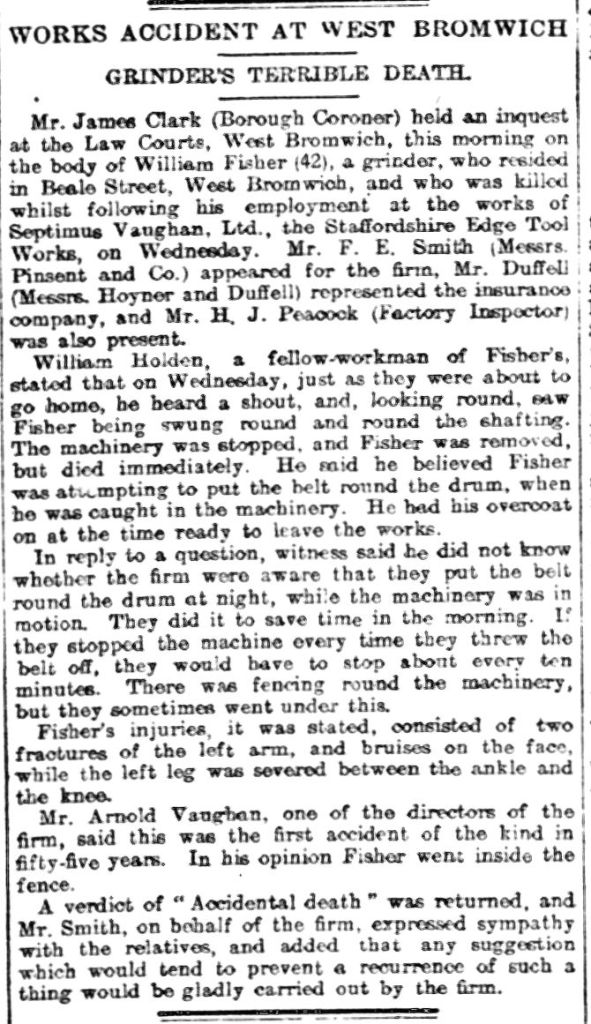
A newspaper report on the inquest into the death of an employee at the works of Septimus Vaughan Limited appeared in February 1909, after a grinder was caught in machinery. It appeared that the employees, probably unknown to the company, used to put the belt round the drum at night, while the machinery was in motion to save time in the morning. He had been wearing his overcoat, ready to go home which may have got caught. Mr Arnold Vaughan, a director of the company, told the inquest that this was the first accident of the kind in fifty five years, (which seems to be to me to be quite an impressive record, given the nature of the machinery in use) and it was thought that he had gone inside the fence around the machinery intended to protect him.  The company representative also expressed willingness to carry out suggestions to prevent such accidents in future.

I was interested also to note that there was a further report at the end of March that year that compensation of £205 5s.9d. had been awarded to the widow and the judge directed that £20 should be paid to the widow forthwith and that the residue should be invested in the Court , to be paid out at the rate of £1 per week for the maintenance of the widow and her five young children. It is not absolutely clear whether the payment came from the company or an insurance company but it is good to know that she was not left completely destitute.

Civic duties

And, like the Vaughan Morgan family, at least some of this part of the Vaughan family also had a sense of civic responsibility. A newspaper article in the Birmingham Gazette in 1914, is about Mr Alfred Vaughan, he of the coming of age dinner mentioned earlier. He was standing as an independent Candidate for the West Bromwich Town Council and was described as a familiar and popular figure in the borough. He had received his training at Messrs Tangye’s works in Smethwick before joining his father in the management of Septimus Vaughan Limited, edge tool manufacturers which he subsequently managed and expanded.  Another article in the Evening Despatch in 1917 notes that Mr Alfred Vaughan JP, had been admitted to the Freedom and Livery of the City of London in the Felt-maker’s Company. The article recounts that his father Septimus Vaughan had founded the well-known firm of Septimus Vaughan Limited, makers of plantation and railway tools at West Bromwich.

In addition to his work there, Alfred was also a director of ‘four other important manufacturing establishments in South Staffordshire and Worcestershire’, and Chairman of three sections of trade associations connected with the edge-tool and other industries. His companies had clearly been involved in manufacturing for the war effort but in this ceremony he spoke of the need for the relationship between capital and labour to be put on a better footing after the war, with joint organisations and labour must have a larger share of the results and also of the responsibilities. He was also a member of West Bromwich Town Council and other local committees. A hard-working and industrious but also able man, clearly, and deeply involved in his community.

Final note on the Vaughans

It has been interesting to observe how many and varied companies emerged from this branch of the Vaughan family over a period of 100 years or so, providing many jobs and companies quick to develop new products or innovations as new technologies emerged. From the patents for improving the manufacture of edge tools in the mid-1800s to the developments of radios, street lighting and a vast range of other goods a century later. From jobbing smiths to major industrialists, still in the same area, the Vaughan family were, it seems to me, a dynasty to be reckoned with.

All of this information (which, believe me, has only scratched the surface of the information out there) has emerged during my research into William James Vaughan who married Mary Ann Alsop. While it has proved to be a fairly lengthy side-track into this large and successful local family, I hope my readers have found it of interest, albeit with only the tenuous link to the Lost Hamlets through Mary Ann Alsop.

Families of the Lost Hamlets – The Alsops 8 – Mary Ann Alsop’s children Part 3 – Mary Ann, Emma Eugenie, Lewis Ralph and Septimus

These four are the last of the children of Mary Ann Alsop and William James Vaughan.

Mary Ann Vaughan 1856-1928

Mary Ann was born in Birmingham on 11 October 1856 and was baptised at St Matthew Duddeston on 25 October that year.  She was at home with her family in Poole Street, Aston in 1861 and with her widowed mother and siblings in 1871. In 1881, the family had moved to 117 Albert Road, Aston, no occupation was shown at that time for Mary Ann.

I cannot find Mary Ann in the 1891 Census. Her father had died in 1869, her mother had died in 1882, and her older brother Thomas in 1886. Her brother Richard had emigrated to Denver in 1888, her younger brother Lewis had followed him at some point and her sister Amelia was acting as housekeeper for their widowed brother William. But Mary Ann is elusive. There is a possible M A Vaughan in Edgbaston as a boarder and a sewing machinist but the age is a few years out. However, ages are not always accurately recorded by householders for their boarders and it may be her as she continued to live in Edgbaston after that time.

By 1901, Mary Ann was living at 42 Pershore Road, Edgbaston (also described as Stirchley) where she was shown as a general domestic servant to Miss Blanche Suckling who was aged 22 and living on her own means, ie had no need to work. Mary Ann was still at that address in 1911, shown as a ‘domestic help’  but by this time the Head of the household was Sophia Hambridge who was 68 and also as of independent means. Blanche Suckling was also in the household but as a visitor. And in 1921 the same three women were at the same address, with Blanche this time shown as Sophia’s daughter and Mary Ann as Housekeeper.

Mary Ann Vaughan died on 12 July 1928, aged 71 at 5 Cannon Hill Road, Balsall Heath, of cardiac and bronchial issues. Her death was registered by her sister Amelia Page Vaughan who had been present at her death and who gave her own address as 6 Twyning Road where Amelia was living with her niece Adelaide and her family.  Amelia described Mary Ann, in the registration, as a spinster and ‘formerly a Housekeeper/Companion, daughter of William James Vaughan, edge tool manufacturer’. She was buried in the family plot at Witton Cemetery.

Another spinster daughter but not an idle one, like so many of the Vaughans, she remained in employment and looking after other people for most of her life.

Emma Eugenie Vaughan 1858-1932

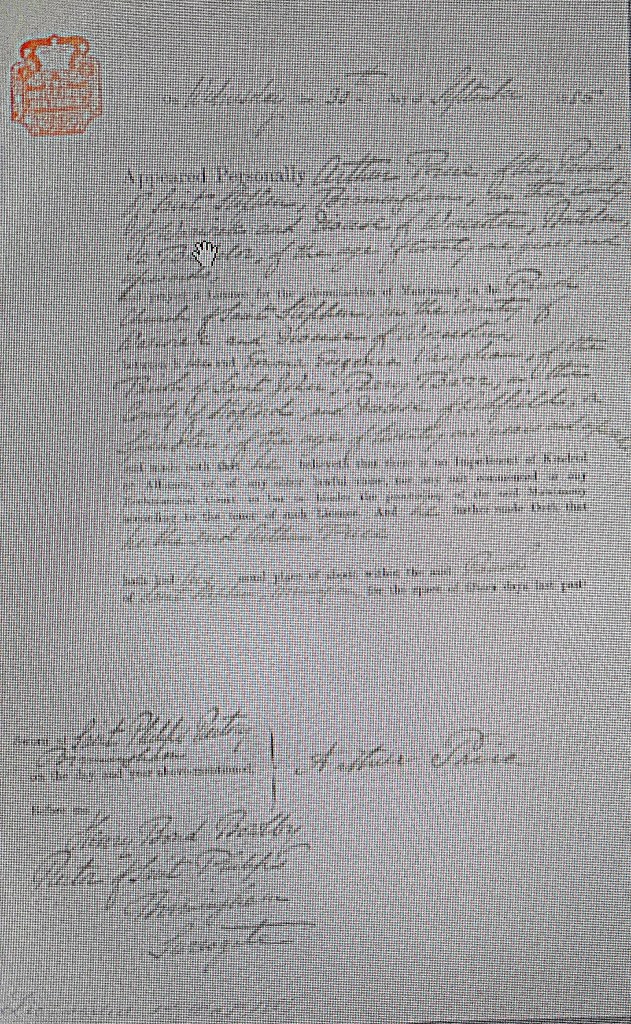
Emma Eugenie was born in 1858 in Birmingham. She was at home with her family in Poole Street in 1861 and 1871. By 1881 her mother the widowed Mary Ann had moved to Albert Road and Emma, by then aged 21 was listed as a Milliner (maker of hats). Mary Ann died in 1882 and on 3 October 1885, Emma was married by Licence at St Stephen’s Church, Birmingham with her abode shown as Perry Barr. Her groom was Arthur Price, a butcher, living in Newtown Row, Aston. It is not clear why the couple chose to marry by licence, rather than Banns and it was a greater cost but, perhaps for this reason, was apparently sometimes chosen by families who could afford this as a demonstration of their financial status!

Copyright unknown. Apologies for the poor quality!

In 1891, Arthur and Emma were living in Victor Street, Walsall where Arthur was again listed as a butcher and with their first child Mabel who had been born in 1886. Although Mabel was later to give her place of birth as Perry Barr, her birth was registered in the West Bromwich RD. In 1901, the family were living in Tanworth village, Arthur a butcher again. Tanworth, more properly Tanworth in Arden, is South of Birmingham, in a rural area, which must have been quite a change from Aston and Walsall. By this time Mabel was 14 and a son George who was 7 and had been born in Kings Norton so the family did seem to move around. Both children had Vaughan as their second names.

After that, things changed a lot as Arthur died in the last quarter of 1906. There were a lot of men called Arthur Price at that time but it seems probable that this Arthur was the Arthur Price whose death was registered in the Solihull RD in that quarter, aged 44 and that he was buried in November 1906 at Lodge Hill Cemetery which is in the Kings Norton/Selly Oak area.

It appears that Emma moved to Alberta, Canada in about 1910, with both her children and she appears in the 1916 Canada Census of Manitoba, Saskatchewan and Alberta, in the 1921 Census of Canada, in the 1926 Prairie Census of Canada and the 1930 Census of Canada. In each of these she was living with her married daughter, but George was not present in the latter two.  Emma died on 6 September 1932 at Sundance, Alberta, Canada, she was buried at the Sundance Little Volga Cemetery, Seba Beach, Edmonton.

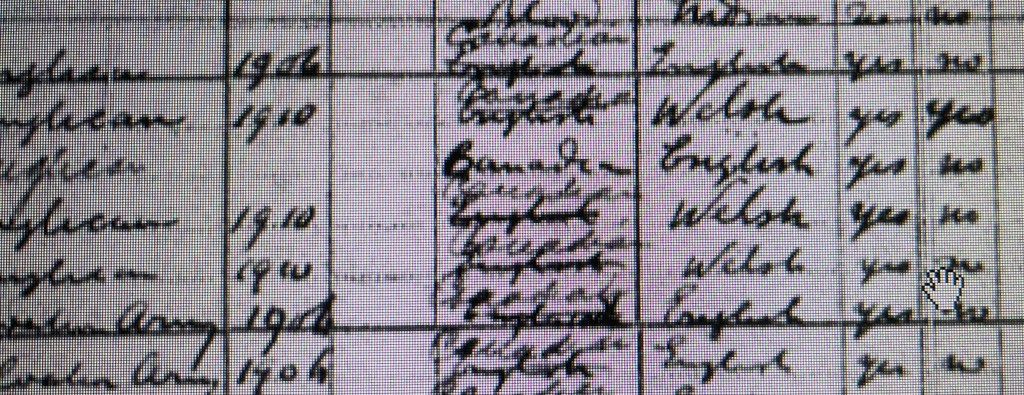
I have mentioned previously about this Vaughan family that I suspected that they had connections to a family of Welsh Vaughans who used very similar Christian names. So I was very interested to see that  the Canadian censuses ask about the Racial or Tribal Origin/Ethnicity and that in two of these censuses   – the 1916 and the 1926, Emma gave this as Welsh and in the 1921 and  1931 as English, as did her children although all of them gave their nationality, in all the censuses as Canadian, so they clearly took Canadian citizenship quite early.  So the family clearly viewed themselves as Welsh by ethnicity, even though they and their parents had been in the Birmingham or Black Country area for at least four generations.

Copyright – Library and Archives Canada . Part of the 1926 Prairie Census of Canada, showing the nationality of Emma and her children as Canadian but their ethnicity as Welsh. Two other members of the household describe their ethnicity as English.

Lewis Ralph Vaughan (1861-1931)

Lewis was born in Aston on the 31 July 1861, although his birth registration has his name as Eli Ralph Vaughan (unless that is a transcription error which is possible). However, he was baptised as Lewis Ralph at St Stephens, Birmingham in September that year and used the name Lewis Ralph all his life. He was born just a few weeks after  the 1861 census so his first appearance in the census was in 1871 when he was listed as a scholar and his widowed mother was living in Poole Street, Aston.  By 1881, he was living with his brother Charles and his family in Upper Sutton Street and working as a Clerk.

In 1889, Lewis followed his brother Richard, ten years his senior, to Colorado. He became naturalised in 1904. Whilst visiting relatives in Birmingham in 1919, he applied for a USA Passport at the American Consulate in Birmingham, to enable him to return to the USA. His temporary address then was 83 Legge Street, Birmingham which was where his sister-in-law Emmeline, widow of his brother Charles (d.1912) was living.  Lewis had lived with Charles and his family at one point so was presumably still close to them.

By the time of the 1930 USA Census, Lewis was living as a Lodger in Cripple Creek, Colorado and divorced, but no occupation was shown so presumably at 70 he had retired. Curiously in the USA censuses from 1900 to 1920, he was in Denver and listed as a Teller, or Clerk and single. So any marriage must have been very late in life and very brief.  I have not been able to find any marriage or divorce for him.

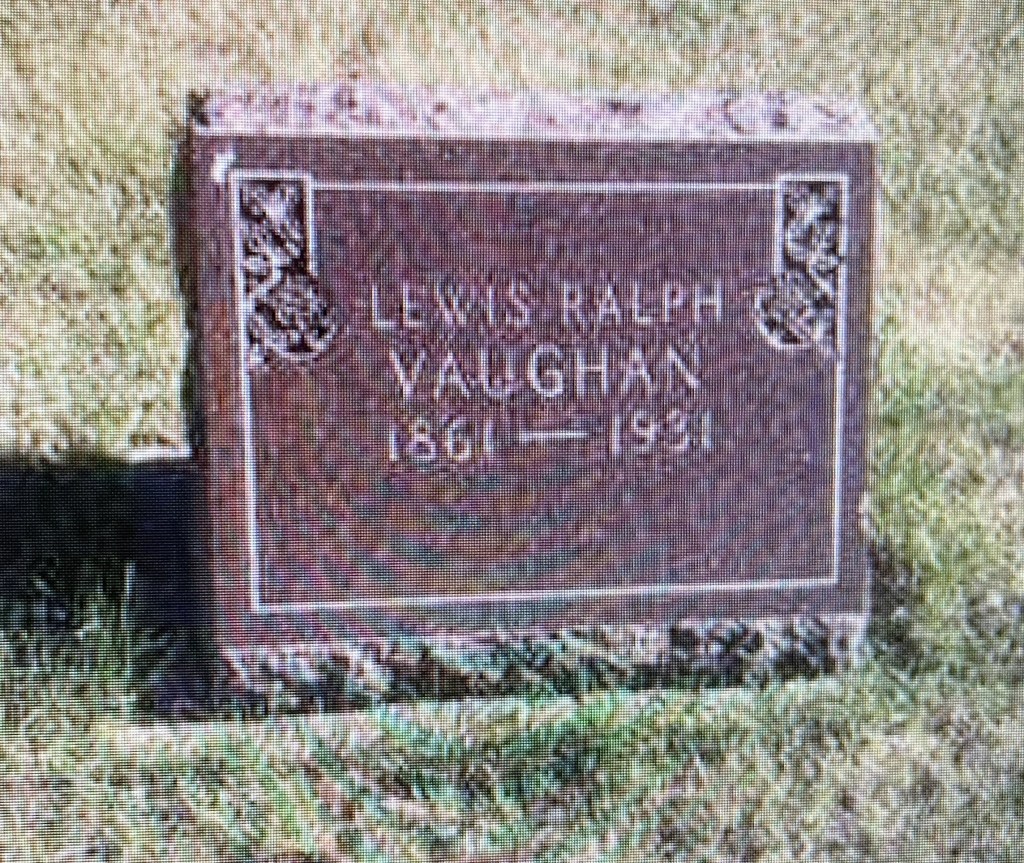
Lewis died in September 1931 and was buried at Crown Hill Cemetery, Wheat Ridge, Jefferson County, Colorado, USA.

Copyright unknown. Lewis’s gravestone is decidedly scant with information!

Septimus Vaughan 1863-1938

Yes, Septimus was the seventh son and last child of William James Vaughan and Mary Ann Alsop. He was born in mid-1863, probably late June or July as his birth was registered in the third quarter (Jul-Sep) and he was baptised at St Stephen’s on 2 August of that year.  But he was not the first Septimus Vaughan, his father William James had brothers Septimus and Octavius who were – yes, the seventh and eighth sons of that family.

It was perhaps his uncle Septimus Vaughan who was listed as living in Castle Bromwich in Birmingham in Kelly’s Directory for 1868, since our Septimus was living in Poole Street, Aston in the 1871 Census with his mother, his father having died in November 1869. By 1881, now aged 18, he was still living with his family, by now in Albert Road, Aston and was a toolmaker. His mother died in 1882 and his brother Thomas in 1886 so it is not obvious where Septimus was in 1891. Certainly I cannot find him anywhere in the census for that year. Perhaps he was visiting one of his brothers who had emigrated.  But wherever he was, he was back in West Bromwich when he married Amy Halladay on 22 September 1899 at Handsworth St Mary, aged 36 and still a bachelor with his occupation given as a manufacturer and his abode as New Hall Hill.

As we have noted so often,  the Vaughans and Alsops usually married into other families in business  and this was the case here. Amy’s father Henry Halladay was a manufacturer of buckles, in the 1881 Census he and his family were living in Burbury Street, Lozells and he employed 17 hands.

In 1901 Septimus and Amy were living at St George’s Crescent, Brearly Street, Birmingham where Septimus gave his occupation as ‘manufacturer of small stamped goods in metal’ – including such small things as buckles, perhaps?  Their first child Clifford Ernest was born on 15 April 1902 and was baptised on 7 September at Birchfield Holy Trinity but sadly died aged only 5 months and was buried on 4 October 1902 at Handsworth . 

Their next son Howard Hallaway Vaughan was born in September 1903, followed by his sister Ida Kathleen in 1906, both in Handsworth  and Constance Amy in 1909 in Aston.  In 1911, the family were living in Sutton Coldfield where Septimus again gave his occupation as Stamper and Piercer of sheet metal’. Another son Donald was born and died in the first quarter of 1918 in Tamworth, Staffordshire. Finally their last child Bryan James was born in 1920, also in Aston. Which I thought was slightly odd, as the family were at Wylde Green, Sutton Coldfield in the 1921 Census and the place of birth of both Constance and Bryan is shown in that census as Sutton Coldfield. But Familysearch tells me that Sutton Coldfield came at that time under the Aston Poor Law Union and was in the Aston Registration District which I found slightly surprising but looking at the map, it is North of Aston and Erdington and Wylde Green where several of the Vaughan family settled is between Erdington and Sutton Coldfield.

Septimus, in a death notice published in the Evening Despatch in April 1938, was described as ‘late of Vaughan and Williams’ and a notice in the London Gazette of the dissolution on 31 July 1931 of the business partnership of ‘Septimus Vaughan and Frederick James Williams, carrying on business as Stampers and Piercers at Brearley Street, Birmingham’, by mutual consent. Frederick Williams then continued the business under the name of Vaughan and Williams.

Septimus Vaughan died on 2 April 1938 and was buried at Sutton Coldfield Cemetery. His Probate record gives an address of Acacia Road, Bournville and his son Howard, a ‘stamper and piercer’, so clearly also in the family business, and his daughter Ida who was at that time unmarried were the executors. The remaining family were living at 1 Mayfield Road, Sutton Coldfield in the 1939 Register. His wife Amy died in 1953 and was also buried at Sutton Coldfield Cemetery.

Septimus and Amy’s children:

Clifford Ernest Vaughan               1902-1902

Born in Birmingham, and died in Handsworth, aged 5 months. Buried at Handsworth St. Mary.

Howard Halladay Vaughan          1903-1975

Howard was born in Handsworth on 2 September 1903. In 1911 he was living with his parents and two younger sisters in Sutton Coldfield, and in 1921 he was still with the family in Wylde Green, Sutton Coldfield, when no occupation was given for him and he was described as undertaking home duties. Howard may have been an active young man as I found a newspaper report in the Derbyshire Times in June 1932 which reported that he had slipped and fallen some distance while climbing Cratcliff Rocks, near Youlgreave, Derbyshire and had fractured his wrist and had other minor injuries, but had been able to return home after treatment by a local doctor. 

It appears that Howard married Claire Holloway in 1937 in Sutton Coldfield and she was living there in the 1939 Register, marked as married and with her parents in the same household. But of Howard there is no sign in the 1939 Register. He may have been travelling or with the armed forces but he was not with his wife or with his mother and siblings. A son Richard was born in the third quarter of 1942 but he appears to have been their only child.

As tends to happen with later 20th century records, there is very little to be found about him after that until his death on Christmas Day 1974 at his home in Troutbeck, Windermere, a death notice in the Birmingham Post referring to him as the ‘dearly loved husband of Claire and father of Richard. No flowers or letters please.’  I have been unable to find any details of his burial. His probate record showed that he left a relatively modest £11,404 at that time.  His widow Claire died in 1992, also in Windermere.

Ida Kathleen Vaughan   1906-1984

Ida was born on 3 August 1906 in Handsworth but by the time of the 1911 Census, the family were living in Jockey Road, Sutton Coldfield.  Another ten years on and they had moved to Highbridge Road, Wylde Green. The 1939 Register shows Ida living at 23 Mayfield Road, Sutton Coldfield with her mother and younger siblings, with no occupation given but ‘living on private means’.

In the early part of 1947 Ida married widower Charles Lightfoot in Sutton Coldfield, and they appear from Voters Lists to have moved to Erdington. Birmingham Voters Lists shows her living with her husband in Erdington until at least 1956. Charles died in 1973, Ida in 1984, both in Sutton Coldfield.  They appear not to have had any children.

Constance Amy Vaughan             1909-1993

Constance was born in Aston in 1909 and in the 1911 Census, the family were living in Jockey Road, Sutton Coldfield.  Another ten years on and they had moved to Highbridge Road, Wylde Green. The 1939 Register shows her living with her mother, older sister Ida and younger brother Bryan at 23 Mayfield Road, Sutton Coldfield. Like her sister Ida she was at that time ‘living on private means’. I have been unable to find Constance after that date, until her death in 1993 in Lichfield, Staffordshire. She never married. A Death notice in the Birmingham Daily Post notes that she was buried in Sutton Coldfield but there is no mention of any surviving family.

Donald Vaughan was born and died in the first quarter of 1918 in Tamworth Registration District, Staffordshire. At that time the Tamworth Registration District included Sutton Coldfield so it seems likely that he was born there.

Bryan James Vaughan    1920-2003

Bryan was born on 2 June 1920 in Sutton Coldfield, when his mother was 44. In 1921 and in the 1939 Register he was living with his family in Sutton Coldfield, in the latter listed as a student. In 1950 he married Betty McCormack in Sutton Coldfield. He died in Suttton Coldfield in 2003, aged 83 and I have been unable to find him anywhere in between! However, a Death Notice for his wife Betty in 1994 (published in the Birmingham Post) shows that she and Bryan were living in Lichfield, not even a mile from Bryan’s sister Constance and that they had two children Paddy and Jackie.

Summary

So these were the last children and grandchildren of Mary Ann Alsop and her husband William James Vaughan. The Vaughans were part of a vigorous, enterprising and ambitious family who developed numerous businesses and provided employment for many people. They began as jobbing smiths but took their expertise to found companies elsewhere. At the same time, they were a close family who often worked together, across generations and cared for each other’s children, their children also marrying into other business families and almost all ending their lives miles from sleepy Rowley Regis and in relative prosperity, sometimes in very real prosperity.

So, like her sister Hannah who had married into the Mallin family, Mary Ann Alsop had ended up as the matriarch of a large and successful family.

Mary Ann and William James had ten children, all of whom lived into adulthood, but the relatively modest number of twenty-five grandchildren, partly due to two unmarried daughters and one or possibly two unmarried sons.  Three of their children emigrated to the USA and Canada.

But not all of the Vaughan family had moved away from the Black Country. Some remained and they were an interesting branch of the family so merit an short diversionary post of their own! Soon…

Families of the Lost Hamlets – The Alsops 7 – Mary Ann Alsop’s children Part 2 – Charles, Richard Henry, Thomas and Amelia Page Vaughan

This piece looks at the next four children of Mary Ann Alsop and William Vaughan, the remaining four will be in the next piece.

Charles Vaughan 1849-1912

The birth of Charles was registered in 1849 in West Bromwich Registration District, and later in life he gives his place of birth as Oldbury or Rounds Green. But he does not appear in the 1851 Census with the rest of the family and nor does Joseph Edward, the eldest child.

By 1851 the rest of the family were living at Handley Street, in Aston, Birmingham. With William aged 31 (shown as a garden tool maker, employing 11 men) and Mary Ann, in addition to their two younger sons William and Richard, is Richard Vaughan, aged 24, listed as Partner and brother of William.  Only William James, aged 3 and Richard Henry, aged 3 weeks were with their parents who must recently have moved to Birmingham.  I think that the two older children must have been staying with other family members to help Mary Ann, certainly Joseph Edward was staying in Tipton in 1851 with two of his Vaughan aunts but Charles is not listed with them.

But Charles who would only have been two in 1851 is nowhere to be found, either in 1851 or 1861. He is not with his family in those censuses. I cannot find him with any of his numerous aunts and uncles nor on a general search of the censuses. I cannot find a death for him in those early years, the rest of his siblings grow up in the family home but it seems not Charles.

I have gone through all the Charles Vaughans who were born within two years of 1851 in England and all the Charles Vaughans of that age who appear in the censuses and accounted for all the others, except him. Very frustrating and puzzling because the Vaughans at least were a pretty close family and I would have expected a baby and child of that age to be looked after within the family.

But then, just when I had concluded that he might have died in infancy, in the 1871 Census, a Charles Vaughan of the correct age appears, living at 1 Shut Lane which was near Moor Street, Birmingham. He was living with a widow Jemima Cooper, aged 52 who was head of the household but described herself as a House Keeper, and her daughter Sarah H Cooper, aged 22 who was apparently a Professor of Music. There was also a female general servant aged 25. And Charles and two other young men of a similar age (20, 23 and 23) all described as Assistants, though it is not clear to whom they were assistants. The House Keeper? The Professor of Music? Why would such a youthful Professor of Music require three young male assistants? I confess  my mind boggles slightly… but nonetheless, it does appear that this might be the missing Charles.

And only three years later, this Charles married Emmeline Mary Lucinda Jeyes at St. Philip’s – Birmingham Cathedral now – but the parish church for part of the city – on 10 June 1874, giving his occupation as a hosier, (a dealer in knitted goods particularly stockings), his address as Aston Street and his father’s name as William James Vaughan, a Garden Tool Maker. No doubt then, this is the right Charles and what is more, William James Vaughan was one of the witnesses, so this implies at the very least that there was some positive contact between them. On 23 March 1875, a first daughter Adelaide Amelia was born to Charles and Emmeline, followed by Clara Emmeline in 1877.

By 1881 Charles and his family were living in Upper Sutton Street, Aston where he was described again as a hosier but out of business and Emmeline was still a milliner. With them also was his brother Lewis, aged 19, a clerk, a Caroline Radenhurst, 56, described as an aunt (perhaps Emmeline’s aunt as the name is unfamiliar), Esther J Vaughan, a cousin and domestic servant and a Henry Strange, a commercial traveller who was a Boarder. Again, the presence of a brother and a cousin in Charles’s household, seems to imply a familiarity and goodwill within the family.

By 1891, Charles, now 42 and his family were living at 123 Bloomsbury Street, Aston and he was still giving his occupation as a hosier, and Caroline Radenhurst (now 66 and identified as ‘wife’s aunt’, living on her own means) and Esther J Vaughan, cousin, aged 43 and a domestic servant – it is not clear whether Esther  is a domestic servant to Charles’s family – are still living with the family. Emmeline is still a milliner, Adelaide at 16 has become a School Teacher’s Assistant while Clara, 14, is still at school.

But by 1901, things have changed. Now aged 52, Charles’s occupation is shown as Iron Caster (malleable). The parents, daughters and Esther Vaughan are now living in Pritchett Street, Aston and both daughters are now teachers, although there is no mention of any occupation for Emmeline nor Esther. So at last Charles appears to have moved into the metal working industry, like so many of his family. Caroline Radenhurst had died in Aston in 1899, aged 75 so it seems likely that she had stayed with Charles and his family until she died.

The 1911 Census finds Charles, Emmeline, Clara and Esther living in Legge Street, Birmingham . Charles now describes himself as a Malleable Iron Founder, Clara is teaching in a Council School and Esther is a General Servant.

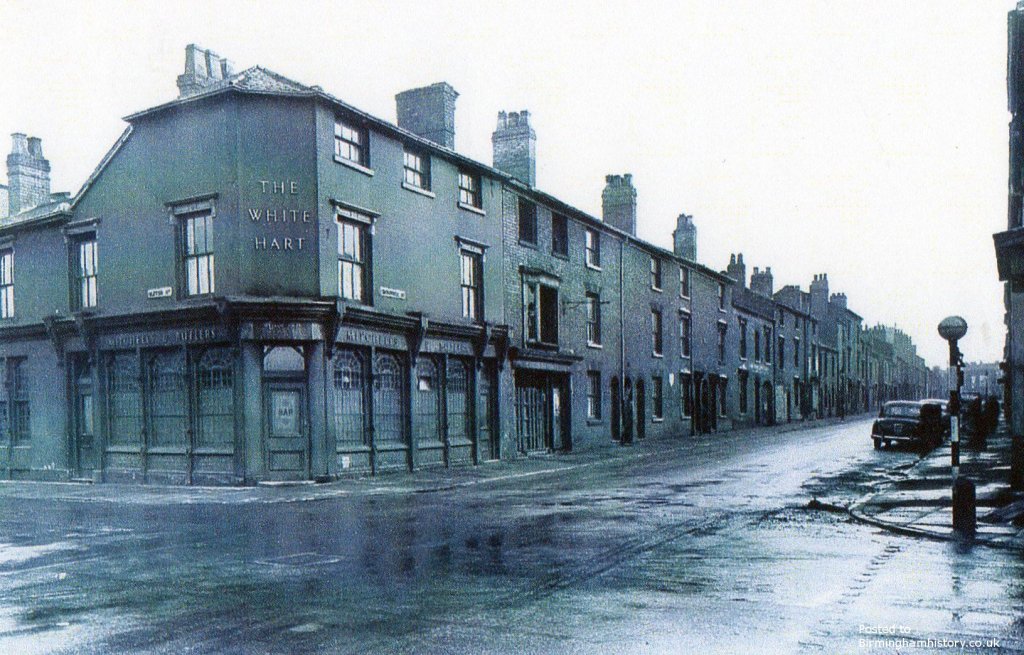
Copyright unknown. However this 1957 photograph shows that some parts of Legge Street survived in good condition for some time. The 1911 census shows that the house that Charles and his family were living in had eight rooms which was an unusually large house for that area, so it seems he had room for various relatives to live with the family.

Charles died on 22 Nov 1912, aged 63, his probate record shows, and he was buried in Witton Cemetery, as was Emmeline when she died in 1922. The 1921 Census shows Emmeline and Clara living in Rotton Park with Adelaide and her husband Alfred Loach who was a manufacturer of Gold Gem Rings, and their three children.

Esther Jane Vaughan, who lived with Charles and his family for upwards of fifty years, died in Rotton Park in December 1929, leaving her estate to Adelaide and Clara, and was buried – like so many of the Vaughans – in Witton Cemetery.

Esther was indeed a cousin to Charles Vaughan, a cousin once removed – her parents were James Vaughan and Rebecca (nee Barnsley).

James was the considerably younger brother of Joseph Vaughan, the grandfather of Charles. He had not followed Joseph and his family to Aston but had stayed in Rounds Green where he and his wife Rebecca had seven daughters and two sons, including a Charles Vaughan who had been born and died in August 1845. Charles, the son of William and Mary Ann, and Esther, daughter of James and Rebecca, were born only a year apart, both in Oldbury and it seems slightly unusual for there to be this close relationship over a long period.  Although he does not appear in any censuses with James and his family, I wonder whether Charles did spend time with this part of the family as he was growing up, which might account for a closer connection. But there is no way to know for sure. 

But the decade or more that Charles is missing from the censuses continues to irritate me! I suspect that he was staying with a married female of the family somewhere and that possibly his surname may have been wrongly transcribed or entered in error as that of her husband. For now, I can only keep an eye out for a Charles of the right age with some part of the (very prolific!) family, as my research continues.

Richard Henry Vaughan 1851-1928

Richard Henry Vaughan had been born on 13 March 1851 – the census was taken on 30th March so he was quite a new baby. He was with the family in 1851 and 1861 but by 1871, he was living at 78 Bull Street, Birmingham, where he was a Draper’s Clerk.

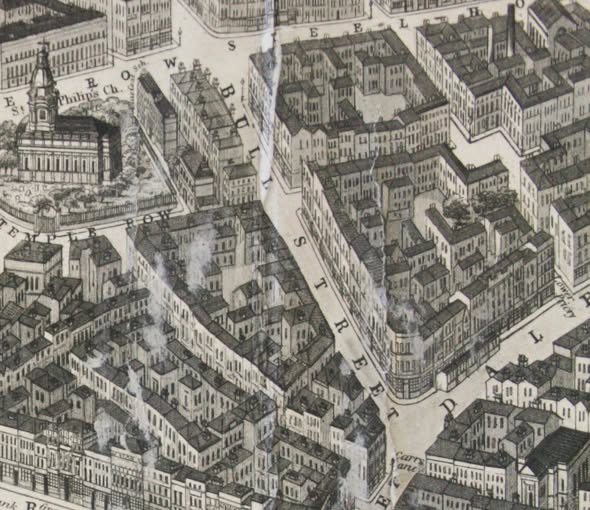
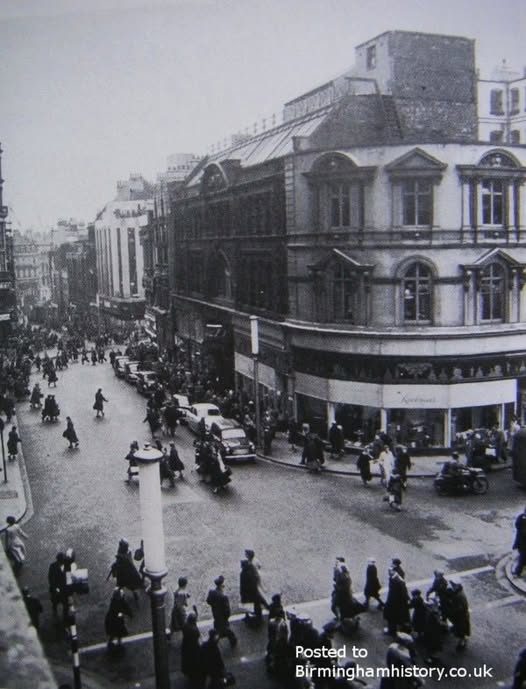
Bull Street, Birmingham, for those who are not familiar with it, is an old street in the centre of the town, only a few yards from the cathedral. It runs from the old Snow Hill Station down to the High Street, crossing where Corporation Street was later built. In my days living in Birmingham in the late 1960s and early 1970s, it was home to Grey’s Department Store and Lewis’s was on the other side of the road. I have been able to ascertain that 78 Bull Street was on the corner of Temple Row and Bull Street, not far from the Cathedral.

Copyright: Paul M Hayes

The census, unfortunately, does not give the name of his employer but it was clearly no small establishment as there were thirty seven members of staff, living on site, which was not unusual for larger or department type stores then. There were seven porters, five clerks and twenty-seven draper’s salesmen, almost all of them in their early twenties or younger. Although a few were local others came from a very wide area, as far away as Hackney, Cambridge and Devon. What an interesting place it must have been to work, for a lad from a family of metal workers in Aston, how much he must have learned from those strangers from other parts of the country.

Whilst I was checking out 78 Bull Street, I was able to find some old photographs of that corner and was interested to see that in later years it was occupied by Rackhams, before they built their large new store. I wondered when they opened and an enquiry on the Midland Memories and More page on Facebook brought me almost instantly the information that Rackhams had opened on that site in 1881, so ten years after Richard Vaughan was there. How interesting! And yet, the two shops must have been in a very similar trade – I wonder whether they changed their name?

Copyright: Paul M Hayes. Looking down Bull Street, towards High Street, with Temple Row coming in on the right. The Rackhams shop on the corner was at 78 Bull Street, where Richard worked and lived in 1871. I think this would be in the 1950s or thereabouts.

In the 1881 Census, Richard was in Hulme, Lancashire where he was still a clerk to some sort of trader.  In 1886, Richard was the executor to the Will of his younger brother Thomas so was in the country then. Perhaps the death of Thomas, at such a young age, unsettled him. Whatever motivated him, Richard was to be one of the few Vaughans who ventured abroad. In 1888 he arrived in New York, USA and it appears that he married Anne Maria Wray in Colorado in 1889. They settled in Denver and he was a bookkeeper there, becoming a naturalised citizen in 1921. Although he and Anne Maria were married in Colorado, Anne was a Birmingham girl, born in 1858 in Aston. Their son Harry Wray Vaughan was born in Denver, Colorado in February 1890, their daughter Doris was born in West Bromwich, England in February 1893 and was baptised at St John, Perry Barr in March of that year. Both Harry and Doris were still in Denver in 1940, both unmarried and living together. 

Richard died in Denver, Colorado in 1928 and Anne Maria in 1938, also in Colorado. Doris died in 1967 and Harry in 1969, both in Colorado.

So Richard and his family appear to have made a complete break with the metal-working traditions of the Vaughans and with the Midlands and England.

Thomas Vaughan 1853-1886

Thomas Vaughan was born in 1853 in Birmingham and was with his family in the 1861 and 1871 censuses, in the latter he was a Jeweller’s Assistant, another slight variation in the metal working tradition! By 1881, however, he was in Newhall Hill, Birmingham as a  visitor in the household of Sarah Howling, a confectioner as was her daughter Emily, 26. His occupation was a toolmaker  but I note that one neighbour was a Jeweller’s Toolmaker and this area was in or adjoining the Jewellery Quarter so it is possible that Thomas was still associated with the jewellery trade.

Thomas died young, however, in Rhyl, Flintshire, Wales, on 19 August 1886, aged 33 and his Will states that he was a bachelor, of Newhall Hill, Birmingham. His death certificate shows that he was a fitter and that he died at 11 Queen Street, Rhyl and that he died of ‘Diarrhoea Syncope’ His brother William James registered the death and was present when his brother died, although his own address was given as Victoria Road, Aston so he  must have travelled to Rhyl, for holiday or because of Thomas’s illness, unless he was also on holiday there. I cannot find a definition now which quite matches this cause of death but it was certified by a doctor so it was clearly an acceptable cause of death to the Registrar and it may be that dehydration led to physical collapse.

It is possible that Rhyl was a favoured holiday destination for the family, many Midlanders holidayed there and along that coast and it was the height of the holiday season. There were also a considerable number of Vaughans living in Wales, too who may have had family connections in the past.

Thomas was buried in the family grave at Witton Cemetery.

Amelia Page Vaughan 1855-1939

Amelia Page Vaughan was born on 15 February 1856 in Aston and was with her family in 1861, 1871 and 1881. She never married and her Will refers to her as a spinster. In 1891, she was living, described as Housekeeper, with her widowed eldest brother William James in Victoria Road, Aston.  After that she seemed to move around the family.

I cannot find Amelia in the 1901 census but in 1911 she was a visitor in Clifton, Bristol with her niece Mary Catherine Fleming, nee Vaughan, (the daughter of Amelia’s oldest brother Joseph Edward and Marian), and her husband John Fleming and their four children.

By 1921, Amelia was living in 6 Twyning Road, Birmingham with her married niece Adelaide Amelia Loach, daughter of Amelia’s brother Charles who had died in 1912. Also living with Adelaide, in addition to her husband Alfred and their three children, were her mother Emmeline and sister Clara. From google street view, it appears that 6 Twyning Road is a Victorian Terraced house of no great size so it must have been fairly crowded!

It appears that Amelia continued to live with or near her two nieces as she appears in the 1936-1937 Electoral Roll at the same address in Rotton Park, Birmingham as Adelaide and Clara, although alas, Amelia died on 28 June 1939 at her niece Clara’s house, just a few months before the 1939 Register was taken. As with her cousin once removed Esther Jane Vaughan, her nieces Adelaide and Clara were named as executors in her Will. She was buried at Witton Cemetery.

Summary

So these were the next four children of William Vaughan and Mary Ann Alsop, all with something of interest about them and most of them showing a close association with the Vaughan family and their businesses, although some were further afield, in Bristol or the USA. Spinster daughters seem to have remained mostly with their brothers or with nephews and nieces, looking after or being looked after and still clearly cherished members of the family. But again, few links lead back to Rowley Regis and the Alsops, although the Vaughan links to Rounds Green and Oldbury seem to have persisted for some years.

 The next piece will look at the remaining Vaughan children – Mary Ann, Emma Eugenie, Lewis Ralph and Septimus and should follow shortly.

Families of the Lost Hamlets – The Alsops 6 – Mary Ann Part 1

Mary Ann Alsop

Mary Ann Alsop was born in 1820, fourth and youngest but one of the daughters of Edward Alsop and Betty nee Hodgetts, she was baptised at St Giles, Rowley Regis on 21 May 1820. The next time there is any record of her is in the 1841 Census when she is living at the Windmill Farm, with her siblings Sarah, Thomas and Rhoda.

But she was not there for very much longer. On 6 May 1844 Mary Ann married William James Vaughan at Tipton, St Martin. William was baptised in Oldbury and it seems very likely that his family were living in Rounds Green. His occupation at the  marriage was shown as a ‘jobbing smith’ and his father Joseph Vaughan was also a jobbing smith.  The witnesses were Mary Ann’s brother-in-law Isaac Mallin and her sister Rhoda.

The Vaughan family

The Vaughan family into which Mary Ann married were a large and industrious family, this particular branch living in Rounds Green, Oldbury but with Birmingham connections. I suspect also that they were connected with a large family of Vaughans in Wales as many of the distinctive Vaughan Christian names also appear in that family and they were also very extensively involved in the iron and metal working industries.

Mary’s new husband William James (1820-1869) was the third son of Joseph Vaughan (1795-1851) and Amelia (nee Page) Vaughan (1797-1843) of Rounds Green, Langley. Joseph, at least some of his brothers and several of his sons were originally described as ‘smiths’ but they had an early association with edged and garden tools, an occupation which was very common in that area, particularly in Brades village.

 ‘The Brades Works’  

I confess that despite growing up barely a mile from Rounds Green, until recently I knew nothing about Brades village or the Brades works. But it is not difficult to find out. Not least, there is a most interesting website called https://madeinoldbury.co.uk/articles/brades-works/ which has a wide range of articles and information likely to be of interest to anyone who has lived locally.

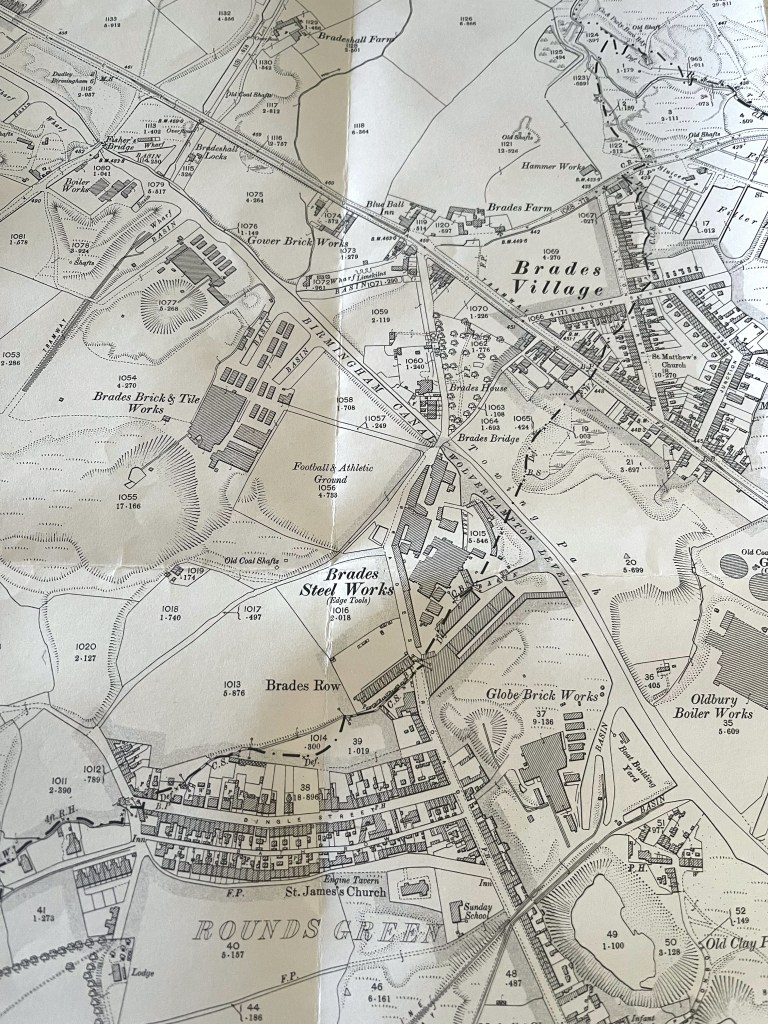
Copyright: Alan Godfrey Maps.

As can be seen from this 1902 map, Rounds Green was immediately adjacent to the Brades works (Brades village is top right on the other side of the canal) and I think it is highly likely that the jobbing smiths in the Vaughan family, living in Rounds Green, worked there.

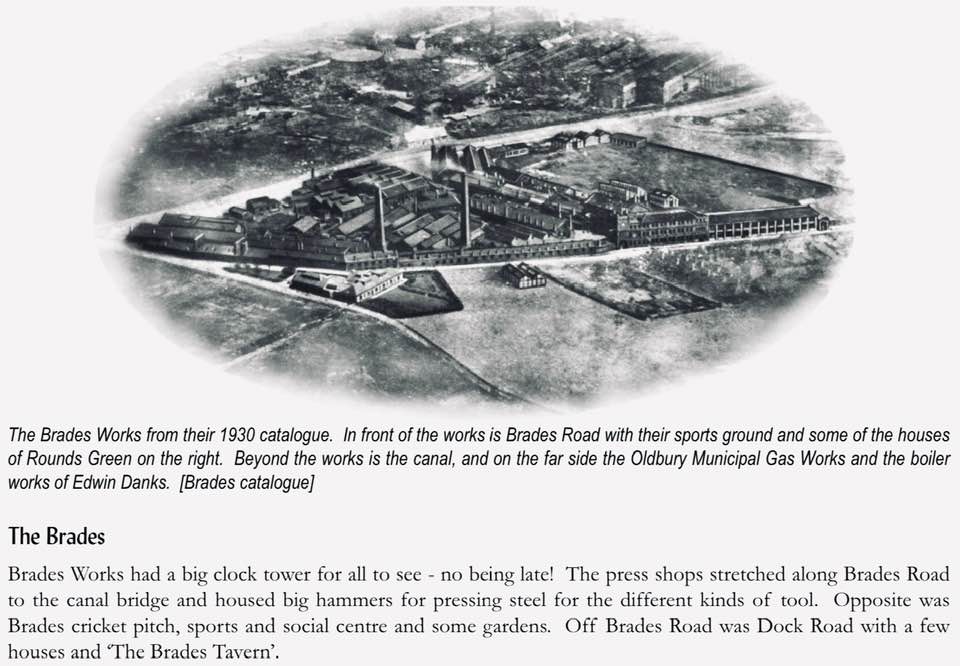
A William Hunt, the Oldbury website tells me, set up a series of small forges and furnaces alongside the Birmingham to Wolverhampton canal in 1782 to manufacture edge tools, and there are accounts for as early as 1796, which list several different departments at work. By 1805 they were also manufacturing steel on site, digging the coal required around the site. Other materials could be brought in and taken out on the canal, a huge advantage at a time when roads were generally very poor. On the site a large number of knives, trowels, spades, hoes and edging knives, axeheads, hatchets, garden shears, wood chisels and scythes were made, as well as supplying the steel for ramrods used during the Napoleonic wars.  There was also a ‘jobbing forge’ which is probably where the Vaughan men worked until they set up their own company. Tools from the Brades factory were sent all over the world and also supplied to the military, including bayonets. One particular design of Brades trowel, apparently, became highly prized amongst archaeologists as being the best trowel for excavating.

Elihu Burritt, the American diplomat based in Birmingham, wrote about a visit to the site in his book ‘Walks in the Black Country’, published in 1869, extracts from which are on the Oldbury website and worth reading, he called these works ‘one of the chief lions of The Black Country’.

Copyright unknown.

After various amalgamations with other companies, Brades Tools has gone now but it is fascinating to look on ebay and see how many vintage Brades tools still fetch good prices! One axe was listed at £285, another at £350!

Back to the Vaughan family and William James’s parents:

Between 1816 and 1840, Joseph, the jobbing smith and Amelia Vaughan had eight sons and five daughters.

Connections to the Page family

After Amelia’s death on 6 August 1843 (buried at St Giles, Rowley Regis) Joseph was left with several young children and he married again very quickly in October 1843 in Birmingham to Lucy Page. I was interested to see the name Page as that was Amelia’s maiden name, so I wondered whether they were sisters. No, they weren’t, I found. But they were sisters-in-law! Lucy’s previous husband was the wonderfully named Fairbrother Page, one of Amelia’s brothers. And the Page family were all in the metal working trades, too in one way or another. And Page was not exactly an unknown name in Rowley Regis, either. Fairbrother and Lucy Page had nine children and he had died, aged only 40 in 1840, and his family were all in the Aston/Duddeston area of Birmingham. Some of the Page family were quite well off, too. Fairbrother was a steel toy maker and his brother William, who was his executor and trustee under his Will, was a spoon manufacturer employing 6 men and 2 boys in 1851. After William’s death in 1857, his widow Rebecca, nee Mucklow,  married a Joseph Needham , who was also a spoon maker, in 1860, continuing to live in the Duddeston area during his lifetime. At the time of his death in 1880, he left an estate valued at under £5,000. But when Rebecca, who had moved from industrial Aston to rural Sutton Coldfield, died in 1889, she left an estate worth £35,290/12/9d! Serious money and so much more than her husband had left less than ten years earlier. Perhaps she was a good investor.

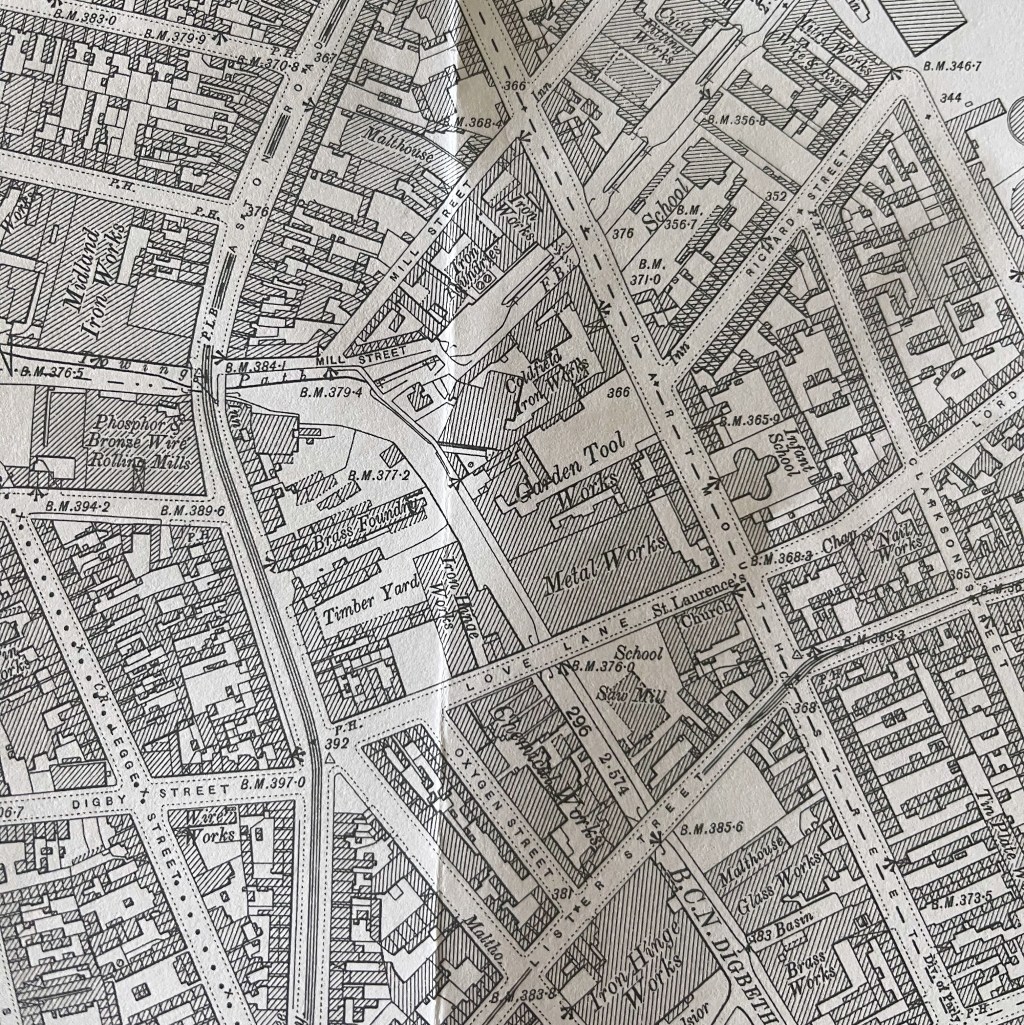
The Vaughans were also apparently a successful family. A trade directory dated 1858 shows brothers Charles, John, William, Richard, Septimus and Joseph Vaughan as ‘edge tool makers’ as individuals and as companies in Dartmouth Street, Summer Lane and Milton Street, Aston. By 1861 Charles, the eldest brother is shown in the census as a ‘garden tool manufacturer’ in partnership with his brothers. An 1858 Trade Directory lists the brothers as manufacturers of ‘garden trowels, hoes, rakes, forks, ladies’ garden tools in sets, ship scrapers, connecting links, flat and convex washers, etc, etc. It appears from other entries in the same page that each of the brothers in the partnership was managing a separate factory producing particular items from the list. Their Dartmouth Street works backed onto the canal and had a canal basin alongside, with a glass works on the other side of the basin and a coal wharf over the canal, the whole area was heavily industrialised.  

Copyright: Alan Godfrey maps.

On this extract from the 1902 OS Map, a garden tools works can be seen which has the canal on one side and Dartmouth Street on the other, very likely to have been the Vaughan Brother’s works. Note the number of other industrial premise around them, interspersed with housing and back-to-back courtyards.

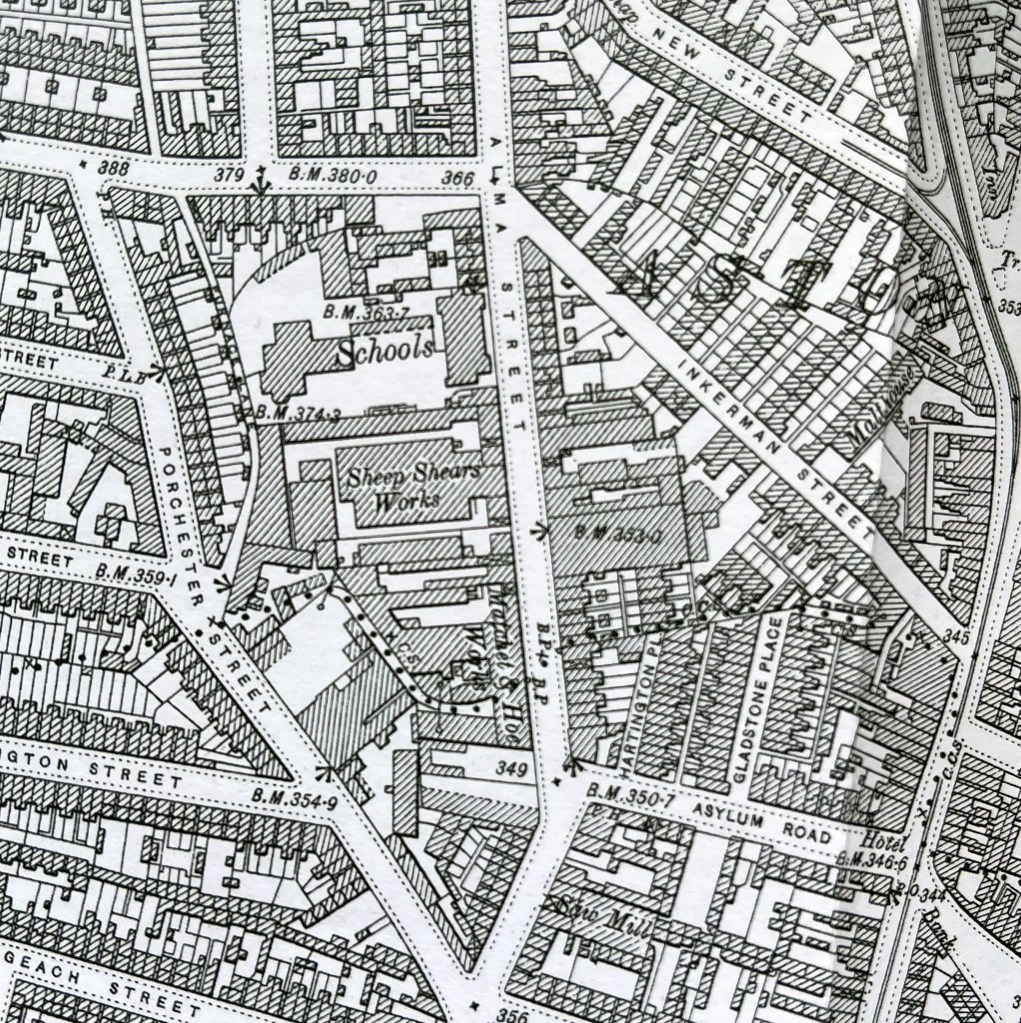
Looking at the 1902 OS Map of the area, I couldn’t see any industrial premises in Milton Street but there was a ‘Hatchet and Hoe Works’ and a ‘sheep shears works’, both in the Milton Street/Summer Lane area which may well have been connected with the Vaughans. 

Copyright: Alan Godfrey maps. Alma Street, Aston showing the sheep shears works and, just below it the Hatchet and Hoe works – these are the sort of products the Vaughan Brothers would have been making. Again, surrounded by poor quality and crammed housing and no green space.

In 1871 the company was employing 57 men, 9 women and 27 boys. The 1881 census shows that this had increased to 72 men, 12 women and 21 boys. When Charles died in 1892, his estate alone was valued at £15,022/3s/9d, equivalent to between £2.4-£2.6million today.

Mary Ann and William James’s family

On 15 May 1845, the first child of Mary and WilliamJoseph Edward Vaughan – was born at Wall Heath, Kingswinford. It is not clear why the couple were at Wall Heath but their second son  was also born there. It seems likely that they were there for William’s work in some way. Wall Heath was not a big place but there was a windmill there at this time and there is still a Foundry Road, either of which may be a clue. Joseph was followed by his brother William James, born on 11 October 1846, also at Kingswinford. (Well, that takes care of the paternal Christian names of both grandfathers – the Vaughans were a great family for repeating the same names through the generations, makes for interesting and at times frustrating research).

Another son Charles was born in 1849 in West Bromwich Registration District, probably the Oldbury or Rounds Green area but he does not appear in the 1851 Census with the rest of the family and nor does Joseph Edward, the eldest child. Only William James, aged 3 and Richard Henry, aged 3 weeks were with their parents who must recently have moved to Birmingham, are  with their parents and also William’s brother Richard. I think that the two older children must have been staying with other family members to help Mary Ann, certainly Joseph was staying in Tipton in 1851 with two of his Vaughan aunts, although Charles is still proving elusive. So by 1851 most of the rest of the family were living at Handley Street, in Aston, Birmingham. With William aged 31 (shown as a garden tool maker, employing 11 men) and Mary Ann, in addition to their two young sons William and Richard, is Richard Vaughan, aged 24, listed as Partner and brother of William.  Richard Henry Vaughan had been born on 13 March 1851 – the census was on 30th March so he was quite a new baby. He was followed in 1853 by Thomas, in 1855 by Amelia, in 1856 by Mary Ann, all born in Birmingham and in 1858 by Emma Eugenie. Two more sons followed – Lewis Ralph in 1861 and Septimus in 1863, these latter all born in Aston. And yes, Septimus was the seventh son!  But he was not the first Septimus Vaughan, his father William James had brothers Septimus and Octavius who were – yes, the seventh and eighth sons of the family. So by this time most of the Vaughan brothers were living in the Aston/Handsworth area where their factories were.

By 1861, the family had moved to Poole Street, Aston. William James Vaughan Snr died in June 1869, when his youngest child was only 5 and was buried at Witton Cemetery, Birmingham. His Probate record showed that his estate was valued at under £2,000 (less than his older brother twenty years later but still a substantial amount).  

The widowed Mary Ann Vaughan was still in Poole Street in 1871 with her son Joseph (25) described as an ‘edge tool maker’ and next son Thomas as a Jeweller’s Assistant, the other children still being at school.

By 1881, when Mary Ann was 61 and an ‘annuitant’ the family were living in Albert Road, Aston, with four of her younger children and one granddaughter Clara, aged 4. The only son remaining at home by then was Septimus who was 13 and already a toolmaker, in the family tradition. His sister Emma who was 21 was shown as a milliner, another  potentially profitable, like shoemaking, as every woman wore a bonnet and  fashionable (and well-off) ladies would have numerous bonnets which would require replacements as fashions changed. Another example of the Alsop/Vaughan families identifying local needs and meeting them, using their dexterous skills – these families were not afraid of hard work or being ‘in trade’.

Mary Ann Vaughan, nee Alsop,  died, aged 62, on the 4 March 1882 in Aston and was buried at Witton Cemetery with her late husband, there was a fine memorial for them, alas last seen laid flat.

Mary Ann and William James Vaughan’s children

Joseph Edward 1845-1909

Joseph was born on 15 May 1845 in Wall Heath and baptised on 24 Aug 1845 at Kingswinford. However, in the 1851 Census he is not listed with his family in Handley Street, Aston. Instead he is staying, aged 6, described as a lodger, in Church Street, Tipton, along with his aunt Selina Vaughan, then aged 21, They are with Cornelius and Mary Ann Guest, (nee Vaughan)  – Mary Ann is Selina’s sister and therefore also Joseph’s paternal aunt. By 1861, Joseph is back with his family, in Poole Street, Aston, now aged 15 and, like his two next brothers William and Richard, they are all, like their father, Garden Tool Makers – in the family business, almost certainly.

In 1871, Joseph was living with his widowed mother and younger siblings in Poole Street, Aston but in 1873 he married Marian O’Donellan in Birmingham, it appears that this was a Roman Catholic ceremony as the details are in Latin. They had three children – Mary Catherine in 1875, George Edward in 1877 and Norman John Donellan in 1880.

In 1881, living in Albert Road, Aston, Joseph was described as a Manager, and in 1891, by now living in 40 Cromwell Street, Aston, he was once more an Edge Tool Maker. But in this census only George of their children is also listed. The other two children were staying with their O’Donellan grandparents in College Green, Bristol.

His wife Marian, however, also has an occupation in this 1891 census – she was a pawnbroker. Interestingly I have also found a trade directory reference to a pawnbroker called Michael O’Donnellan who was Marian’s father, in Sherlock Street, Birmingham in 1868 so perhaps this was a family trade. Later census entries for both Michael and Marian O’Donellan record them both as chiropodists but perhaps they were pawnbrokers first! And trade directories dated 1888, 1890 and 1892 show Joseph Edward Vaughan as a pawnbroker at 40, Cromwell Street, Duddeston, Birmingham. The Register of voters for 1885-86 1890 shows Joseph Edward Vaughan at 40 Cromwell Street, but still owning a house at 131 Albert Road, which was where they had been living in the 1881 Census. But the 1891 Census has Joseph, as an Edge Tool Maker, Marian and George living at 40 Cromwell Street, where Marian was a Pawnbroker.  So perhaps Joseph continued his work as an edge tool maker but his wife ran the pawnbroking business. Cromwell Street was not by any  means as affluent an area as where most of Joseph’s family ended up living but undoubtedly it would have been a good catchment area for a pawnbroker.

Copyright unknown. A view of Cromwell Street in the 1950s. Other than the cars, it would probably have looked much the same when Joseph and Marian had their pawnbroking business there.

Copyright Birmingham Libraries ‘Slum Collection’.

I cannot find either Joseph or Marian in the 1901 Census, so perhaps they were travelling.  Joseph died, aged 63, on 17 February 1909 and was buried at Witton Cemetery as were most of his siblings and his parents. By 1911 Marian had moved to Bristol where her parents had lived for many years and was listed as a chiropodist, like her father.  She died there in January 1920.

Joseph Edward and Marianne’s children

Mary Catherine married and settled in Bedminster, Bristol and it may be that she had lived in Bristol most of her life with her grandparents.  Her husband John Fleming who was 20 years her senior, died in 1915, they had one son and three daughters. She died in Bristol in 1958, her Probate Record interestingly gives her name as Vaughan or Fleming so perhaps she had gone back to using her maiden name for some reason.  In 1989 there was a George Edward Vaughan living in a tenement in Chancery Lane, London and in 1901 George Edward was in Poplar, London where he was shown as a Merchant Seaman, and he received his UK Second Mate’s Certificate also in 1901. He emigrated to Melbourne, Australia in 1914 and enlisted in the Australian Navy there in 1915, giving his mother Marianne’s name and address in Bristol as his next of kin.   George travelled at least once to the USA, probably to visit his brother. He died in Australia in September 1970, aged 93. Norman John Donellan Vaughan also became a seaman and also emigrated, in 1905 he went to Vancouver and then San Francisco where he became a naturalised citizen in 1925, his address on the Registration card given as Golden Gate Bridge! He was an auto-mechanic and had married in England in Middlesborough where his only daughter Catherine had been born. A possible death is in Nevada in 1963.

So this little branch of the Vaughans uncharacteristically settled far from the place of their birth, as had their Irish O’Donellan grandparents, or perhaps raised mostly many miles from the larger Vaughan and Alsop families in the Midlands, they did not feel part of that larger clan nor to have been in the metal trades, both boys becoming seaman which would have been much easier, living in the Port City of Bristol.

 William James Vaughan 1846-1928

William was born in 1847 in Wall Heath and baptised on 3 January 1847 at Kingswinford. He was with his family in Handley Street, Aston in the 1851 Census, and in 1861, he was with them in Poole Street, with his three brothers and three sisters. The census in 1871 was taken on 2 Apr but William had been married just a few days earlier on 21 March to Elizabeth Prudence Sturges whose father Robert Sturges was a partner in an electro-plating company. William was listed, with Elizabeth at Penzance Place, Victoria Road, Aston where he gave his occupation as a metal worker.

By the time of the 1881 Census, their family had grown with the births of Robert Edward on 30 January 1872, William James in 1874, Ernest Charles in 1875, and Elizabeth Sturges Vaughan in 1877. In 1881 they were living in Yardley, Birmingham and their next children were  Lawrence Sturges Vaughan born in 1882 and Thomas Ralph born in 1886, (who died in 1887).  Elizabeth Vaughan died in 1889 in Aston and was buried in the family plot at Witton Cemetery.

It seems likely that William had been working for his father-in-law’s company – Sturges, Bladon and Middleton since at least the time of his marriage if not before. Trade directories for the company which was originally founded by an Elizabeth Sturges, who had been active in the industry since 1829 at Suffolk Street, Birmingham, with her son Richard Ford Sturges between 1833 and 1841 as Sturges & Son, making Platina, British Plate and Britannia Metal wares. He continued the business on his own account from 1841 to about 1863 at 46 Broad Street, Birmingham. It was perhaps the next generation who were in partnership with Bladon and Middleton who made tea and coffee sets, trays, tankards, condiment sets, casserole dishes, Fruit and Cake Baskets and Old English Pewterware.

Copyright unknown. A silver plated teapot produced by Sturges, Bladon and Middleton

William was at 156 Victoria Road, Aston in 1891, along with his four sons and one daughter and his sister Amelia was also living there as his housekeeper.  By now his occupation was shown as an Electro-plate Manufacturer, as were his sons Robert (19) and Ernest then 16, while William at 17 was a Clerk.

In the first quarter of 1893 William re-married to Mary Ann Pagett, and they continued to live at 156 Victoria Road where their children Madeline Lilian (1897), Edgar (1898), Horace (1903) and Frank (1905) were born. By the time of the 1911 Census, the family had moved out to Acocks Green, where Frank was born.

Mary Ann died on 28 February 1917, aged 52 and was buried in Yardley Cemetery where her son Edgar was also interred in 1918, aged 20, who had served with the Royal Marine Light Infantry and died on 13 June 1918 of wounds, at Whalley Military Hospital, Lancashire. 

In the 1921 Census, William was at Lincoln Road, Olton, near Solihull with his son Horace who was now 18 and a Clerk at the Britannic Assurance Company. William died on 6 May 1828, aged 81 and was buried at Witton Cemetery with his first wife Elizabeth and their son Thomas who had died in infancy. His estate was valued at just over £3,000.

William and Elizabeth’s children

Robert Edward Vaughan was born on 30 January 1872 in Aston. He married May Pottle Chinn in December 1901 and they had two sons Edward Winston (1903) and Clifford Sturges (1907, followed by a daughter Kathleen in 1909. They lived for many years in Grove Road, Sparkhill and Robert worked for Sturges, Bladon and Middleton, as it appears his sons also did. Robert later moved to Stratford-on-Avon where he became a farmer – a greater contrast to the metal plating industry is hard to imagine – and he died in 1950 in Earlswood, another rural area. His widow May died in 1958.

William James Vaughan was born in 1874 in Aston and remained there, living with his family and working as a Clerk until his marriage in 1900 in Solihull when he married Annie Elizabeth Smith.  Unlike most of his brothers, William did not go into the metal industry and became a Clerk for a Timber Merchant so that he and his family lived in Knowle, Solihull, rather than Aston. Although William gives his occupation as a Clerk up to 1911, by 1921 he had become Managing Director of the timber company, living in Marshall Lake Road, Shirley and his eldest son was also working for the same company as a Clerk to the Timber Merchant. William and Annie had two sons Charles Smith (1900) and William James (1906, and three daughters Dorothy Beatrice (1910), Mildred May (1912) and Olive Margaret (1916). William James died in August 1932 in Shirley, aged 58  but Annie lived on in Solihull until 1962, when she died aged 82.

Ernest Charles Vaughan was born on 18 February 1875 in Aston and was with his family until his marriage in 1903, when he married Florence Eugenie Salvey in Aston. They had two children Eric in 1906 and Dorothy in 1907, both born in Handsworth.  At that time it seems that Ernest was working in the electro-plating business, probably in the family business. By 1911, although Ernest was still listing his occupation as an Electro Plate Manufacturer, the family had moved to Suttton Coldfield and in 1921 they had moved on to Wylde Green, Sutton Coldfield where he had the same occupation. By 1939, however, they were living at ‘Garage House’, Kingsbury Road, Minworth, Sutton Coldfield where Ernest had become a garage owner. He died in Sutton Coldfield in 1948. His wife Florence died, still at Garage House, in 1963 and both Ernest and Florence were buried at Witton Cemetery, the resting place of so many members of the Vaughan family.

Elizabeth Sturges Vaughan was born on 22 December 1876 in Aston and was with her family until her marriage in 1906, when she married Thomas Henry  Salvey in Solihull. Thomas was the younger brother of Florence Eugenie Salvey  who had married Elizabeth’s older brother Ernest in 1903. Like his father Thomas was a dentist. Thomas and Elizabeth lived in Cheshire for a time. Their daughter Hilda was born in Nantwich in 1907, their son  Vaughan was born in Crewe in 1911  and they were in Crewe in the 1911 Census. But by 1921, the family were back in Birmingham, living in Stratford Road, Sparkhill, Birmingham where Thomas and Elizabeth still lived when the 1939 Register was drawn up. Elizabeth died in 1953 and is buried in Yardley Cemetery, Thomas Selvey lived to the age of 90 and died at Arreton Manor on the Isle of Wight in 1968, his daughter Hilda also died in Newport, Isle of Wight, in 1994 so he had perhaps moved to be near her.

Lawrence Sturges Vaughan was born in 1882 in the Solihull Registration District. His mother died in 1889 when he was only 7 and in 1891, when the remaining family were living in Victoria Road, Aston, his aunt Amelia Vaughan was living with the family, acting as her brother’s housekeeper. By 1901, his father had married again and a halfsister and half brother had been added to the family. Lawrence was listed as a Tool Maker, although whether this was with the Vaughan family and their numerous companies making garden and edge tools, it is not possible to know. Lawrence married Ada Williams, nee Bartlett, a widow and business woman, in September  1910 in St James’s, Aston Park and in 1911, they were living at 112 Ettington Road, Aston, along with his stepson Francis Williams who was 11.

By 1921, they were still living there but now Lawrence gave his occupation as collecting and delivering laundry and Ada gave her occupation as superintending the Laundry. Her son Francis, by now 21 was working in Electro-plating. Lawrence and Ada appear not to have had any children together. Lawrence died, aged only 47, in 1929 and was buried at Witton Cemetery. His wife Ada Vaughan is listed among those killed in ‘World War II Civilian Deaths’, she died at 112 Ettington Road, on 12 December 1941, aged 64, presumably in a bombing raid and was also buried at Witton Cemetery. Ada left an estate valued at £7,685, a substantial sum in those days. Her executor was her son by her first marriage Francis Williams who was described as a laundry manager, so presumably he had taken over the laundry business which had originally been owned by his father.

Thomas Ralph Vaughan was born in 1886 in Aston and died in 1887, aged 9 months, buried in Witton Cemetery, his parents were both interred in the same grave when they died in 11889 and 1928 respectively.

William and Mary Ann’s children

Madeline Lilian was the first of William’s children with his second wife Mary Ann Pagett. She was born on 24 May 1896 in Aston. She was baptised at St Mary Aston Brook, on 12 August 1896. Madeline was at home with the family in 1901 and 1911 but visiting friends in Cardiff in 1921. Her occupation was shown as a shorthand typist to Alldays & Onions, Sparkbrook, Birmingham .  It appears that Madeline did not marry, she was living alone at 14 Hazelwood Road, Acocks Green in 1929, according to Voter’s records.  She was at a Riding School in Brackley Northamptonshire in the 1939 Register and  her occupation there was recorded as a shorthand typist to a Chartered Accountant.  Madeline appears to have remained in Birmingham until at least 1955 but by 1960 she had moved to Laughton, near Eastbourne, West Sussex where she died in 1968. I have been unable to find any record of her burial.

Edgar was born in Aston on 11 June 1898, and was at home with his family in 1901 and in 1911, when he was still at school. However, on 12 February 1917, aged 18 years and 8 months, he was called up and enlisted into the Royal Marines Light Infantry , giving his occupation as a Polisher, presumably in the family business. He was posted to the 2nd Royal Marines Battalion on 18th March and wounded on the 27 March. Edgar was brought back to England and died in Whalley Military Hospital, Lancashire on 13 June 1918. He was buried with his late mother at Yardley Cemetery.

Horace was born in 1903 in Aston and was with his family in 1911 and in 1921 when his occupation was given as a Clerk. I cannot find him in the 1939 Register and it is possible that he was either in the services or that he was abroad for a time. It appears that Horace married Kathleen Waters in 1945 in Birmingham. Three children appear to have been born to this marriage in Birmingham but as they may well be living, I am not giving their names.  There are some indications that he may have worked in aircraft production during WWII but nothing definite. Horace died in 1986, aged 83 and was buried at the church of St Laurence, Birmingham with his address given as 75 Woodland Road, Northfield. Kathleen died in 1988.

Frank was born in 1906 inAcocks Green, baptised on 26 October 1906 at Aston-juxta-Birmingham and appears with his family in the 1911 Census, aged 6. And then – nothing definite.  It is rather odd – when his father died in 1928, his Will named two of his sons, – Robert Edward, from his first marriage-  a farmer, Horace from his second marriage- an Insurance Clerk and his son-in-law Thomas Selvey, a dentist. But there is no mention of Frank, nor can I find a death registration nor a burial for Frank. Looking for a Frank Vaughan of the correct age and birthplace in the 1921 Census, there is only one. And he is an ‘Inmate’ in a ‘Home for Feeble-Minded Lads’ in Monkton, Jarrow, South Shields – a long way from home but his birthplace is shown as Birmingham, Warwickshire so it is possible that this is the correct Frank – there were about 50 boys in the home and they were from all over the country. Many of the inmates were in their twenties and thirties, this Frank would have been amongst the youngest there. Knowing of accepted practice around such institutions in those days it is entirely possible that most of the inmates remained there for many years.

And yet, there is a Frank Vaughan in Birmingham in the 1939 Register who was married and a storekeeper at the Austin Works in Longbridge. He was married in 1934 to an Olive Blake but I note that at their marriage he gave his father’s name as John Vaughan so perhaps this was not him. I can see that other researchers who have worked on this record have also been unable to find Frank after 1911 so he must remain a mystery. I have been unable to find out when Frank died.

So there we have the ten children of William James Vaughan II and his two wives, the grandchildren of William James Vaughan I and Mary Ann Alsop. Again, most of the family were involved in working in the metal industries, both through their own company and through the families they married into, such as the Sturges family. None moved very far from Birmingham, although they gradually migrated out from Aston to the leafier suburbs (though it’s difficult to criticise them for that!) but none of them either seem to have moved back towards the Vaughan home ground in Oldbury and Rounds Green. They did, mostly, appear to stick quite closely together, especially the Vaughans and there are numerous Vaughan burials over at least three generations in Witton cemetery.

Summary

So yet again, one of the the Alsop children – Mary Ann had married into another prosperous local business family and was associating, through them, with other families involved in the works and factories of the ‘City of a Thousand Trades’ and far removed, in material terms, from your average Rowley nail maker, as you can imagine.  And again, the close association with Rowley village was lost within one or two generations, although the family members appear mostly to have remained close.

I have written in this piece about Mary Ann Alsop  and William James Vaughan’s first two children and fourteen grandchildren. I begin to think that the Alsops may end up with as many grandchildren as the Hill family but spread further afield!

As this piece has got so lengthy and there are still eight more of the children of William James Vaughan I and Mary Ann Alsop to look at, I will finish this piece here and continue in another piece!

A little diversion from the Alsops – but not completely!

A cobbler in the family – my granddad Rose

It gives me particular pleasure when my research for my One Place Study throws an unexpected light on another part of my family. And that has happened recently when I was looking at part of the Alsop family.

The Bootmaker

I had discovered that Edward Alsop Jnr’s branch of the family had moved from the bottom of the village to the expanding new town of Blackheath, which was, admittedly, not very far – barely half a mile, and had set up a boot and shoe making business next to the Shoulder of Mutton on the corner of the Birmingham Road and the Market Place.

Boot and shoe making and mending must have been a pretty secure job in those days gone by. Working men – especially in quarries, mines, furnaces – needed sturdy boots – no safety wear was provided by employers in those days as can be seen from photographs of quarrymen and men often had to walk quite long distances to work before public transport was developed. And no doubt people would also have had their footwear repaired as long as possible, no ‘throw-away society’ then. Though undoubtedly often people would have mended their shoes themselves if they could. But it seems quite likely that even a small town would support several of these shops, some perhaps concentrating on mending and others on making and selling new boots and shoes.

I had noticed that, in the course of his working life, Edward Alsop, who I was looking at as part of the Alsop Family Study, changed from being a cordwainer in the Bell End area to a ‘Boot and Shoe manufacturer’ by 1881, a step  up from being a simple shoe maker. I have, since starting to look at this branch of the family, learned from Dennis Allsopp, who manages the Allsopp Genealogy website and One Name Study, that many Allsops were cordwainers or shoemakers so Edward was not starting in an unknown trade but picking up one of the family trades. Possibly he was even apprenticed to another part of the family to learn his trade, perhaps in the Walsall area where there were many Allsops and also a vigorous  leather trade.

I was also interested to note from census returns that at one time the Alsop family had a bootmaker’s (or cobbler’s shop) in Oldbury Road, Blackheath, in addition to their main business. From the census return it appears that it was in a row of other shops, probably on the same side as the Handel hotel which was on the corner of Oldbury Road and Birmingham Road, on the Oldbury side, opposite the Shoulder of Mutton. There were several other shops in the same row – a tailor, a harness maker, a grocer, a shoe shop and a corndealer and beerhouse –day to day necessities of life. I also noted, looking at several censuses that there were several other shoe makers living in the immediate area, a load of cobblers in fact…. Were they all working for the Alsops? Possibly.

The cobbler in my family

The reason for my particular interest is that my maternal grandfather William Rose (1886-1966) was a cobbler, a shoe maker and mender and I can clearly remember visiting him where he lived behind his shop in Birmingham Road, next to the Handel Hotel. Even after he retired, his machinery and lasts, tools etc were still in the spare bedroom many years later.

My mother’s memories of her father’s cobblers shop

My mother’s memoir says, of her childhood:

“My earliest memories are of about 1921 or 1922 [my mother was born on Christmas Day 1919 so I suspect it might have been a year or two later –  it is unusual for people to have memories from barely two years of age] when dad had a lock-up shop at the top of Oldbury Road, Blackheath. We lived in a slightly larger house in a block of four , near to Station Road, half a mile from the lock-up shop.

Our home near Station Road was one of a row of four houses, each with a ‘brewhouse’ across a blue brick yard. Here family laundry was done and the main and only water supply was for each house. [At one time, of course, many families brewed their own beer, too – hence the brew house. And such brewed ale was considerably safer to drink than water, because the water would have been heated for the brew which would have killed off a lot of the bacteria which was a common source of poisoning from contaminated sources.] The boiler had a fire underneath. It was a nice place for children to play in on cold and wet days. Opposite the house were hedgerows all the way to Whiteheath, above a mile away. The fields stretched from my home a long way up the slopes to Rowley Hill.

Bell End was a curving road, reputedly called this after the bell on a hunting lodge at the Rowley end of the road, supposedly owned by King John.

This was all a mining area when I was a child. There were many pits, giving work for local men – Bell End Pit, Ram Rod Pit was near where I live now. All were eventually worked out [in fact most were flooded during the General strike and never re-opened but mum didn’t realise this] but leaving slag heaps and debris piled high in banks for a long way. But, as we found out later these banks were playgrounds for us children where celandine and coltsfoot and bluebells grew and we could run and climb up high above the fields. Small streams, after rain, – marshy places where we found Marsh Marigolds. Banks of Rose Bay Willow Herb growing tall and straight. There are no banks now in the whole of this area, from Uplands Avenue and Rowley Hill down to the Oldbury Road is one great housing estate, with a senior school and grounds [now also gone]. The outer edges are private estates.

At the bottom of Rowley Hill, my friend Amy Jones lived in a very old dilapidated farmhouse. We used play and wander from her house right up to Bell End and down to Oldbury Road. We wandered over the banks of pit waste, we paddled little streams and roamed the fields picking wild flowers – coltsfoot, buttercups and daisies, Ladies Smock. With the older leaves of coltsfoot we rubbed away the woolly coat and made ‘picture frames’. We often came home with muddy or very wet shoes and feet. We used to eat sorrel leaves and hawthorn leaves which we called Bread and Cheese – I wonder how we lived to tell the tale!

[The paragraphs above are not strictly relevant to this piece but I have included them because I simply find it lyrical and it paints a picture of a Blackheath and Rowley long gone, almost exactly a century ago. My mother goes on:- ]

The Cobblers Shop [in Oldbury Road]

Our shop was long and narrow and ‘barny’, all the shoe repairing machines, shop window, counter and bench were at the front end – at the back there was stock, bends of leather stacked, boxes of rubber heels and soles. Even now I can smell that leather! Dad made me a swing there hanging from the exposed rafters – I spent a lot of time with him and how I loved that swing – how high I went! There was also a black iron fireplace in the shop. Dad used to make me roast (baked) potatoes and all black and dusty chestnuts which cracked open at a touch.

I realised at this early age that cobblers shops were ‘canting’ shops as mom used to say. But later on when our shop and house were in one premises, mother indulged just as happily as dad! I do remember one middle-aged man who wore a cap with a shiny peak; another, Dick Bird, a fruiterer, was a daily visitor, as did some others, especially in winter. A good coal fire was a great attraction. I remember arguments about football – Dad and Bill were loyal West Bromwich Albion supporters and some customers favoured Aston Villa.”

In about 1923, yet again my parents moved house, having bought a detached house and shop in Birmingham Road. It was an old property, I believe an old iron warehouse, with some red and blue quarried floors – which I sometimes had to scrub as I grew older. The rugs I remember as a child were ‘podged’. All the old coats and skirts and trousers were cut up into ‘thrums’ and, with a special hook, attached to sacking – they were very thick and warm.

The house [Later known as 59 Birmingham Road] had six large rooms. Dad’s shop was at the front obviously and it was a long house, with rooms behind each other.”

Copyright unknown. This was the house and shop bought by my grandfather, where he had his shoemender’s shop and where my mother grew up, just prior to demolition. I remember as a child in the 1950s visiting and we went in through the tall gate at the right hand side of the shop and walked down an entry paved with blue bricks, past the front door which like many Black Country front doors, was never used and in through the lean-to kitchen/scullery which still had the upright water pump, later superseded by a cold water tap!

My mother’s memories continue:

“We had a cellar. Our pantry shelves topped ten brick steps down to a full room sized cellar with a blue brick floor and a yard wide brick sill all the way round. There was a small well in the cellar floor which got troublesome in times of heavy rainfall. Later Dad invested in a pump.

Our garden was quite small, made smaller by the added building of a downstairs bathroom and adjoining coalhouse which Dad and Bill (my uncle) built. But flowers we had. And I would still love a root of Solomon’s Seal which dad used to grow so well.

Mother and Dad had friends in the road. Mrs Bertha Adams had a shop almost opposite and was Mom’s very good friend. The Adams family were all members of our church [Birmingham Road Methodist]. Emily Ingram and Lily Hancox are the surviving members of the family. Mr Adams had a forge where he made nails and rivets – in the Nail Shop for Thomas Gadd’s factory.”

So these were my mum’s memories of the time the family lived in Oldbury Road and Birmingham Road. This was written during the late 1970s, I am hugely grateful that my mother did this before she succumbed to dementia, as there are so many precious glimpses of my mother’s life here. My mother noted that at one time they lived in High Street in a shop which later became Lloyd’s Bank. At the time of writing she still bought her vegetables and fruit from Birds who were, as she put it “an old Blackheath family who my people knew very well.”  Even in the 1970s, descendants of that family were still trading in fruit and vegetables under the same name.

Why did my granddad become a cobbler?

I have often wondered how my grandfather came to go into the cobbling business, as he was the first to do so in a family of rivet makers. It was relatively unusual until then for boys not to follow their fathers into the nail or rivet making trade, and many of the Rose men were rivet makers. But the hand made trade was drastically reduced by then as mechanisation took the trade from more expensive hand made nails and rivets and William didn’t become a rivet maker. His father Absalom Rose was a rivet maker, working for Thomas Gadd’s, but William was not. And this is where the two threads begin to come together!

In 1881 Edward Alsop, aged 42, was living at No.42 Birmingham Road which is listed next to the Shoulder of Mutton. And in 1885 my grandfather was born at 45 Birmingham Road, three doors away. The two families, although with no direct connections that I have been able to discover, remained close neighbours for many years. What a coincidence, isn’t it?  Edward Alsop was expanding his business and there were several boot and shoe making workers living very close. Did the Alsop family take my grandfather as an apprentice. I noted also that the Alsops had had a cobblers shop in Oldbury Road, was this shop the one that my grandfather took over at some point before he moved to premises of his own? I have no way of knowing but it does seem possible.

The ‘Rose and Adams families and shops’

Now in Anthony Page’s first book of Blackheath photographs there is a picture of a family outside two shops in Birmingham Road, which the caption says, is of the Rose and Adams families. Since the photograph came from my second cousin on that line, I have no reason to doubt that is accurate and that this group connects in some way to my family. The caption continues  ‘These two shops stood a few doors away from the Shoulder of Mutton, and belonged at various times to the Rose and Adams families. Behind the shops, through the archway, was the original mill belonging to the Sturman family (part of which remains today as a food outlet, behind Barclays Bank). The goods on display in the windows included fresh fruit and vegetables and home-made lemonade.”

Copyright: David Taylor.

Hmm. My mother remembered Mrs Adams as a friend of her mother but does not mention her being related. So can I find a connection through my family tree? And how long were the Rose family and the Adams family associated with that little group of houses on the corner of Birmingham Road and the Market Place?

Looking at the censuses

1841: The 1841 has very little detail or indication as to where people actually lived so I have not been able to  identify who was living in the Birmingham Road area and the same has proved ture of the 1851 Census.

The 1861 Census is not a great deal more helpful, except that by now James Payne is listed as a ‘Butcher and Beer Shop’. Yet again, we have a butcher combining his trade with that of the publican, just as Joseph Bowater was doing at the Bulls Head in Tippity Green, at this time and both pubs derive their name from the butchery trade.  Next to the beer shop in Birmingham Road was John Homer, a breech pin maker who was also there in 1871 and then James  Bissell, a gun barrel grinder and his family, next along was Thomas Jennings, a bricklayer – plenty of work in Blackheath for him, at this time – and then William Adams the butcher. Not very different to the line-up in 1871.

But looking at the premises on the other side of the beer shop, there were two households of nailers – Jesse Robinson and Mary Adams – that Adams name cropping up again. And then there is a draper – an incomer, too – from Somerset, by the name of William Collard and his wife Mary. That Collard name will come up again before long.  So it appears that there was already a draper’s shop facing on to the market place, almost next to what would be the Shoulder of Mutton, as can be found in later censuses.

1871: The development of shops in Blackheath town centre must have followed the sale of the church glebe lands and the huge number of new houses built on the old glebe lands. James Payne was a licensed victualler at the Shoulder of Mutton which was, according to Hitchmough, first licensed in about 1854. Next to that in Birmingham Road is Edward Alsop, listed as a cordwainer with his family. Then there is John Homer who is a (former) gun breech forger, aged 59, and then Ezra Homer, aged 35, also a gun breech forger, with his family, all of whom are either rivet or nailmakers or still at school.  Next there is the first time I can find the Roses in that area with Joseph Rose with his mother Ann and siblings Agatha and Absalom. Absalom, a nail maker was my great-grandfather. Ann Rose’s maiden name was Adams so perhaps that was the Adams connection mentioned by my cousin and Anthony in the book. Next door was William Adams, a butcher. However, I have not yet found a connection between Ann Rose, nee Adams and William Adams the butcher. After William Adams is a Noah Barnsley,  who was a Blacking manufacturer – I wonder whether this was the premises with a large yard and a wide opening from Birmingham Road?

1881: By the time of the 1881 Census, the Alsop family are at No.42, next to the Shoulder of Mutton. There is a Hannah Preece, a widow at Number 43 and Ezra Homer and his family still at number 44. Joseph Rose has married and moved away to Malt Mill Lane. Absalom Rose, a rivet maker, has also married but is still living there at 45 Birmingham Road (the first time house  numbers are shown in the census) with his widowed mother Ann who is shown as the Head of the household, his wife Betsy  and eldest daughter. Also at 45 Birmingham Road is William Daniels, son-in-law of Absalom, the widower of Absalom’s eldest sister Matilda or Tilda Rose and with their four children. Next door at 46 is Henry Sturman who at that time was a General Labourer. No shops are mentioned at this time. There are no Adamses in the row. But, if you remember, the caption on the Adams/Rose family photograph noted that ‘the original mill belonging to the Sturman family’ was behind these houses so obviously they held at least some land there.

1891: In 1891, the Alsop family have moved round the corner to what is called 122 Halesowen Street in the census but which is later called 2 Market Place, the shop shown on later photographs. Next door to them, at 123, between the Alsop’s shop and the Shoulder of Mutton is Henry Bennett who is a General outfitterwith his family (although I have been interested to note from censuses that many members of his Bennett family around the Rowley area were cordwainers or shoemakers). Absalom, still a rivet maker, is to be found at 43 Birmingham Road, with his wife and three children, plus his wife’s niece Clara Harvey who is described as a servant , (relative has  been crossed out). At 44 is a John Priest with his family, at 45 James Chatwin who was a Journeyman Boot maker and at 46, Henry Sturman. So it looks as though the Roses moved two doors along. Still no sign of any Adamses living there.

1901: In 1901, which is close to the time the photograph of the shops was taken, Absalom, with his wife and two of his children, is still at 43, Birmingham Road, still a rivet maker. No occupation is shown for his wife Betsy, there is no mention of a shop. His son William, my grandfather is a Boot and Shoe finisher. At No.42, previously occupied by the Alsops, there is a note that the occupier slept away so we do not know who was usually there. Next door to Absalom at 44 are Jesse and Mary Ann Law, Mary Ann is Absalom and Betsy’s daughter. No 45 is empty. James Chatwin is still at No.46. But there has been a change at No.47, it is now occupied by Thomas (a carpenter) and Elizabeth Hadley, there is a note that there is a Fried Fish Shambles between 47 and 48.

1911: In 1911 –  aha! At number 42 is Bertha Adams, a widow with her two daughters and one son, there is no mention of any occupation. At number 43 are Absalom and Betsy Rose, at 44 is a John Horton who was a waggoner, and at 45 is Matilda Sturman, aged 36 and single, who is described as a ‘sweets and general dealer’ and her brother Edward Sturman, 21 who was a ‘fish, fruit and potato salesman’, both said to be ‘working in own account’, ie self-employed.

And next along  at 46 is William Bird, with his family of seven children. William, who was then 40, is also a Fish Salesman, again working on his own account and his son William Walter Bird, aged 17 is assisting in the business, and working from home. The next son Leonard at 15 is a grocer’s assistant but not working from home and with a different occupation code so presumably working elsewhere.  Since both Edward Sturman and William Bird are fish salesman, does this relate to the ‘Fried Fish Shambles’ mentioned  which was situated between numbers 47 and 48 in the 1901 Census?

At No. 47 is James Wharton, aged 65 and a labourer at a colliery with his three sons who are an Insurance Agent, a boilermaker and an Electrical Engineer so all working in better jobs than labouring and all requiring literacy which was probably not available to their father.  And at 48 is a John Johnson, chainmaker working at home.

1921: In 1921, the last of the historic censuses available, the census form for number 42 is labelled on the cover sheet as being the home of Lucy Bennett, widow of Henry Bennett who had until very recently been the draper at 123 Market Place, next door to the Alsop’s shop on the other side of the Shoulder of Mutton. But she does not appear on the actual census page. The head of the household listed as head of the household is Bertha Adams, aged 40, with her sister Dorothy Violet Bennett and Bertha’s three children also listed. Bertha has no occupation shown other than household duties and Dorothy, aged 27, is a Pen worker. Both Bertha and Dorothy give their place of birth as 123 Market Place.  Bennett – I checked for Bertha’s marriage, Bertha was a Bennett, she and Dorothy are two of the daughters of Henry Bennett who had died in 1897 – Lucy Bennett  was Henry’s widow and presumably owned or rented number 42. But in 1921 Lucy herself was living with her other daughter Florence Bennett who was a pawnbroker in Halesowen Road, Netherton, Florence again working on her own account. 

Absalom is still at 43 Birmingham Road with his wife Betsy, in 1921, still described as a rivet maker, for Thomas Gadd at the Ross Rivet Works, although also marked out of work. Perhaps he still hoped to return to work there at some point although he was now 65. Also in the house were two lodgers who were unrelated to them (I think!).

At  number 44, is Benjamin Billingham, aged 64 who was a roadman, with his wife Maria and step-daughter Sarah Aston, aged 41. Sarah, who was unmarried, was born in Lye (incomers!) and was a Stationery and Fancy Goods dealer, working on her own account and presumably from home though the place of work is only shown as Blackheath. 

At 45 is William Tromans, who was 56 and an Out Porter at the GWR Rowley Regis Station.  His wife Matilda, aged 46, is shown as a General and Hardware Dealer. Also listed is their daughter Alice Bertha Kathleen Tromans,  aged 4 years and 8 months. Is this Matilda the same Matilda Sturman who was living at 45 in the last census? Yes, of course it is! Matilda had married William Tromans in the last quarter of 1914 and Alice’s birth registered in the last quarter of 1916. I wonder whether Alice’s second name of Bertha was for Bertha Adams who was just a couple of doors away?

At Number 46 is still William Bird with his wife Annie and seven children. William is a ‘Fish Fruit Poultry shop Keeper’ with the place of work shown as High Street, Blackheath. The four eldest children are also employed in the fish business, including two boys Leonard (26) and Thomas (21) working from home as Fish Salesmen  and Annie (19) working as a shop assistant in the High Street shop, whereas Arthur (16) is shown as ‘assisting father in general’  and working from home. Looking back to my mother’s memoirs of  family friends and visitors to her father’s shop, she referred to the Bird family who were fruiterers with a High Street shop who must surely be this family. And although she remembers a Dick Bird, who does not appear in this family, might this not be a nickname – Dickie Bird? I searched the 1921 Census for a Dick or Richard Bird in the area, there was none of any age so I am sure that this family, living almost directly opposite my cobbler grandfather (and whose shop was in the High Street, is the family that my mother remembered.

After this entry, the 1921 census sheets do not shown house numbers but the houses are occupied by families with unfamiliar names so I think that they were rented out and occupants changed more often than the group of houses, shops and business premises between the Shoulder of Mutton and Number 47.

Absalom Rose died in 1922 and his wife Betsy in 1926. By that time their children were all established elsewhere so presumably other occupiers moved into number 43.

Unfortunately, although there was another census in 1931 this was destroyed by fire in 1942 (not bomb damage, just a fire), no census was taken in 1941 because it was wartime and the next census was in 1951 which will not be released until 2051 – I doubt I will be around to see it! There was the 1939 Register which was taken to organise identity cards and rationing which includes some useful information but no relationships. Bertha Adams was still in Birmingham Road in 1939, indeed she lived until 1979. Her Probate record gives her address as Harvest Road, Rowley Regis so even Bertha moved away from Birmingham Road eventually. Most of the shops were demolished to make way for a shopping centre and a multi-storey car park which was never built.

The Market Place/Shoulder of Mutton/Birmingham Road group of premises

So I have identified that there is a group of business premises, shops and houses which wrap around the Shoulder of Mutton and the residents of these premises appear to move between the different houses or shops over a period of at least fifty years. And most of those houses and shops which I have investigated so thoroughly, have now gone, although I remember them from my childhood in the 1950s. And some of them are shown in the photograph of the Adams/Rose families, and also in this picture taken, apparently in the 1930s, looking from the Market Place towards Rowley, which appeared on a different Facebook page.

Birmingham Road 1930

Copyright David Morris.

Most of them can be placed fairly accurately on this extract from the 1902 OS map, mainly from the yard entrances and covered entries which also appear on the map.

Whether all or some of these properties were owned by the Allsops or by the Sturmans or by someone else, at this point in my research, I could not tell.

Certainly one of the shops, over a long period was run by Bertha Adams and it seems likely that Betsy Rose also operated a shop. A friend of my mother gave me a photograph a few years ago which she said was of my great-grandmother Betsy Rose standing with two younger women in the doorway of a shop which was supposed to be in Birmingham Road and which I think from the fashions was probably taken in the 1920s. Was this Betsy Rose? I am told so and perhaps the young ladies are my great-aunts!

Copyright Glenys Sykes.

Front room shops

I believe, regardless of these business arrangements not being recorded in censuses, that it was quite common for women to run small shops from their front rooms which sold basic items and sweets, etc, as my mother mentions elsewhere in her memoir, visiting her mother’s aunt Mary Ingram (Fred’s granny) in Bell End which, after the pits had closed was now all fields with a row of small terraced miner’s cottages where Great-aunt Mary lived. My mother described it like this –

“There was a tiny pantry with a front facing window. Aunt Mary made it into a little shop with sweets and chocolates, lucky bags and pop. I suppose she sold groceries too but they wouldn’t have interested me! Oh, yes, I remember blue paper bags of sugar.”

I think that those little cottages in Bell End survived into the 1960s as I remember them, almost opposite to where Fred and Emily Ingram lived! And again, these were the sorts of shops, like Bertha’s in Birmingham Road, which sold useful day-to-day necessities and pop! Home made lemonade, somewhere local people, even children, could pop in for a few items without having to go too far.

The Adams connection

I had been unable as yet to find any link my mother mentioned between the Emily Adams who became Emily Ingram and the Charles Eli Adams to whom Bertha Bennett had been married. However, just to stir the mix, Charles Eli was a first cousin to Alfred Adams who married Mary or Polly Alsop, daughter of Edward Alsop who lived and traded in this cluster of houses and shops. So perhaps the Alsop family allowed the widowed Bertha to take over their shop when they moved round the corner.

It appears that another apparently unrelated Adams family lived in Mott Street, later called George Street off Birmingham Road, and moved into Birmingham Road in the early 1920s and it was this family which had, amongst others, the daughters named Emily and Lily who my mother remembered.

And then I found another of those intertwining threads that keep emerging in this game. Both of these daughters of the Adams family married at Birmingham Road Methodist church with which my family was closely connected on my mother’s side. Emily Adams married Fred Ingram and they were well-known to anyone connected with Birmingham Road Methodist church, real stalwarts. They lived in Bell End when I first knew them but then moved to Olive House in Halesowen Street, formerly the home of Miss Estelle Hancox, another stalwart of Birmingham Road and a great friend of my mother’s. Lily Adams married Cecil Hancox, whose address at the time of the marriage was Olive House in Halesowen Street. Yes, Cecil was the brother of Stella Hancox. And Cecil ran the confectionary and sweet shop at the Kings cinema, to which my grandfather Rose used to take me as a child to buy sweets on Saturdays! So the Adams/Hancox/Ingram connection to Olive House becomes clear to me.  Many chapel events were held in the lovely garden there over many years.

And Joseph Adams, the father of Emily and Lily was certainly a rivet maker working from a forge behind his house so this was probably the Mr Adams mum remembered, but nothing to do with Bertha!

And looking for items to illustrate this piece I found a map which appears to show Blackheath at the time when the Glebe lands were about to be sold and there were very few houses in Blackheath. But, off what became the Birmingham Road, there was an unnamed road leading off to the right, almost opposite the Causeway. It appeared to have only one building in the road. But the name Wm Adams appears against that house or houses.

Very probably the same Adamses who lived in Mott Street which was in the same area fifty years later. So those Adamses were in that area for a long time too and may well have been connected to the William Adams who was a butcher in Birmingham Road in 1861 – I have not built that family tree any further back from Emily and Lily and their father to check!

The Gloucestershire/Somerset/Blackheath Connection

Another diversion then emerged.

While I was researching the Bennett family who were drapers in the Market Place, I found that Lucy Roberts (who married bootmaker Henry Bennett) had been born in Chipping Sodbury which is a delightful little town in Gloucestershire only a few miles from where I live now. So I knew from the census entries for her family there exactly where she lived, as those houses are still there today.  Her father Joseph Roberts was a publican, he had married three times, each of his wives was named Ann (that took some meticulous working out as most of the trees on Ancestry think he had only one wife!) and he remained in Chipping Sodbury until his death in 1902.

So I was a little surprised, when checking out Lucy’s earlier life, that Lucy (aged 18) and her younger brother William (aged 13) were already living in High Street, Blackheath by 1871, living with and described as the niece and nephew of William Dudley, aged 39, born in Wednesbury, who was a ‘Pawnbroker & Draper & Local Preacher’ – an interesting combination! Lucy at that time was an assistant in the Drapery, William was a scholar. Pawnbroking was something of a family trade for William’s Dudley family and he had had a pawnbroker’s shop in Oldbury before he moved to Blackheath. Also in his household with Lucy and William Roberts was a Constantine Lovell, an assistant pawnbroker who was also said to be a nephew, his place of birth was not known, given as either Gloucester or Somerset (now known to be Clifton, Bristol).

Constantine was not difficult for me to track, he had been living next door to Lucy in Chipping Sodbury in 1851 and his mother and Lucy’s were sisters. Constantine’s father had died in 1852, and it seems likely to me that Constantine and his two siblings were sent away from Chipping Sodbury then or soon after, as in the 1861 Census, his older brother was in the navy, his younger sister was in the workhouse in Somerset, in the parish of her Lovell grandparents and Constantine was working as a Worsted spinner, near Halifax in Yorkshire. It was not uncommon for boys of his age to be sent from workhouses in the south of England to mills in the North to work. However, somehow he had been brought back to his family in Blackheath by 1871 and Constantine went on to become a Pawnbroker in Smethwick for the rest of his life. His sister was also in West Bromwich within a few years and married there so they appear to have kept in touch with their wider family.

The maiden name of the two sisters who were the mothers of these youngsters was Collard, yes, they were the daughters of the very same William Collard who had a drapery shop in the Market Place in  1861– he was grandfather to all three of these youngsters.

Lucy and William Roberts’s mother had died in 1868 and their father re-married in 1869, so it appears that the Roberts children had moved to be with their grandfather. Their aunt Mary Collard, his youngest child, had married William Dudley in 1863 and that was how they had come to be described as his nephews and nieces.

Was it coincidence that Lucy’s eldest daughter Florence later became a pawnbroker? I wonder whether the draper’s shop in the Market Place also operated as a pawnbroker?  It seems that Henry Bennett was originally a boot and shoemaker (yet another!), and he had come into the family drapery business when he married Lucy so most of the business experience of drapery – and pawnbroking – was on Lucy’s side.

So the premises at Market Place, later occupied by Lucy and Henry Bennett had actually been originally occupied as a drapers by Lucy’s Collard grandfather, as early as 1861 and appear to have been operated as such over a long period.

To summarise:

So this was my convoluted attempt to trace the movements of people and families around the houses and shops in this very small area of Blackheath in the late 1800s and early 1900s and to relate them to my mother’s memories of growing up there.  This very long tale may not be of great interest to anyone else but has been an interesting exercise in research for me.

It does appear that there were close-knit networks of families who owned or occupied houses, shops, mills and warehouses, who moved around each other, swapped houses and shops, intermarried, employed their own and neighbour’s children in their businesses and ran a wide variety of small businesses which helped Blackheath become the busy and thriving little town it became. But also that the burgeoning ‘new town’ of Blackheath also attracted traders and shopkeepers from outside the immediate area.

I still do not know quite who owned which land or houses or when or how those yards at the back interconnected and I may at some point investigate through land taxes but that is another rabbit hole for another time!

Families of the Lost Hamlets – The Alsops 5 – Edward

Edward Alsop (1818-1901)

Edward was baptised at St Giles, on 17 Feb 1818, the fourth son of Edward Alsop and Betty (nee Hodgetts). Their abode was shown at that time as ‘Windmill’ and his father’s occupation as miller. On 29 July 1838 FreeREG shows that Edward married Rebecca (often spelled Rebekah) Clift (also known as Parkes) at Christchurch, West Bromwich. Edward was shown as a bachelor and a farmer of Rowley, of full age and Rebecca as a spinster of Rowley, also of full age. Whether Edward was older at baptism than usual I don’t know but with a baptism in 1818, it seems likely that he was only just of full age, which was 21 in those days! Or perhaps he lied… Edward’s father’s occupation was shown as farmer and Samuel Parkes as a Nail Factor.

The man Rebekah names as her father in the marriage entry was Samuel Parkes who was a Nail Factor, business families  marrying into other business families again. There were many members of the Clift family living on the Portway/Oldbury side of Rowley and it appears that Rebekah was baptised as the illegitimate daughter of Sarah Clift of Mincing Lane.  Rebekah gave her own surname as Clift and the name of her father at her marriage as Samuel  Parkes and her mother Sarah appears to have been living with Samuel Parkes in the Club Buildings in 1841 and in Bell End in 1851 when she was shown as his wife but I have not been able to find a marriage between Sarah and Samuel . Rebekah also gave her maiden name as Parkes when the births of her children were registered. Whether Samuel was actually her father is unclear but it appears that she considered him such.

In the 1841 Census, Edward was living at Yew Tree, with Rebecca whose age was shown as 25, so it appears that she was a little older than Edward whose age had been rounded down to 20. Also listed living with them was a daughter Mary (actually registered and baptised as Mary Ann), aged 3 and a son Joseph, aged 6 months. Edward was shown as a Ag Lab. Mary Ann was baptised on 19 October 1838 at St Giles when the abode was given as Windmill and also, apparently, 9 December 1838 when the abode was given as Mincing Lane. This seems very odd. But both entries appear in the parish register, just a few lines apart and there is no other female Alsop born in the area in that period. I suspect, though I cannot be 100% certain, that this may have been a private baptism in October, often performed at home when a baby was in danger of dying. Then, if the baby survived, another ceremony was held a little later to ‘receive the baby into the congregation’ of the church. Joseph was baptised on 14 March 1841 when his parents were living in Yew Tree where Edward was a farmer, confirmed by the 1841 census. And another son Samuel Edward was born in 1844, baptised at St Giles on 14 March 1844, but his mother Rebecca was buried the same day with a note on the burial entry in the register that she had died in childbirth.

Poor Edward’s family life seems to have been badly affected by Rebecca’s death. By the time of the 1851 Census he had  moved to Barr Common, Great Barr where he was farming 39 acres with just one labourer sharing the house with him. His daughter Mary Ann appears to be in service as a house servant, aged 12, at a farm in Handsworth, Birmingham. Joseph is living with his maternal grandmother in Bell End, Rowley and Samuel Edward is living with his paternal  grandparents at the Mill Farm.

In the 1861 Census Edward was still farming at Barr Common but he had re-married in 1859 in Aston, Birmingham to Eliza Paviour , a widow, nee Billingham. With that maiden surname you will probably not be surprised to hear that Eliza, although she had been living in Aston at the time of her marriage to Edward, gives her place of birth as Rowley and there is a baptism at Park Lane Presbyterian chapel in Cradley in 1814 which may relate to her. However, her age in censuses varies in each census and her estimated year of birth from those ages ranges from 1813 to 1820, with three instances of 1817! Edward and Eliza appear not to have had any children.

Also in this census his son Samuel Edward, by now aged 17, was also living with him.

By 1871 Edward and Eliza were still farming at Barr Common but by 1881 Edward was described as a retired farmer and they had moved to Birmingham Road, Great Barr. Eliza died in 1889 and Edward remained in Great Barr in 1891 and 1901, dying in July 1901 and he was buried at St Margaret’s Great Barr on 27 July 1901. His substantial probate in December 1901 showed that he left more than £7,000 which was a substantial sum in those days.

Edward and Rebekah’s children:

Mary Ann (1838-1859)

As already mentioned above, Mary Ann was baptised twice and was apparently in service in Handsworth in 1851. It was not unusual for girls to go into service so young, brutal as we might find it today, and it appears that her two younger brothers were also separated and being cared for by different grandparents at that time. However, I was, at first, unable to find much trace of Mary Ann after that census.

At least one family tree on Ancestry has Mary Ann recorded as marrying a William Ward in Moxley, Staffordshire  in 1864 and subsequently moving to Yorkshire but her father’s name in the FreeREG entry of that marriage record was shown as Henry so definitely not our Mary Ann.

However I did find a death and burial of a Mary Ann Alsop in Great Barr in August 1859. Great Barr was where Mary Ann’s father had moved to following her mother’s death and where he was also buried after his death. This Mary Ann was aged 20 which is the correct age. Bearing in mind that in the 1861 Census Edward’s son Samuel was also living at the farm with his father, it does not seem unlikely that the children, as they grew up, moved to live with their father, especially as Mary Ann could housekeep for him.  I have not been able to find Mary Ann in any later censuses and I think that this is our Mary Ann.

Curiously the Civil Registration Death Index through FreeREG shows two entries for the death of Mary Ann Alsop in Walsall RD in this quarter, with the second entry being inserted below the first and in a different handwriting and with the page number being one different – very odd! But the GRO online search couldn’t find either of them so I couldn’t even order them to satisfy my curiosity! However, I did raise a query with the GRO, and some correction has been made and I have now been able to obtain Mary Ann’s Death Certificate.

Not easy to read but this confirms that this Mary Ann was indeed the daughter of Edward Alsop, farmer and that she died of phthisis (tuberculosis), aged 20 on 12 August 1859 at Great Barr. She had been suffering from  phthisis for three years.  

So two baptisms and two death registrations for this poor girl in her short and hard life.

Joseph 1841-?

Joseph was baptised at St Giles on 14 March 1841, when his parents were living at Yew Tree where Edward was farming. In the 1841 Census his age was given as 6 months and that census was taken on 6 June so presumably he was born sometime in December 1840, though his birth was not registered until the first quarter of 1841. In 1851, aged 9, he was living with his maternal grandmother Sarah Clift/Parkes in Bell End and he was still there in 1861, aged 20 when he was a warehouseman.  His widowed grandmother, by then 65, was listed as a shopkeeper. This is not the first time we have found members of the Alsop family keeping a shop in Bell End, one wonders whether the tenancy was passed around the family as others moved on!

But after that, Joseph disappears. Searching for him has been difficult because he had a first cousin also named Joseph Alsop, also born in 1841, son of his father’s older brother Joseph Alsop and Sarah Eliza Dingley and who at one time also lived in Bell End…. Only by looking at the name of the groom’s father in various marriages was I able to establish that none of the marriages of Joseph Alsop in the surrounding area in following period was this Joseph. He was not with his father and brother in Great Barr in 1871 and I can find no other Joseph born in Rowley Regis in 1840/41 in any of the later censuses, all the entries I can find relate to his cousin. I cannot find a death registration for him in the UK nor a burial any where locally.

It occurs to me that Joseph may have emigrated, perhaps after his maternal grandmother died, as he was living with her in the last two censuses but I have not found any specific records of Sarah’s death or of him emigrating. There is no evidence of him living with his father in later life and his only sister died in 1859, so perhaps new adventures appealed.  Certainly his brother had emigrated to Australia by the mid-1860s, perhaps they went together or one followed the other.

In the meantime, none of the other trees on Ancestry who have this Joseph on them have any information after 1861 either which probably means that there is no more information to find about him, at least at present.

Samuel Edward (1844-1933)

Samuel was baptised at St Giles on 14 March 1844, the same day that his mother was buried. This left his farmer father with three children, including a new born baby, under the age of six. It seems that he got a lot of help from his family, as the two boys were later living with grandparents, Samuel was with his paternal grandparents Edward and Betty Alsop at the Mill Farm, off Tippity Green, while his father had moved to farm in Great Barr.

By 1861 Samuel was living with his father in Great Barr and I found a newspaper report in the Walsall Free Press and General that, in June 1863, Samuel Edward Alsop, farmer, Great Barr, pleaded guilty to carting night soil through the streets during prohibited hours . It appeared that, on Friday last, the night soil had been brought from West Bromwich, and that the waggon passed along Bridge Street during prohibited hours. Under the circumstances, the defendant was sentenced to pay a fine of 1 shilling and costs.” Which does not seem to be a very severe punishment – one cannot help thinking that if the smells associated with this work were so unpleasant that they could not be transported through the streets when people were out and about (I presume this was the restriction!), and bearing in mind that it was June and possibly quite warm, the magistrates had some sympathy for poor Samuel!

As mentioned above, Samuel’s father had remarried in March 1859, and his sister Mary Ann had died in August 1859 so perhaps Samuel Edward decided that there was not much to keep him at home. Certainly by 1867 he had been in Victoria, Australia long enough to marry his wife Matilda Blazeley. They appear to have settled in Condenand then Camperdown, Victoria and they had at least six children.

I found this obituary for his son Samuel, which gives some of the story of his father’s early life in Australia.  

I was very interested, looking at some of his children on other family trees on Ancestry to see that his son Henry Alsop, born in 1871 in Victoria, was married in Australia and subsequently settled in New Zealand. The reason for my interest? His bride was a Lily Dingley – born in Wolverhampton – another Alsop/Dingley connection and one that showed that the close connectionns between these families had crossed the world, not confined to the Rowley area. And Dennis and Lily were married in the Wesleyan church by a John Adams. And the witnesses at the marriage were Lily’s mother and Grace Rose Adams, presumably related to the Wesleyan Minister. Lily’s parents were Dennis Dingley (born in Titford, Oldbury) and – wait for it… Betsy Alsop (born in Rowley Regis, the daughter of Joseph Alsop and Sarah Eliza Dingley)…  So Henry married his second cousin. What a cluster of very familiar Rowley and Blackheath names – I wonder whether there was a mini-Rowley settlement  there?! It must be challenging to move to the other side of the world, leaving all your loved ones behind – what could be more natural than for people to settle near to others from the same area and who had the same connections back at home?

Samuel Edward returned at least once to England, sailing back in April 1896, apparently, from passenger lists, alone and he returned to Adelaide arriving back in Albany in November of that year.

He died in July 1933 at Camperdown and is buried there.

Conclusion

So of Edward and Rebekah’s three children, the only definite issue was Samuel Edward’s children in Australia. After Edward’s death in 1901, an advertisement appeared in the Walsall Observer on 17 August, giving details of the auction of the contents of Edward’s house in Birmingham Road, at the behest of the executors of Edward’s Will  so it seems likely that there were none of his children in England to take possession.

The Allsopp Genealogy website

In the course of my research on this twig of the Alsop family tree, I found the Allsopp Genealogy website (https://allsoppgenealogy.com/ ), run by Dennis Allsopp in Australia and he is also working on a One Name Study for the Allsopp family. It is an extensive and well documented website and if you have any Alsop connections, you will find it of interest. Dennis has kindly placed a link to this blog on the site as he thinks it may be of interest to some of his members, including this delightful illustration he has created about the Rowley Alsop family.

Whether Dennis has direct links to the Rowley Alsops I do not know but he has noted that Staffordshire was a ‘hotbed for the Allsop name’ and he is continuing to add names to his One Name Study.

I shall continue the story of the Rowley Regis Alsop family in my next piece, with Mary Ann and Rhoda’s stories still to come.

An Alsop connection on the other side of the world!

When I am working on a family study for my OPS, I use many different sources, family history search engines, censuses, parish registers, newspaper reports, academic papers – anything which throws additional light on the family I am looking at. In my mind, the variety of different sources helps to build a bigger picture of the family and how they conducted their lives and adds to the interest, rather than simply a list of names and dates.

As regular readers may remember, in my first piece on the Alsop family I referred to an interesting paper I had found which related the skills and training of mill wrights to the development of engineers in later times, as they were accustomed to complex machinery and the need for accurately made parts so that the moving machinery operated smoothly. I had noticed that there seemed to be a number of Alsops/Allsops/Allsopps who were millers in the surrounding area, at least from the early 1700s and very possibly earlier.

A recent online search for ‘Alsop + millers’ brought up a few interesting links and one of these was a link for an Allsopp Genealogy website.  A very interesting website too, very well set out and extensive and including reference to an Allsopp One Name Study.  I sent off an email, mentioning the OPS and my Alsop family study and asking whether the owner of the website had noticed a lot of Alsops who were millers.  
I received a very prompt reply from Dennis Allsopp, who is in Australia,  he had clearly looked at my posts on WordPress and he asked whether I would allow him to place a link to the study on the website, as he felt that visitors to his site would find it interesting. Of course, I am very happy for this to happen. Dennis described Staffordshire as ‘a hotbed for the Allsop name, especially around Walsall’ which tied in with my findings. He had not observed a great number of millers in his database but did comment that many were shoemakers or cordwainers – which again ties in precisely with my findings!

Not even 12 hours after my first contact with Dennis, he had read, it seems, quite a few of my posts about the Alsops and related those to the family and their place in the Industrial Revolution.  He talks, in his link to my blog, about the technical skills of the family and their transition from artisan craftsmen to modern engineering  in the Black Country and elsewhere. And, having written about this, he had then added this fabulous image, incorporating names, dates, a mill and machinery , all designed and done in less than a day after I had contacted him! This sort of contact is one of the things which make this study so worthwhile!

So, if you have Alsop links by name or in your family tree, do go and look at the Allsopp Genealogy website, this link goes to the page about the Lost Hamlets but if you click on the home button at the top, there is a huge amount to explore. I am very impressed by (and tbh, somewhat envious of) the technical skills used here.

https://allsoppgenealogy.com/732-2/

 Dennis is also working on the Allsopp One Name Study and there is a Facebook page, too where Dennis has also apparently put a link to my study. Thank you, Dennis!

Just to think that I thought the Alsop family would be a quick easy Family Study, a bit of a recreation from some of the more familiar Rowley families – but it seems that every family I look at expands in this way and provides new areas of interest!

Families of the Lost Hamlets – The Alsops 4, Joseph and his eldest son Edward

Joseph Alsop (1816-1868)

Joseph, the third son of Edward Alsop and Betty (nee Hodgetts), was baptised at St Giles on 14 January 1816, so may have been born late in 1815.

Joseph married Sarah Eliza Dingley on 4 December 1836 at Clent. In the 1841 Census they were, from the description of the enumerator’s route, living at the bottom of Rowley village, very near to Lillypot Row, with their 3 year old son Edward and also Nahan (Nathan?) Dingley, aged 14, presumably a relative of Sarah. Joseph was a shop keeper.

In the 1851 Census, Joseph and his family are shown as living in Blackheath. But then, so is everyone else in nine pages! Trying to work out whether these were actually the same place, I looked at the route described by the enumerator. The enumerator’s route, however, is slightly – but only slightly – more informative when trying to work out exactly where they were living and then only if you know where other named individuals were also living, as routes are often defined by reference to the occupants or sometimes the builders or owners of particular houses. I do not have that knowledge! So:-

“All that Part of the Parish of Rowley Regis called Blakeheath [a common spelling variation then and later in the document the writer consistently spells the name as Bleakheath] , commencing at two houses lately built by James Preece [no help at all!], taking both sides of the road up to the Endowed School, then Lillypot Row, Barton [at this period Barton seems to have referred to an area around what is now the Britannia Inn. The historical meaning of barton refers to a barley farm and I am interested to note this as I know from other studies that at  least one farmer of this land was also a publican on the site and perhaps grew barley for use in brewing his beer] and up to the Partridge’s on that side only, then along Siviters Lane, taking New Ross and Shepherd’s Fold including the Yew Tree Lane and Hyams Hill House, and Scotwell Cottage, thence to Benjamin Adshead [again, no help, except that I was interested to see that there were Adsheads living in this area as I had previously only  come across this surname in connection with the Levett family] taking that side of the village to the National School.”

The Enumerator’s route for the adjoining part of the 1851 Census reads :

“All that Part of the Parish of Rowley Regis called Mincing Lane, taking Bell End, MackMillans’s Green, the North side of the village including 2 houses at Whiteheath Well, Spring Row, the Parsonage, Hawes Lane, Club Buildings, the Mill Farm House and Tippity Green, ending at Joseph Parkes.”

From various descriptions, Mackmillan’s Green appears to have been below Bell End, perhaps opposite to what is now the entrance to Britannia Park.

Copyright: Alan Godfrey Maps. Surveyed 1883, revised 1902.

So it appears that the line of what was or is now called Birmingham Road was the boundary between these two Enumerator’s sections and that  Joseph and his family were living somewhere at the bottom of the village, between Lillypot Row and Siviter’s Lane, on the side where Britannia Park is and possibly where the Tesco is now and possibly in the same place as in 1841. But this time, Edward was described as a farmer of 7 acres, so not a big farm.

Joseph and Sarah had six children: Edward (1838-1908) who is looked at in the rest of this piece; Joseph (1841-), Eliza (1844-); William (1845-1846); Elizabeth (1847-) and Rhoda Ann (1849).

Rhoda is quite an unusual name but appears several times in the Alsop family, both in Rowley Regis and as far afield as Shropshire, Gloucestershire, Derbyshire, Cambridgeshire and London in the 1700s and early 1800s. Presumably this Rhoda was named after Joseph’s youngest sister Rhoda (1821-1903)of whom more anon.

In this piece I will deal with their eldest son Edward who had an extensive and busy family. The others will follow soon! I hope…

Joseph and Sarah’s children:

Edward Alsop (1838-1908) married Sarah Whitehouse at St Edmund’s Dudley on 25 December 1858. Sarah’s family lived in Portway. It was not unusual to have weddings on Christmas Day in those days, as this was the one day that workers were on holiday and would not lose pay. Perhaps also it was a day that families often got together to celebrate so that a separate celebratory gathering was not necessary.

In the 1861 Census, when this Edward  was living in Rowley Village with Sarah and their eldest son Joseph, aged 3, he was a cordwainer or shoemaker, a trade which he passed on to others in his family and in which he appears to have built up a successful business in the Blackheath area.

Edward and Sarah had six children, all blessed with the usual Alsop names, leading to some confusion at times. I apologise in advance if I confuse you, too! These were : Joseph (1859-1932), Eliza (1863-1939), Mary (or Polly) (1865-1938), Alfred (1871-1900), Alice (1875-1887) and Annie (1879-1954).

Joseph Alsop (1859-1932)

Their eldest son Joseph, like his father and brother, became a boot and shoe maker, he had a shop for many years in Oldbury but moved back to his father’s business in Blackheath after his father’s death. It does appear, looking at the locations of the family in various censuses and wills that they kept a connection to a shop in this immediate area for many years. Other records refer to 4 Long Lane and others to Market Place, Blackheath. And as seen before, the boys in the family appear to have been placed in businesses of their own, even if in the same trade, but carefully situated far enough apart not to compete with each other.

Joseph married Annie (Susannah) Grosvenor at Quinton in 1880, they had  three sons. The eldest Edward (1881-1946) was in Barnsley Hall Mental Hospital in the 1921 Census and apparently remained there, dying there in 1946.

I can remember when I was growing up in Rowley in the  1950s there was an absolute horror of people being ‘taken to Barnsley Hall’ and I know from other people I have researched that quite often people who were admitted to mental hospitals, including some who were admitted after shell shock in WW1 military service, never came out. Whether Edward was admitted for these reasons we cannot know but it is possible that he remained there for most of his adult life.

Joseph and Annie’s other sons were Alfred (1886-1973) who married Elsie Oakley in 1909 and was a Master Shoe Maker, staying in the Blackheath area for the rest of his life.  Alfred and Elsie appear not to have had any children.

And Horace (1892-1945). In the 1911 Census Horace, then 19, is recorded proudly as ‘Student – Arts Degree’. This is the first time I have come across a member of this family graduating, which Horace clearly did as he became a secondary school teacher and later an Inspector of Schools. He married Hilda Lusty in 1917 and was a schoolmaster in Norwich by 1921, where he stayed for the rest of his life.

Joseph died in 1932 and his Probate Record describes him as ‘of Long Lane, Blackheath, I have been unable to find a record of his burial and Susannah died in 1933.

Eliza Alsop (1863-1939)

Edward and Sarah’s daughter Eliza married James Stafford (1864-1940) who was a Boot and Shoe Maker in 1886 (although he later became a publican and also, at some point a shopkeeper); they lived in Mott Street, Blackheath in 1891, just around the corner from Eliza’s parents, later at the Quinton end of Long Lane in 1901 and later still in Riddins Street, Old Hill (which was apparently somewhere in the Brickfields area) in 1911 and 1921.

And Hitchmough confirms that James Henry Stafford was indeed the licensee of the Riddins Tavern from about 1905 1930. What fascinated me about the entry in Hitchmough was the name of the previous licensee – John E French [1899] – [1901]. Hang on, we already know about a John French who was a licensee, the son-in-law of Hannah Alsop, Eliza’s aunt. And although he was dead long before this, he did have a son John E French. Was it possible that Eliza and her husband took over the pub from her cousin?

Well, no, apparently not!  The John Edgar French (1881-1973) on the Alsop family tree was born in Belbroughton in 1881 and was a farmer whereas the publican John E French was, according to various censuses, born in 1866 in Cradley Heath. And our original John French (1832-1886) was the son of George French, and was born, as was his father, in Wardington, Oxfordshire. The Cradley John E French was the son of Andrew and Ann French who were both from County Mayo, Ireland. Just a strange coincidence, it seems! But it is tempting to wonder what connections there might have been further back…

James and Eliza had two daughters Elsie (1889) and Lily May (1893) and one son James Leonard (1898). Eliza died in January 1939, her death being registered in the Rowley  Regis Registration District so she had not moved far from her Rowley roots, James died in 1940.

Mary (or Polly) (1865-1938)

Mary [usually known as Polly] Edward & Sarah’s next daughter, married Alfred Adams (1865-1943) in 1889, he was a Solicitor’s Clerk. In the 1921 Census, which asks for the name of employers, Alfred says that he was employed by T Cooksey and Co., Solicitors, of Old Hill. They stayed in the Blackheath/Cakemore area for the rest of their lives.

Polly’s husband Alfred Adams is related to me as a distant cousin, through my maternal line, and I will be doing a separate piece about the Alsop premises in Blackheath and how they relate to my Rose/Adams/Parsons family.

Alfred and Polly had four sons, Eli Percy (1890-1891), Alfred Theodore (1894-1960), Bertram Leslie (1897-1992) and Harold Cyril (1902-1974). Of these, Eli died in infancy, Alfred and Cyril appear to have stayed in the Halesowen/Cakemore area and Bertram, who was a Civil Servant lived in various places including Nottingham, Doncaster and London, but died in Bournemouth. Alfred does not appear to have married though both his brothers did. He was noted in the 1939 Register as living with his retired father and his occupation , very unusually for a man in those times, was shown as ‘unpaid domestic duties. Since he died in Powick Mental Hospital in 1960, it is possible that he suffered from some disabling condition.

This Alfred was a second grandson of Edward & Sarah’s who appeared to have long term residence in a mental hospital. It seems very sad that this should have happened and that it appears to have been relatively common to have people confined in these hospitals for such long period but there appear to have been relatively few effective treatments at that time, conditions such as PTSD were not defined (although shell shock was) and it was many years before a campaign was undertaken to move people who were capable of being released into the community.

Polly died in the second quarter of 1938, aged 73 and Alfred Adams in 1943, aged 78.

Alfred Alsop (1871-1900), was born in 1871, in Rowley Road, Blackheath (which was another name for Birmingham Road at that point), and was less than one month old at the date of the 1871 Census (which took place on 2 April 1871). In 1881 the family were stillat Birmingham Road, living next door to the Shoulder of Mutton, a property with which they appear to have retained a connection well into the 1900s. More of that in my next piece.  Alfred was then a scholar. In 1891 he was still at home with the family (who had moved from Birmingham Road to 122 Halesowen Street), now aged 20 and a journeyman bootmaker, following the family trade. He married Flora Jones, who was a dressmaker, on 20 March 1895 at St Paul’s Blackheath, Flora being a Quinton girl. Alfred’s sister Polly (Mary) and her husband Alfred were the witnesses at the wedding. Alfred and Flora had two sons Arthur William Alfred (1895-1979) and Harry Leslie (1897-1954). Sadly, Alfred died on 18 July 1900, aged 29 and was buried at St Paul’s on the 20th. His widow re-married in 1908 to James Adderley and Flora, by this time a widow again, died in Hove, Sussex in 1845. Her son Harry was living in Hove in 1939, working as a Motor Mechanic and died in Hove in 1954. His older brother Arthur died in Eastbourne, Sussex in 1979, a period of fifty years between those deaths so presumably they had all moved to Sussex at some point.  So this was another branch of the family who moved a long way from Rowley Regis.

Alice (1875-1887)

Alice was born at Birmingham Road, next to the Shoulder of Mutton and was listed as a scholar, aged 6 in 1881. Alas, this was the only census in which Alice appears as she died in 1887 and was buried at St Paul’s, Blackheath on 1 September 1887, aged 12.

Annie (1879-1954)

Annie was also born at Birmingham Road, and was there in 1881. In 1891 she was with the family in 122 Halesowen Street when she was a scholar. As the youngest child she was still at home in 1901, at Halesowen Street, with her parents and their grandson Arthur, son of Alfred, mentioned above.

Where exactly did the Alsops live?

I was still trying to sort out the exact location of these addresses in my own mind, as more and more family addresses seemed to link back to this immediate area. So I looked in more detail at the censuses for this area. In the 1891 Census, the list goes:

123 High Street: George Darby, Grocer and his family.

Next house:

122 Halesowen Street: Edward Alsop, Boot & Shoe Manufacturer and family.

Then:

123 Halesowen Street: Henry Bennett, General Outfitter and his family.

And then:

124 Halesowen Street: The Shoulder of Mutton, Thomas Miller Gun Wadding Manufacturer and Licensed Victualler – interesting combination!

It appears, from carefully reading the extensive information in Hitchmough about the Royal Oak Inn (which was later demolished to make way for the roundabout in the Market Place) that George Darby was born in The Royal Oak as his father owned it and that the Darby family owned extensive properties in this area and, again, all the family were involved in different businesses and pubs. 

Detail showing Market Place/Halesowen Street/High Street. Copyright: Alan Godfrey Maps. Surveyed 1883, revised 1902.

So I think that the households listed above ran across the west side of the market place, where the Midland Bank and Burtons were later so that the Alsops were in the middle of that row of shops. And it seems quite possible that this is the same place sometimes known as 3 Market Place, where Edward Alsop died in 1903. The Royal Oak was sometimes described as in Halesowen Street and sometimes in High Street so it can be quite confusing!

I have found this photograph in Anthony Page’s Second Book of Blackheath Photographs which shows this area (albeit slightly later) and refers to the Shambles which ran from the back of some of the shops in Birmingham Road and the Shoulder of Mutton (which had been built on land originally owned by the butcher who had asked for the pub to be named after one of his products!) into Market Place and High Street. And I think that the Alsop’s shop and home in this photograph was between the advertising hoarding and the Shoulder of Mutton. The Royal Oak faced them, on the far right of this photograph, with a van parked outside. The Darby family hired various means of transport from the pub so this may well have been one of their vehicles.

The day after publishing this, and by pure coincidence, I was amazed to see a postcard photograph of this very area from the other direction which Phil Sims posted on Facebook. The pub on the right is the Shoulder of Mutton. And Phil has very kindly allowed me to add it here. When the scan is enlarged, the names can be read on the shops which place the photograph about 1905, I think.

Copyright: Phil Sims

Back to Annie

Annie married William Leonard Butler in 1907, and they continued to live in Halesowen Street. They had one daughter Vera May Alsop Butler in 1908. Although Vera later moved to Mucklow Hill with her husband Reginald Hiscock, Annie stayed in Blackheath. In 1939 she was living at 3 Halesowen Street (which as so often may have been the same house previously numbered 122 which appeared from the census return to be immediately adjacent to or on the Market Place). William Leonard Butler died in 1949 and Annie in 1954, they are buried together in Quinton Cemetery. Annie’s Probate entry still refers to her as ‘of The Market Place, Halesowen Street, Blackheath so there was an Alsop connection to that address as late as 1954. Does anyone remember Alsop’s Shoe shops? I don’t, I’m afraid but it must have been before my time, nor have I found any advertisements for the shop or business .

Summary

So this was the family of Edward Alsop,  (eldest son of farmer Joseph Alsop), and Edward’s wife Sarah Whitehouse. Edward’s family started and expanded the boot and shoe making of the Alsops.  

As usual, the Alsops were in trade, always willing, it appears, to diversify into new areas of trading and to ensure that their children also had business opportunities and training or education to take later generations into the professions. A far cry from the millers/farmers only a few decades earlier, but clearly the business acumen and drive of the Alsops was fully present in this branch of the family.

Their six children had given Edward and Sarah the fairly modest (for that time) total of thirteen grandchildren.

In my next piece I will look at the other younger children of Joseph and Sarah.

Families of the Lost Hamlets – The Alsops 3 –Sarah, John, Thomas and Mary

This very short piece looks at the next younger children of Edward and Betsey (nee Hodgetts) Alsop , having dealt with their eldest daughter Hannah in my last piece. This piece covers Sarah, John, Thomas andMary. Joseph will be looked at in the next piece, as he has turned out to have quite a lot of information available about him, and the remaining children Edward, Mary Ann and Rhoda will be in the final piece.

This picture (copyright unknown) shows the view to Turners Hill from Hawes Lane which would have been very familiar to the Alsop family, their farm was just over the wall! They must also have had good views of Turner’s Hill, and this was before the hillside quarries really ate into the hillside, and their own quarry also created a very large hole! I am not sure what the enormous heap on the right is, as I am not aware of any mining in this immediate area which would create spoil. Perhaps it was material from their quarry or perhaps it was Alsop’s Hill which appears on the 1902 OSMap. I think that the houses on the left are in Tippity Green and it is possible that by this time, the mill and farm may have disappeared.

Sarah Alsop (1805-1884)

Sarah was born early in 1805 and baptised on the 2 June 1805 at St Giles. In 1841, 1851 and 1861 censuses she was living at Mill Farm, one of several unmarried children of Edward.  In 1871 she had moved to Mincing Lane where she was living with her sister-in-law, Eliza Alsop (widow ofJoseph) . In this census she is described, at the age of 69, as an ‘idiot’ which does not have quite the same meaning  as it might today but implies some sort of mental condition or handicap. However, by 1881 she had moved to 93 Rowley Village where she was living with Jesse Patrick, a tailor and his wife. By now Sarah was 77 but there is no mention in this census of any health issues. Whether Sarah was suffering from dementia we cannot tell nor whether any health issues might have prevented her from marrying but it seems unlikely that she would have lived to such a great age if she had suffered from Downs Syndrome or some such disability. It is possible that she had some degree of learning difficulties and certainly she was looked after with the family until at least 1871. She never married.

Sarah died in Rowley Regis and was interred at St Giles on 27 April 1884, aged 79 and ‘of the village’.

John Alsop (1807 -?)

John Alsop, named presumably for his grandfather John Alsop, was baptised at St Giles on 4 October 1807. And that is the only definite information I can find of him. I cannot find a burial or a marriage for him in Rowley Regis or the surrounding area.  The period of his younger life was before censuses, of course, so there are no clues there. There is a possible baptism for a John Alsop, son of John and Mary Alsop  at Dudley St Thomas in 1839, the father being a baker who could be the right man. But I cannot find that couple in the 1841 Census so that is also inconclusive.  There are three other trees on Ancestry which have John on them but none of them have any further mention. It is tempting to assume that he died in infancy but no subsequent sons were called John, as often happens when an infant dies and a later sibling is given the same name, especially when it is a family name. So John is a mystery!

Thomas Alsop  (1809-1865)

Thomas was baptised at St Giles on 29 October 1809. He was living, unmarried, with his family at the Windmill Farm in 1841, in 1851 when his occupation was given as ‘Farmer’s son’ and in 1861 when, at 51, he was the farmer at Blowershill Farm (otherwise known as Mill Farm or Windmill Farm), farming 35 acres. His father had died in 1860 so Thomas had taken over the farm but there is no reference at any stage to him being involved with the milling trade, unlike two of his brothers. He was still single in 1861 and his unmarried sisters Rhoda and Sarah were also living there. John Wright, a labourer and carter born in Rous Lench , near Evesham, Worcestershire, was also living there. Another instance of labour being brought in from outside the area, even for relatively unskilled work for which one would have thought there would have been suitable local candidates.

Thomas Alsop, of Blower’s Hill, was buried at St Giles on 10 July 1865, aged 54, having outlived his father by only five years. In the next census, his sister Sarah, as related above, had moved to live with her sister-in-law in Mincing Lane which would tie in with this.

Mary Alsop (1811-1813)

Mary was baptised on 24 November 1811 at St Giles and buried there less than two years later on 17 October 1813. The entry in the Burial Register has her abode as the Windmill and the cause of death as a ‘bowel complaint’, a very common cause of death for infants, not only then but for more than a century to come, before water supplies and sewage disposal conditions were improved in the area which helped gradually to reduce the number of infant deaths.

The next brother, Joseph, turns out to have quite a lot of information available so he will probably have a post of his own, hopefully very soon.