The family of Joseph and Ann Maria Redfern, Part 2

Later Redferns after 1851

Following on from my last piece about the older children of this couple, this piece looks at the children born after the 1941 Census.

By 1851, the family was still on Turner’s Hill, Joseph still a labourer but now with his age given as 48 and his place of birth as Rowley Regis as were the whole family. Maria was now 50, Eliza 20, Joseph 18, William 16 both boys working as labourers; Ann at 13 was still a scholar. In the interim between the censuses, Solomon, aged 9, John aged 7 and Samuel aged 5 had all been born. All were described as scholars.

Incidentally, when I looked at later Censuses, I noticed that Joseph’s widow Maria, later described herself as the widow of a Highways Labourer and in 1871, he described himself as a Furnace Labourer, although he and Maria had a boarder who was a Highways Labourer so perhaps he moved from one job to the other. Certainly other Redferns were Furnace Labourers, gruelling hot work for much of the year, I suspect. Their family has grown in ten years.  

In 1851 Eliza is still living at home, now aged 20, Joseph aged 18, William, aged 16 and Ann, aged 13, the two boys were working as labourers and Ann and the younger children were Scholars. But Elizabeth, like her mother, had no occupation shown. Also Solomon, aged 9, John, aged 7 and Samuel aged 5 had come along. The household is almost next to Turner’s Hill Farm so they were pretty high up on the hill.

Henry Redfern

I also noted that there was another Redfern in the later censuses, living with Joseph and Ann Maria and later with his own wife and family. This was Henry Redfern who was born in 1854, the illegitimate son of Eliza Redfern. Henry was baptised at St Giles on 22 Mar 1854 as the son of Eliza Redfern of Turners Hill with no father named and appears to have been raised by his Redfern grandparents as he was with them in the 1861 and 1871 censuses, and after his mother had married Daniel Hughes in 1859 and moved to Dudley.

Family trees on Ancestry state that on his marriage certificate in 1875 (when Henry married his cousin Elizabeth Redfern), his father’s name was given as Luke Lashford. I can find only one reference to this name in the locality and this was in 1851 when a Luke Lashford, born in Birmingham, was living and working as a butcher for Joseph Bowater at the Bulls Head in Tippity Green – the dates fit, so presumably this is Henry’s father.  After this census Luke Lashford disappears without trace. I cannot find a death for him, nor any other record of him later, it does look as though he may have ‘done a runner’! Fortunately, the Redferns were obviously a very supportive family for Eliza.

Henry worked for most of his life in the stone quarries and he and Elizabeth lived on Turners Hill all their lives, it appears from censuses, and had nine children. Their children were Mary A (1874), Henry (1875), Eliza (1878-1878), Joseph (1879), Martha (1882), Louisa (1885), Walter (1889), Sarah Jane (1891) and Ernest (1895) – another nine great-grandchildren for Joseph and Ann Maria.

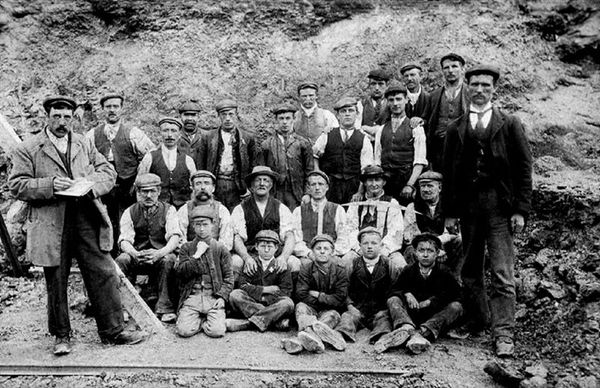
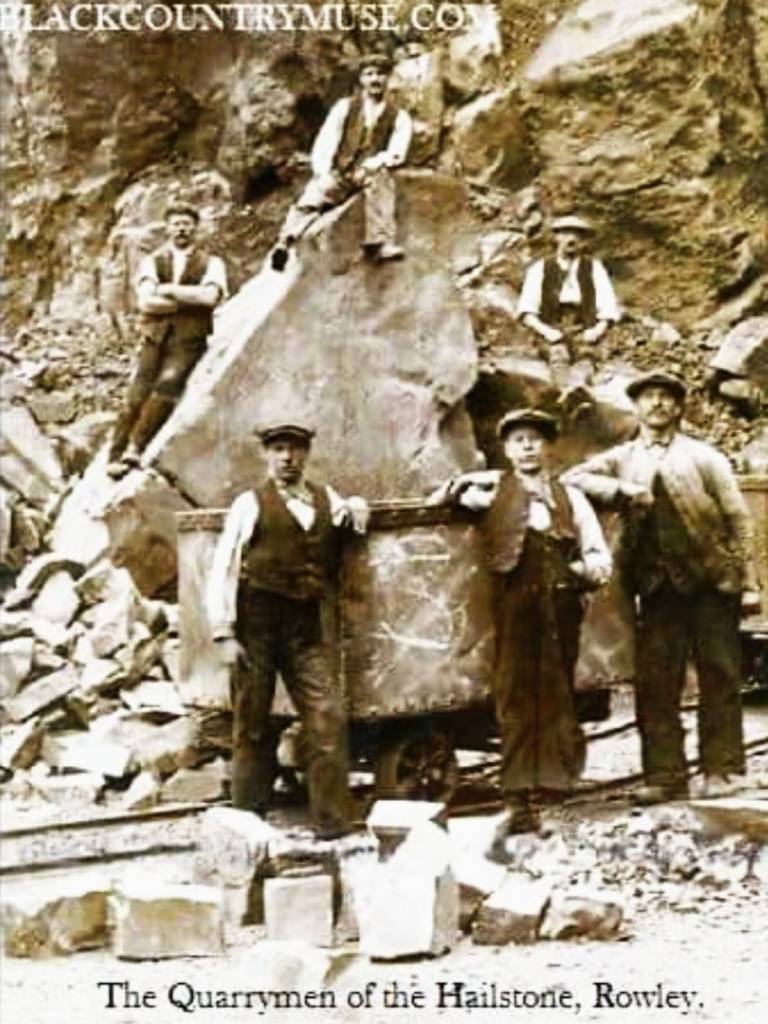
It seems likely to me that, since Henry worked in the quarry for at least forty years, he may appear on some of the numerous photographs of quarry workers which are in various books and online. Alas, I have no way of identifying him if so but perhaps some members of the Redfern family might recognise a family likeness. Do tell if you can!

Younger children of Joseph and Ann Maria Redfern

Solomon Redfern 1841-1928

Solomon stayed in the hamlets all of his life, working in the quarry. He married Mary Ann Mole of the Club Buildings, Hawes Lane, on 8 Feb 1863 at St Giles when he was 21 and she was 22. They initially lived in Hawes Lane, possibly at the Club Buildings but by 1881 they were back in Perrys Lake where they stayed for the rest of their lives. In the 1901 Census, the address is given as Hailstone Quarry, following on from Perrys Lake in the list so perhaps they were further up the hill, actually within the quarry. Family members may be able to tell me this.

Solomon’s children:

Solomon and Mary Ann had six children that I know of.  These were William (1863-1863), Ann (1864-1948), Alfred (1866-1940), Edward (1868-1871), William (1872-1956) and Samuel (1876-?).

Of those children, the first William died aged 15 weeks, sadly not unusual in those days.

Ann (1864-1948) married Eli Eades at Reddal Hill church on 19 Dec 1891. They had three children, Annie in 1893, William G in 1895 and Jesse in 1901. Eli Eades was a draper and died in 1023. William appears to have followed him into this trade and they may have had a shop in Long Lane, somewhere in the area of Shell Corner. Ann lived on until 1948.

Alfred (1886-1940) stayed in Perrys Lake in Rowley, marrying Kate or Catherine Whithall, also of Perrys Lake on 25 Dec 1887 at St Lukes, Cradley Heath.  He appears to have worked at the quarry for his whole life and they lived at 12 Perrys Lake but had no children. He died in 1940 and Catherine died in 1954.

Edward (1868-1871) had died at the age of three and was buried on 12 Nov 1871 at St Giles, Rowley Regis.

William moved to Threlkeld in Cumberland to work in the quarry there, at some point between 1891 when the census shows that he was still in Perry’s Lake and 1900 when he married Sarah Ann Airey in Threlkeld. They had five children – Ernest in 1901, Edith in 1902, Alfred in 1903, Mildred in 1907 and Annie in 1909. By 1939, William and Sarah had moved to Langcliffe, Craven where William still gave his occupation as a Limestone quarryman. Their son Alfred lived next door but one with his family, he was also a quarryman.  William died in 1956 and Sarah in 1957, they are buried together in Langcliffe, Craven District, North Yorkshire, England.

I could at first find no trace of Solomon’s youngest child Samuel after 1901 when he was still living at home. None of the online family trees had any further information on him either. He did not appear to have died between 1901 and 1939 in the UK, he did not die in the First World War, I could not find him in the 1911 or 1921 Censuses . Did he start using another name? Did he emigrate?

But I think I have now found him. The 1939 Register, (which was not a census but a listing of the whole population taken by the Government just before the Second World War and which was to be the basis of rationing and later used by the NHS, ) is a useful source as it shows dates of birth, addresses, implied family groups, occupations but not places of birth. Many newer entries are redacted, blacked out for 100 years from their date of birth because those people are or are assumed to be still alive, although people who have died can be opened up. But I could search the Register for the whole country for a Samuel Redfern born in 1876. There were six Samuel Redferns in the whole of England and Wales in 1939 who had been born between 1875 and 1877. Of these most were in Derbyshire or Cumberland. But one was in the Cockermouth area, where, as I showed in a previous post, quite a number of Rowley quarry workers had settled, recruited by the quarries there for their sett making skills. Those had included William Redfern, Samuel’s brother who had settled in the Threlkeld area.  

It appears that Samuel had followed his older brother up to Cumberland, he had married in the Cockermouth area in 1908 to Mary Elizabeth Charters and they had two children William Lawrence in 1909 and Mary Frances in 1911. In 1939 Samuel was living in Rakefoot, Embleton, Northumbria with his wife and daughter, his occupation was given as a Roadstone Quarry Worker – the granite connection again! Using this information I was then able to find the family in the 1911 Census in Wythop Mill Nr Cockermouth and in Tile Kiln Cottage, Arlecdon, Cumberland in the 1921 Census, Samuel always working in quarries.

John Redfern 1844-1929

John was living at 26 Rowley Village in 1911, with his two daughters Ann Maria 1871- and Phoebe 1880.  He had married Leah Tromans on 24 December 1865 at Dudley St Thomas and states in the 1911 Census that they had had 8 children of whom only four were still alive in 1911. I can only find the birth registrations for six children between their marriage in 1865 and 1890, the last child I can find was John, born in 1883. The first two children Martha (1866-1866) and Sarah Ann (1868-1868) had both died in their first months and were buried in St Giles. It is possible that there were another two stillbirths which would not be registered but which would still be counted by the family as their children.

Some of the trees on Ancestry have a photograph of a farm called Upper House Farm, Wolferlow in Herefordshire, attached to the information about this John, stating that John farmed there with his son John before returning to Ockbrook, Derby and Stanley, Derbyshire where the family had originated from, a Moravian settlement , where John’s grandfather German Redfern had lived.

This may be possible and may come from family information, since the trees are those of Redferns. However, this may not have been over a prolonged time period as both John and his son John are in the Rowley and Blackheath area for all of the censuses that I have been able to find and all of their children were born in the area.  John the older died in Rowley Regis in 1948. Neither of them appears to have any farming experience from their listed occupations which does not necessarily preclude a period of farming, family members may be able to explain how this came about. There were certainly Redferns farming in Wimborne, Dorset but I have not looked at the Derby Redferns in any detail. His father was given as John Redfern, a labourer and hers as Joseph Stokes, deceased, also a labourer. The witnesses were Joseph Stokes and Jane Hadley.

Leah Redfern died in 1905 and was buried on 17 Aug 1905 at St Giles, aged 58. John Redfern , of 26 Rowley Village, where he had lived with his family for many years, died in 1929, aged 85 and was buried at St Giles on 4 Mar 1929.

John’s children

John and Leah’s known surviving  children were Ann Maria born 1871, Joseph born 1875, Phoebe born 1880 and John born 1882.

Ann Maria 1871-1955, Phoebe 1880-1955

Neither Ann Maria or  Phoebe married and they lived in Rowley Village with their father until his death in 1929, after which they appear to have continued to live together in the same house. Online family trees record that Phoebe died on 9 February 1955 aged 75 and Ann Maria died only a few days later on the 17th, aged 84. Whereas Ann Maria seems to have taken care of domestic life for the family, Phoebe worked, in 1901 as a Nail Bag Maker, in 1911 as a ‘counter of nuts and bolts’ in Rowley, in 1921 as a ‘weigher of nuts and bolts’ at T W Lenches in Ross, and in 1939 as a ‘checker of nuts and bolts’ so it appears likely that she worked at Lenches all her life.

Joseph Redfern 1875-1943

Joseph married Eliza Stokes at St Paul’s Church, Blackheath on 22 Apr 1895. He was 21, a labourer and gave his abode as 74 Halesowen Street while Eliza was also 21 and gave hers as 97 Halesowen Street.  They had at least seven children and in 1911 were living at 91 Rowley Village. He was then working as a Brick Kiln Labourer. Their children were Joseph (1896), Ethel (1899), Doris (1902), May (1905), Leonard (1908) and Lily (1910) and Annie (1912). In 1901, the family were living in Rowley Village and Joseph was working as a labourer at the Cement Works; in 1911 they were at 91 Rowley Village, and Joseph was working as a Brick Kiln Burner; in 1921, still living at 91, Rowley Village, Joseph was working as a Yard Labourer at T W Lenches. The 1939 Register shows Joseph living at 6 Limes Avenue, Blackheath and working as a Works Watchman. With him is his daughter Ethel with her husband Thomas Astley, and Joseph’s youngest daughter Annie.

Although Joseph is noted as a Widower in the 1939 Register, Eliza appears still to be alive and she is listed in the 1939 Register in the Staffordshire Mental Hospital near Stafford, she lived until 1957 by which time she was back in Rowley Regis. There may have been an assumption that Joseph was a widower on the part of the person completing the 1939 Register as Joseph was living alone in Limes Avenue. Joseph died in December 1943 and was buried on 18 Dec 1943 at St Giles, Eliza in 1957.

John Redfern 1882-1948

John married Annie Crumpton in about 1906, in the Stourbridge Registration District. They went on to have at least nine children – Leah – 1906-1906, Percy in 1907, Lily in 1910, Phoebe in 1913, John in 1915, Arthur James in 1919, Harry in 1922, Hilda in 1924 and Stanley in 1928. The family lived in various roads in Blackheath and John was at times a labourer but in 1921, a storekeeper at British Thompson Houston. In 1939, the family were living in Grange Road and John was listed as a general labourer and also as an Air Raid Warden. Annie died in 1947 and John died in 1948.

So all of John and Annie’s  children stayed in the Rowley and Blackheath area for the rest of their lives.

Samuel Redfern

Samuel Redfern 1845-1911

Samuel was the youngest child of Joseph and Ann Maria and by 1861, at 15 years of age he was already a labourer, still living at home with his parents on Turners Hill. In 1871 he was again still living at home and both Samuel and his father were described as Furnace Labourers. In 1891, Samuel appears to have been a patient in the North Lonsdale Hospital, Barrow in Furness where he was described as a ‘Stoker at the Steelworks’. Yet another instance of Rowley men moving up to the North for work, in this case in the steel industry, rather than quarries. But he did, after all, come from a family where many of the men were furnace workers.

After that, records become sparse for Samuel. In 1901 he is still in Barrow in Furness living with his wife Sarah, formerly Hartley and a son named in the census as Henry H Redfern, Samuel’s occupation given as a Steelworks labourer. Samuel and Sarah had been married in Barrow in Furness in 1896. But there is no birth registration for a Henry Redfern in this area in 1882, I suspect that Henry was actually, as so often in those days, put down as Redfern because that was the name of the head of the household and he was actually Henry Hartley, that Sarah was a widow at the time of her marriage to Samuel and Henry was one of three sons of that previous marriage. And there is a Birth Registration for a Henry Hartley in Barrow in Furness in 1882 and a Henry Hartley appears in the 1911 Census in Barrow in Furness, too. So I do not think Henry was Samuel’s son.  

Samuel appears to have died in Barrow in Furness in the early months of 1911. His widow Sarah remarried in 1912.

Redfern Overview

Any errors in this research are all my own, corrections welcome. I have looked at Redfern Trees online and sometimes used those to guide me to additional information (I have said so where I have done this) but generally I have only included information where I can confirm information and sources.

So although I have not gone any further back from Joseph and Ann Maria in that first 1841 census, in two generations they had between them 11 children and at least 54 grandchildren in the Rowley area or within a few miles, shown on this screenshot here (of the Redfern part of my own family tree – Joseph is the paternal grandfather of the husband of my 1st cousin 3x removed, so not exactly closely related!). 
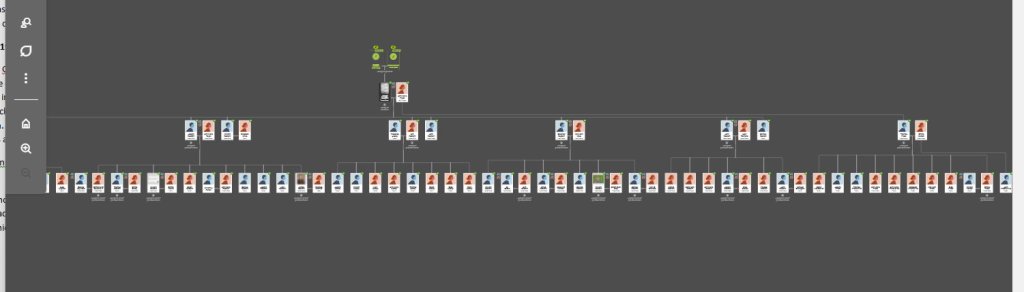
Copyright: Glenys Sykes, all rights reserved.

The screenshot is, I’m afraid, much too small for you to read the details but Joseph and Ann maria are at the top just under those little green symbols. And I couldn’t even get all of the grandchildren on the screen, too many of them, the tree is too wide but it gives an idea of how big their family was! And the majority of them stayed in the Rowley and Blackheath area, although a few went North, no wonder there are still many Redferns in the area today.

There are several Redfern family trees on Ancestry and the Redfern Family website https://redfernsworldwide.com/   and One Name Study which I mentioned in my last article so plenty of opportunities for co-operative researching!

More family studies from the Lost Hamlets coming in due course!

The Redfern Family in the Lost Hamlets 1

The 1841 Census for the Lost Hamlets has one family of RedfernsJoseph Redfern was living on Turners Hill, a labourer, with his age given as 35. His wife Maria (sometimes Ann Maria), nee Priest, has her age as 40. Joseph and Maria appear to have been married at Tipton on 16 Jul 1827. Maria sometimes used Ann Maria and sometimes Maria, in records throughout her life. Their children Sarah aged 12, Eliza aged 10, Joseph aged 8, William, aged 6 and Ann, aged 4 completed the family, all of the children were born in Rowley Regis.

In later censuses, Joseph gave his age as 48 in 1851, giving a birth year of about 1803. I can find no baptism for a Joseph Redfern in the area in that year, so it is possible that he was born elsewhere, though he consistently says in censuses that he was born in Rowley Regis. Another possibility is that he was baptised in a non-conformist chapel. Certainly, the Priest family into which he married had very strong connections with the Presbyterian Chapel in Cradley Heath which was also in the parish of Rowley Regis.

Maria or Ann Maria gives her age in 1851 as 50 which gives her birth year of 1801. The only baptism I can find for this period of a likely Ann Maria is Maria, the daughter of Cornelius and Mary Priest of Bournbrook , Cradley Heath who was baptised at St Giles, Rowley Regis on 4 Oct 1801. But this is by no means certain, there may be another baptism somewhere that I have simply not been able to find.

The fact that Joseph and Maria were married in Tipton perhaps argues that she was not connected to the Cradley Heath Priests but I cannot find another Maria or Ann Maria baptised in the Tipton area either. And since Maria had had a baby out of wedlock, it seems possible that her family sent her to stay with relatives in Rowley to hide the shame for the family (possibly their view, not mine!). And it seems that David Priest , living with his family in Gadds Green in 1841 was born in Cradley Heath and directly related to the Priest families there so they would have been known to each other and were probably related.

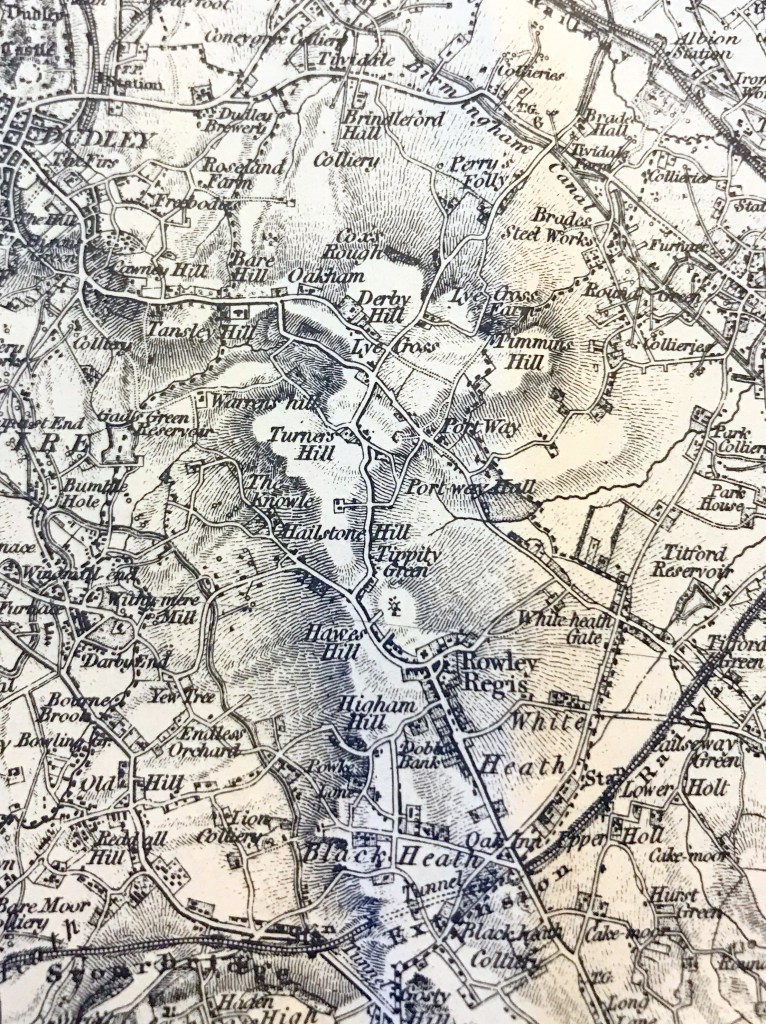
At various points Joseph gives his occupation as a labourer or a furnace man or a furnace labourer. This seems to have been a common occupation for the Redferns as at least two of his sons were also furnace labourers. In 1856, at his son Joseph’s marriage his occupation was given as a Blast Furnace man. One census entry notes that he is a furnace labourer in a coal mine (fires were kept burning at the bottom of shafts to pull air through the mines and reduce the build-up of explosive gases) but others were noted as Blast Furnace labourers, a very different job. I am unsure where the nearest blast furnaces were to Turner’s Hill, possibly at Tividale/Tipton where there were extensive iron works and at least three furnaces shown on the 1st Edition OS Map though there were almost certainly others in the area including Brades where a furnace is also shown. If Joseph was working at the iron works in the Tividale/Tipton area, this may account for the marriage at Tipton church.

Ist Edition OS Map, copyright David & Charles, surveyed about 1830. Several furnaces and iron works are shown on this map including ones at Tipton and Dudley Port, also at Brades.

Ann Maria

The name Ann Maria is used frequently in the family from this point on, often, it appears, with the name Maria being used day to day. Almost all Joseph and Ann Maria’s children and many of their grandchildren named one of their daughters Ann Maria so they are liberally scattered around the family tree!

Are they on my family tree?

Yet again, having thought when I started this study that I had no connections with the Redferns, I now find that I have two, so far, as Cornelius Priest was already in my family tree!  I suspect that the more I look in detail at the families in the Lost Hamlets, the more I shall find that my lines are married into them at some point, sometimes several points, perhaps a natural result of them living in such small communities with limited contact with other communities.  So yes, they are on my tree!

Who was Thomas Priest?

Thomas Priest, aged 15 was also living with the Redfern family on Turners Hill. The 1841 Census does not show relationships within households. Thomas was baptised at Dudley St Thomas on 26 Mar 1826, the son of Ann Maria Priest and there is no name shown in the Register for the father so he was probably illegitimate. Joseph and Ann Maria were married in July 1827, fifteen months later so this was certainly not a hasty marriage shortly before or after Thomas’s birth. There are several family trees on Ancestry which suggest that this Thomas was the illegitimate son of Ann Maria and Joseph, born before they were married.

My expert consultant on such issues agreed with me however that, at this time, when parents of an illegitimate child subsequently married, that child usually then became known by the father’s name and is shown in sequence in censuses as the oldest child whereas step children tend to be listed after full children. Since Thomas is shown at the end of the household in 1841, and with the name Priest, not Redfern, and after Joseph and Ann Maria’s other younger children, I suspect that he was not Joseph Redfern’s child but a stepson. It was very common at that time for stepchildren to use their stepfather’s surname or to swap between the two names so the later use of the Redfern name is not conclusive. The only document I can find which lists Thomas as Priest is the 1861 Census when Thomas was living in between his stepfather and stepbrother. I suspect that the enumerator knew that Thomas had grown up in the Redfern household and perhaps thought of him as a Redfern so that the use here is an enumerator error. Certainly all of Thomas’s children were registered as Priest, not Redfern.

At his own marriage to Emma Moreton in 1850, at Dudley St Thomas, Thomas gave the name of his father as Joseph Priest, a Furnaceman, not Joseph Redfern – although he was also a Furnaceman!

There was at least one Joseph Priest in the area who is of about the right age and could have been this man but although there was one family of Priests at Finger i’ the hole in 1841 there is no Joseph listed there and other Priest families appeared to have been in Blackheath and especially in Cradley Heath (which is also where I theorise that Maria’s family were living). It is also possible that the priest asked ‘What is your father’s name and Thomas replied ‘Joseph’ and this was attached to Thomas’s surname of Priest so that gave Joseph Priest. Or Thomas may simply have invented a father’s name, rather than have that space empty, thus showing that he was illegitimate, something that genealogists find is not uncommon with illegitimate children.

A DNA test might prove the final answer to this, perhaps the current members of the Redfern family have done this and established the answer to their satisfaction!

Certainly in later years, Thomas remained in the hamlets, at one stage he and his family were living next door to other members of the Redfern family for several decades.

I shall do a separate post about the Priest family.

Where had the Redferns come from?

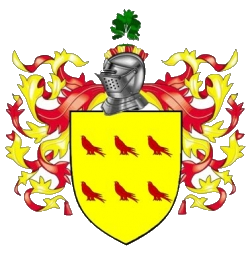
One of the crests associated with the Redfern family, courtesy of Andrew Redfern.

Wikipedia suggests that Redfern is an English surname of French Norman origin. It originally appeared as De Redeven.

The first Redfern mentioned in the St Giles’s Parish Registers is the baptism of Ann, the daughter of William and Sarah Redfern on 9th December 1792, followed by John, their son on 20 May 1798. This John must have died, (although I cannot find a burial for him), as another John was baptised to William and Sarah on 11 Jul 1802.

In 1813,Elizabeth, daughter of William (a farmer) and Sarah Redfern of Piddocks Green, Rowley Regis was baptised on 5th August, in June 1815 Edward, son of William and Sarah of Plants Green, farmer,  was baptised . Plants Green was certainly in the Old Hill/Cradley Heath area but I do not know where Piddocks Green was, it may well have been the same place, place names were sometimes quite flexible.

On 19th January 1817 Henry Smith Redfern, base born son of Mary Redfern of Turner’s Hill was baptised (there may just be a clue as to the identity of his father there, although I haven’t looked any further into that!).

On 15th July 1821, William, son of John and Mary Redfern of Turners Hill, a nailer, was baptised, followed by sister Rebekah on 7 September 1823. On 25 September 1825 Joseph, son of John and Mary, now described as a labourer and of Lye Cross was baptised. On 9 Mar 1828 Mary Ann Redfern of Lye Cross, died, aged 28 of Fever.

On 4 December 1832 Esther Redfern of Mincing Lane, aged 30, died of diabetes.

On 7 Jul 1833 Elizabeth Redfern of Dudley Wood was buried, aged 27, having died of decline.

On 16 Oct 1839, John Redfern of Turners Hill, aged 9 months died of measles.

On 13 February 1848, Harriet, daughter of William (a miner) and Ann Redfern of Portway was baptised.

On 2 December 1849, William Redfern of Turners Hill was buried, aged 81, the cause of death being given as Old age.

So clearly there were Redferns in the area, including Turner’s Hill and Lye Cross as early as 1821.

Both Joseph and Ann Redfern give their place of birth consistently in all censuses as Rowley Regis. And yet, I cannot find baptism for a Joseph Redfern in Rowley or in the surrounding area.

At least some of Joseph and Ann Maria’s children were baptised at Dudley St Thomas, Joseph and Eliza both on 12 Aug 1832, with Joseph’s occupation given as a Furnaceman and their abode as Rowley Regis. William was baptised there on 2 Jul 1837 and Ann Maria was baptised the same day.

Also at St Thomas, John, son of John (another Furnaceman) and Mary Redfern of Portway, was baptised there on 18 Oct 1835.

So it appears that these Redferns moved between St Thomas at Dudley and St Giles at Rowley, which seems to be quite common for families living in this area. And there were Redferns scattered around both Rowley and the wider neighbourhood after about 1790.

To muddy the waters, Solomon (one of Joseph and Ann Maria’s later children, to be covered in a later post) appears to be a Redfern family name. There are Solomon Redferns in Stockport in Cheshire in 1866 and in Meltham near Huddersfield in 1852, though that name is spelled Redfearn.  And in Denton, Lancashire in 1866. Although all of these Solomons were married to a Mary so it is possible that they are all the same person, moving around!

Online trees trace Joseph’s birth to Stanley in Derbyshire, but I have not investigated this possibility any further, since Joseph himself believed that he had been born in Rowley Regis and there were certainly Redferns in the area at that time.

So this is the Redferns in the Lost Hamlets in the 1841 Census. Since this is such a short piece, I will add some details about:

Joseph and Maria’s older children (those listed in the 1841 Census)

Sarah Redfern 1829-1885

The oldest daughter Sarah, who was aged 12 in 1841 was no longer in the household by 1851. In fact she was living at 84 Snow Hill, Birmingham where she was a servant in the household of Josiah Blackwell, who was a grocer. She was described as a House Servant but there were also three other Assistant Grocers living in so there would have been plenty to keep her busy. Snow Hill Station was, of course, the Birmingham Station familiar to those of us who used the train into Birmingham, that trains from Rowley and Blackheath later ran in to on the Great Western line but the station was not built until 1852 so it was not open when Sarah was working there. But a long row of shops remained long afterwards, running down the hill. Rowley Regis and Blackheath Station did not open until 1867! But even without the busy station that Snow Hill became later, there must have been quite a contrast between the rural outlook of Turners Hill and the increasingly busy city of Birmingham.

On 25 Dec 1854 Sarah Redfern was to marry William Damby or Danby, a miner, at Dudley St. Thomas.

Her father Joseph’s occupation then was given as a Furnace labourer and a Joseph Redfern was one of the  witnesses, possibly her brother Joseph who would have been 21 by this time but more likely to have been her father. Sarah and William had ten children, born in Cradley Heath and then The Knowle before William died at The Knowle in January 1873, aged only 41. He was buried in St Giles. By 1881 Sarah had moved to Dudley with the younger four of her children. Among the children of the couple were several with the recurring Redfern names, including Ann Maria (known as Maria) and a Solomon. Sarah died in December 1885, aged 58 and was buried on 20 Dec 1885 at St Giles, with her abode shown as 26 Cinder Bank, Netherton.

So Sarah does not appear in the hamlets after the 1841 Census, although at one later stage she was living at The Knowle, just around the corner from Lost hamlets.

Eliza Redfern – 1831-1909

The next daughter was Eliza, born in about 1831/2, and baptised on 12 August 1831 at Dudley St Thomas was still at home in 1851. On 15 Jun 1859 Eliza married Daniel Hughes at St. James Church Parish, Dudley, and the couple made their home in Dudley, where they had 5 children. Eliza died in September 1909. So Eliza only appears in the hamlets in one more Census, the 1851, before moving to Dudley.

Joseph Redfern 1833-1912

Joseph stayed firmly on Turners Hill, all his life, and married Ann Maria Taylor in 1856, another Ann Maria! Was she related? There were certainly Taylors living on Turners Hill so I shall check this out. Emma Redfern was born in the June qtr of 1854, but Joseph and Ann Maria did not marry until June 1856 so it is not known whether or not Emma was Joseph’s child. However, she was always described as his daughter on census returns and used the name Redfern until her marriage so she may have been. Joseph and Ann Maria went on to have Thomas in 1856, William in 1858, Sarah in 1860, Ann Maria in 1864, Samuel in 1866, Joseph in 1869, John in 1870 and James in 1873.

In 1861 there were three Redfern families living in a row on  Turners Hill, this Joseph, his brother (or half-brother) Thomas Priest/Redfern and his father. By 1871, Joseph was working as a labourer in a ‘potyard’, presumably Doulton’s factory. In his census entry in 1901, Joseph was, at 69, still working as a labourer in the stone quarry. In 1911, still at Turners Hill, he was noted as a pottery labourer but also Old Age Pensioner, a whole lifetime of hard physical labouring of one sort or another.  

He states in 1911 that his marriage had resulted in 9 children of whom only four were still alive. Ann Maria died in 1903, buried on 14 Jul 1903 and Joseph died in 1912. He was buried on 07 May 1912 at St Giles, his abode given as 3, Turners Hill.

William Redfern 1835-1917

William also stayed in the hamlets, living on Turners Hill until his marriage to Elizabeth While in Halesowen in 1871, when he moved to 6 Perry’s Lake where he stayed until his death in January 1917. William and Elizabeth had no children. William was a general labourer all his life, sometimes working at the pottery and his last census entry in 1911 he stated that he was an “Old Age Pensioner, Retired Labourer Moving Pipes”. William was buried at St Giles on 17 Feb 1917. Elizabeth died in 1926 and the entry in the Burial Register at St Giles says that she was ‘late of Perrys Lake’.

Ann Redfern 1838-1919

Ann Maria married Frederick Hadley in the Dudley Registration District in the last quarter of 1857, (although I only know this from GRO Index and have not yet found the marriage).  They lived in Lye Cross for a while before moving to Turners Hill and they had at least eight children: Joseph in 1859, William in 1861, Mary in 1863, Ann Maria in 1865, Thomas in 1868, Sarah in 1871, Eliza in 1877 and Ellen in 1881. They stayed living on Turners Hill, next door to Ann’s older brother Joseph until their last census entry in 1901. Frederick died in 1909 and was buried at St Giles on 31 Jul 1909. Ann died in 1919 and was buried at St Giles on 13 Mar 1919.

Thomas Priest or Redfern 1823-

Thomas was the illegitimate son of Ann Maria or Maria Priest, probably not the son of Joseph Redfern. He married Emma Morton on 10 June 1850 at Dudley St  Thomas. Emma had two children before this marriage, John in 1847 and Sarah in the March quarter of 1850. It is not clear whether these were Thomas’s children although they both subsequently used the Priest surname. Thomas and Emma had at least a further eight children: Joseph in 1854, Thomas in 1857, Ann Maria in 1858 (who died the same year), Ann Maria and Elizabeth (twins) in 1859, Mary in 1862, Eliza in 1865 and Emma in 1867. Emma, wife of Thomas died in 1895 and was buried on 04 Aug 1895 at St Giles.

Thomas Priest died in January 1905 and was buried on 19 Jan 1905 at St Giles, with his abode still given as 2 Turners Hill so he had lived there for nearly 50 years.  

So this is all relating to the Redfern family as they were shown in the 1841 Census. There were more children born to Joseph and Ann Maria later but I will cover them in another post.

The Redfern Family One Name Study

There is a website about the Redfern family which is linked to a Redfern One Name Study and this may be of interest and allow Redfern family members to join forces to compare their information. Andrew Redfern who runs the website and study would welcome contacts with members of the Redfern family wherever they are. Here is the link:

https://redfernsworldwide.com/

The Farms in the Lost Hamlets

As I have mentioned before, although the landscape around Rowley became industrialised and scarred by mining, clay extraction and quarrying, much of Turners Hill remained open countryside and in use for farming, supplying the local population with milk and eggs until well into the 20th century and much of the area on the hill is now being returned to a green condition as quarries are filled in.

There were several farms on the Rowley side of Turners Hill itself, and this post is principally about Freebodies Farm, Hailstone Farm and Turners Hill Farm with a mention of Lamb Farm, nearer to Portway Hall. To local people these farms were often known by the names of the farmers living there at the time but on maps their traditional name are usually shown.  Of the local farms, there were apparently at least four dairy farms in the area in the 1920s and 30s, run by the Monk, Richards, Merris and Skidmore families.

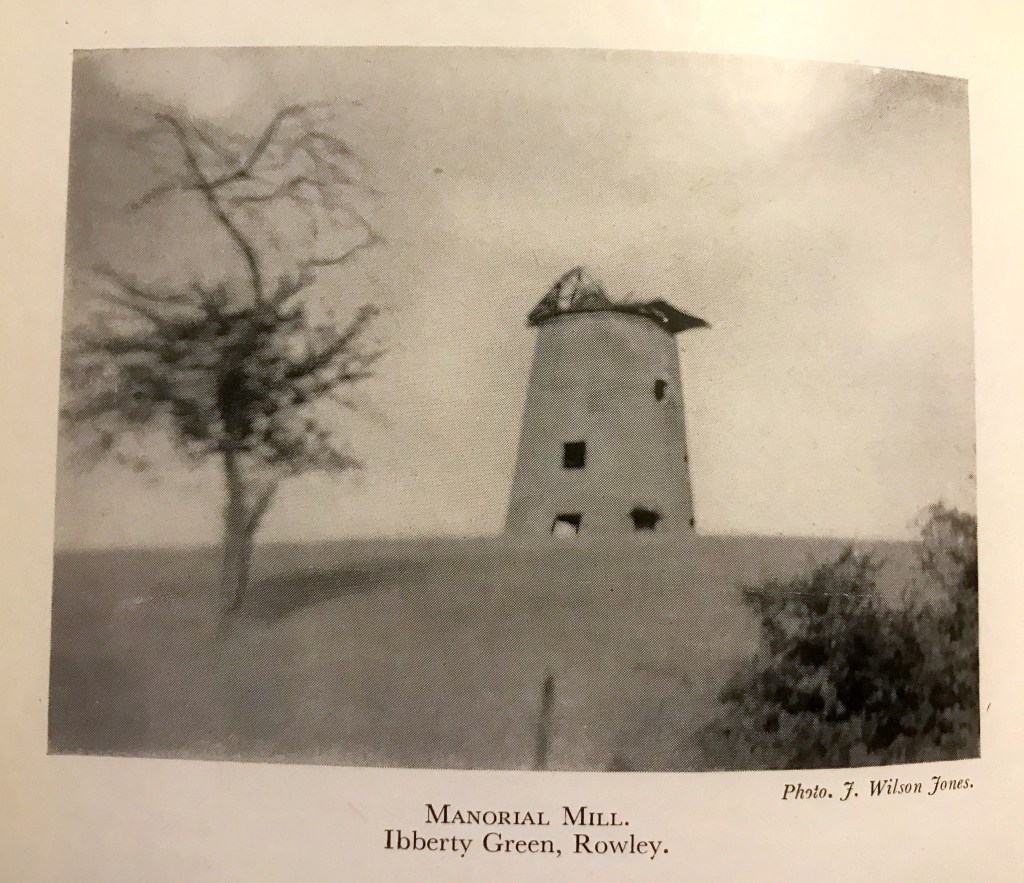
At an early stage there was a Mill or Windmill Farm at Tippity Green although this was not identified in the later censuses, it appears to have been on the site of the former parish windmill and this area was subsequently quarried away.

This photograph of the Ibberty (later Tippity) Manorial Mill appears in J Wilson Jone’s book, The History of the Black Country which was published in about 1950 although the date of the photograph is not known.

In 1841 Edward Alsop aged 60 was listed as a farmer at the Wind Mill Farm in Tippity Green, with his presumed wife and four children, plus a male servant. Next listed on the Census was Elizabeth Lewis, aged 40, an ironmonger, with her family and then Joseph Bowater who was a butcher and subsequent licensee of the Bulls Head so that is the correct area in Tippity Green. Neither the Alsop nor Lewis families are listed in the area by the time of the next census.

There was also a Knowle Farm but this is not quite within the area of the Lost Hamlets and I have not indexed the Census for this area.  

Also, the late Anthony Page has a picture in his first book on Rowley of Warren’s Hall Farm which was over the top of the hill on the Oakham Road, a large white house. It later also had riding stables and later still became a residential Nursing Home before being demolished and replaced by housing. Again, it is not quite within my study area and I have not indexed the census for this area.

Portway Farm, also slightly outside my study area, still exists though no longer in farming use, perhaps the only one of all these farms to have survived as a building to the present day.

The Censuses

The Censuses are not consistent about how the farms were recorded. Sometimes they were not listed by name. Where I have been able to identify the farms I have shown the results under details about each farm. To date I have only transcribed censuses for the Study area up to 1881. Later ones will follow in due course and I hope to upload the transcripts to a website for the Study at some point. 

Not all the censuses include the acreage farmed by each farm but where they do, they vary considerably from one census to the next which does not help with the identification process.

Where on Turners Hill were the farms?

I was very unclear until recently exactly where each of these farms was although I think I have them identified now. No doubt someone will help me out if I have this wrong!

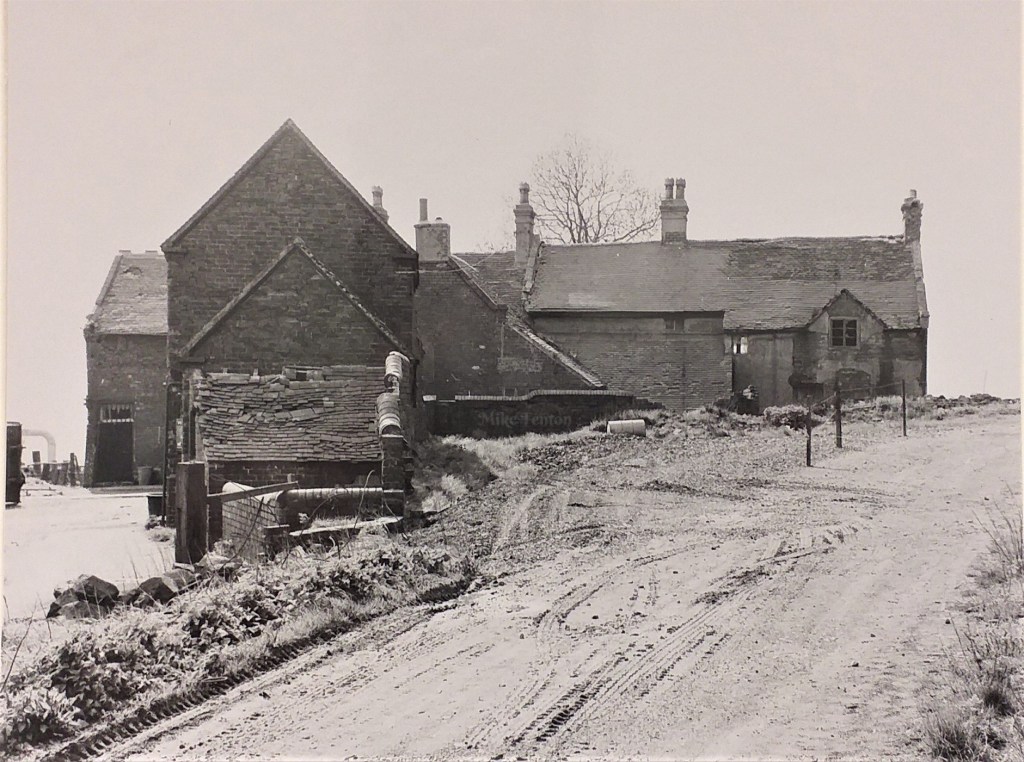
Freebodies Farm and Hailstone Farm were next to each other down a lane on the left off the Turners Hill Road, above the Hailstone quarry with the Hailstone Farmyard being at the end of the track in the area shown on OS maps as Gadds Green. Hailstone Farm occupied the two buildings shown on the left on this photograph and Freebodies the three buildings on the right.

The date of this photograph is not known (copyright also unknown but will be gladly acknowledged if informed) but the two farms are very much on the brink of the quarries so probably 1960s.

Turners Hill Farm was further up the hill, on the right.

Turners Hill Farm, 1969. Copyright: Mike Fenton

Many of the fields were divided not by hedges but by stone walls which is a very common practice in areas where there is a ready supply of stone for use, as in the Cotswolds and in the Yorkshire Dales. There were some hedges, though, because Reg Parsons who grew up at 2 Turners Hill in the late 1930s told me that his mother loved the wild sweet peas which grew in the hedges near there. He remembered Vera Cartwright with the milk cart which delivered daily to Blackheath, Whiteheath, Langley and Rowley Regis, seven days a week. Before the advent of milk bottles, milk in most parts of the country was taken round in churns and cans and the cans were taken into the customer’s house to be dispensed into their own jugs. This was not just in Rowley, my husband can remember, as a boy, helping his uncle with his milk round in Gloucester where the same system was used. He also said that the horse or pony would know the route and stopping places where they would wait patiently for the milk to be dispensed before moving on to the next stop.

Reg Parsons also remembered that there was a field below his home on Turners Hill which was used as an fuel dump in the Second World War, he remembers piles of Jerry Cans on concrete bases and also an anti-aircraft gun (known apparently as Big Bertha) near the Wheatsheaf pub. My mother used to be on fire watch sometimes during the war, with the St John’s Ambulance brigade and  she also remembered the gun there. Sarah notes that one of her grandfather’s fields was requisitioned by the army so this would have been for the fuel storage that Reg remembers and she also tells of family memories that during the war a German bomb landed on one of the fields killing a cow. And during air raids, the ponies pulling the milk carts had to be unharnessed in case they bolted, with all the potential loss of milk and vehicles. Later, in the 1950s, six caravans were put on the site which were lived in by local people.

Many people have mentioned their memories of the Cartwright family who farmed at Hailstone Farm on Turner’s Hill for many decades and who had a riding school, as well as the milk round. Sarah Thomas has written a fascinating book called Hailstone Farm about life on the farms there which she has published privately and, having come across my study online, she has very kindly sent me a copy but with the stipulation that she does not wish to have any of the contents to be put on social media. However, she tells me that she has deposited copies of the book in national and local archives so it would be well worth enquiring, if you are visiting local archives or perhaps Blackheath library, whether they hold a copy. Certainly Dudley Archives lists a copy and Sandwell Archives appear to but do not specify where it is held and it is not reservable through the library system. The book is full of photographs and pictures of documents and family memories and history. I will not be reproducing anything from it but it will inform me about the farms and where they were so that this study has a more accurate record of the farms and their ownership over recent years.

Freebodies Farm, Turner’s Hill

There has been, if not specifically a farm, then an area known as Freebodies on Turners Hill for centuries.

A Survey of English Place Names refers to it as an ‘early-attested site in the Parish of Dudley , a name of the manorial type, deriving from the family of Frebodi  found in Dudley in 1275 and 1327’. Bear in mind that for centuries the main route from Rowley to Dudley ran over Turners Hill so directly through the site where Freebodies Farm later was.  There was, may still be, an area of Dudley called Freebodies in the Kates Hill area of Dudley and the Freebodies Tavern was there until very recently.

The Morgan website has a large amount of well documented and referenced information on local families and the area and notes that a document in the Dudley Archives shows that there was a Deed Poll in about 1550 by a William Chambers Alias Ireland assigning ancient ecclesiastical land of the Priory of St John’s at Halesowen. A number of his descendants for the next 150 years appear in the local records of Rowley Regis and Dudley, using the names ‘Chambers alias Ireland’  These include intermarriages with the Darby family. The name Ireland is sometimes spelled ‘Ierland’ or ‘Yearland’. The same document demonstrates that they owned ex-monastic lands at Rowley called Freebodies, and this reference recurs in a number of later Darby wills. If you have Chambers/Irelands/Darbys or Cartwrights on your family tree it is well worth looking at this site https://www.morganfourman.com/  Sadly I have none of these names in my tree!

A survey by Lord Dudley’s Stewards in 1556 produced a rent roll in which William Ireland’s Freebodys, later called Freebury Farm is recorded, suggesting that it was established before the neighbouring Hailstone Farm.

A Will of John Chambers in 1870, implies that the farm on Turners Hill was originally part of the Freebodies estate. Certainly, John Chamber’s brother William was an executor of his will and was described as a farmer of Rowley Regis.

At other times it was known as Freebury Farm. Spelling was very variable in those days!

Censuses for Freebodies: At Freebodies Farm in 1841 were Josiah Parkes and his family (including Sophia Cole who was mentioned in my earlier article about the Cole families around Turners Hill, and one male and one female servant.

However, there is no mention of Freebodies in the 1861 Census nor any farmer listed in Gadds Green.  However, listed as Farmhouse, Turners Hill and as a farmer of 30 acres is William Smith, aged 54 with his wife Sarah and his Levett granddaughter, plus two servants. Was this Freebodies?

In 1871 there is no mention of Freebodies Farm but two households are listed as ‘adjoining Hailstone Farm’ – John Bradshaw, an agricultural labourer aged 26 with his wife and his 11 month old son plus his brother aged 21 and also an ag lab. The brothers had both been born in Haselor, Warwickshire and his wife in Solihull. Also described as living ‘adjoining Hailstone Farm’ was a blacksmith Henry Russell aged 33 with his wife and daughter. So both of these households were from outside the area. It is possible that the land of the two farms was being worked together and the farmhouse used to house either farm workers or tenants.

The next building listed is Brickhouse Farm which was some distance away in Cock Green on the Dudley Road and which was being farmed by the Levett family with one ag lab and one female servant. There is sometimes no accounting for the routes taken by census enumerators!

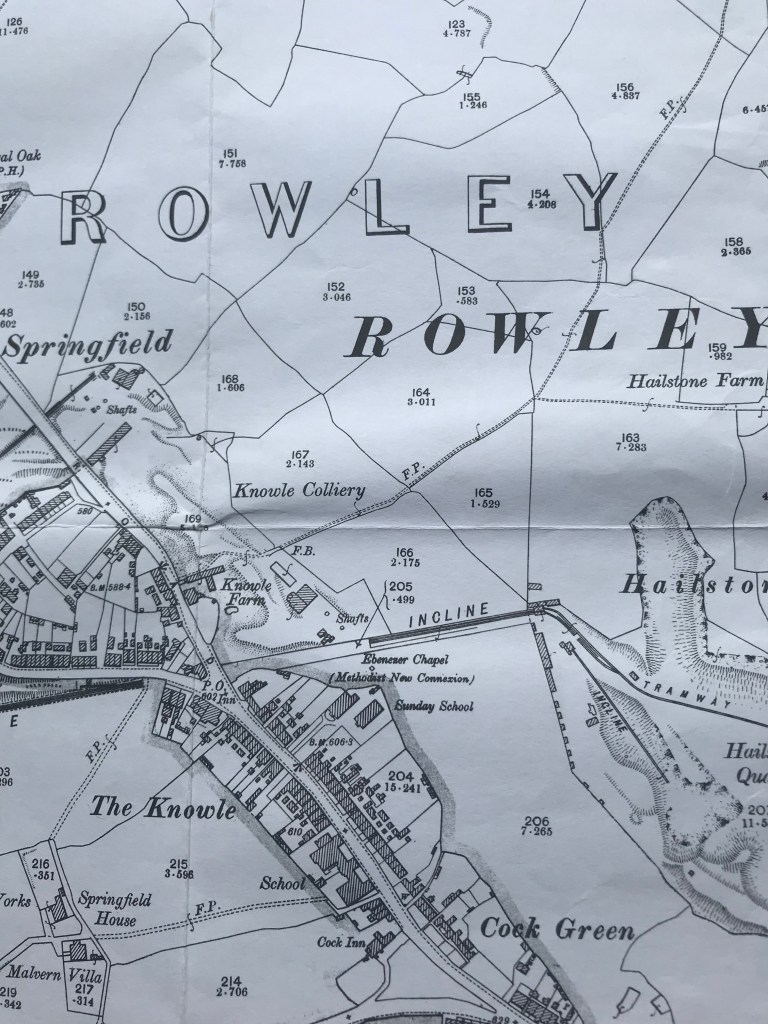
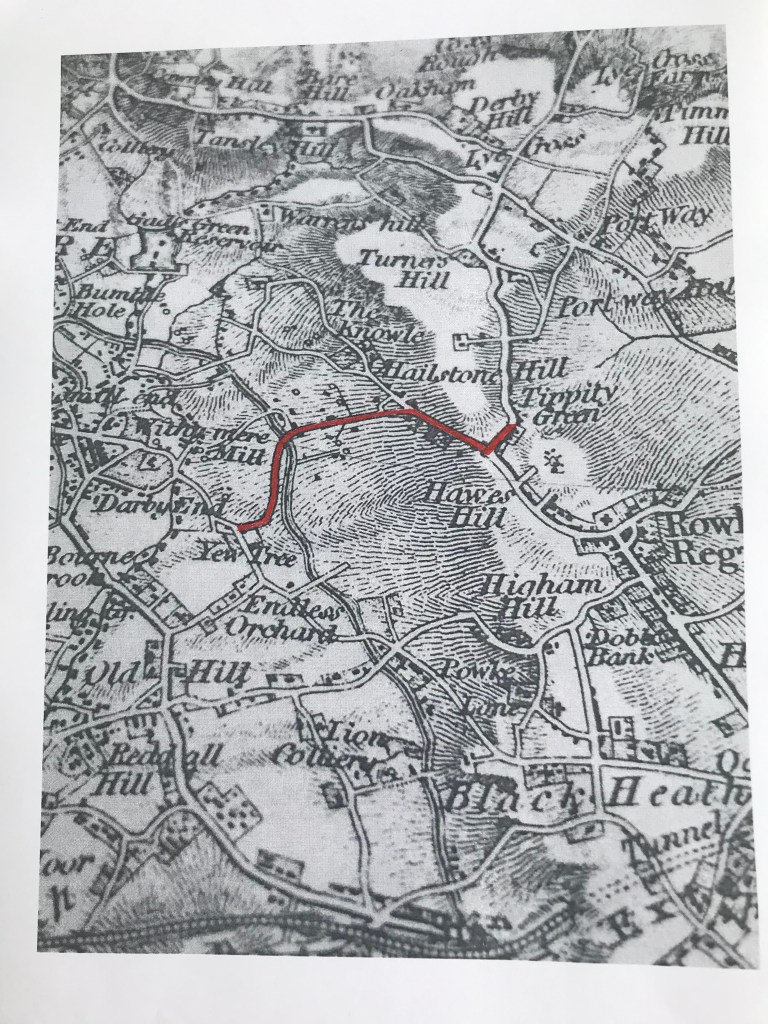
Or was there a well established path across the fields between Hailstone and the Dudley Road at Springfield which everyone used? This seems likely as Reg Parsons mentioned to me that his father, on his way home from work, would sometimes get off the bus at Springfield to buy something from the shop there and would then cut up over the  fields to home. This does seem more practical than the residents up on the hill always having to walk down to Perrys Lake, along Tippetty Green and to the Knowle that way. There is certainly a Footpath marked on the 1904 OS Map, here, running from Knowle Farm to Hailstone Farm and also further on up Turners Hill. .

Copyright: Alan Godfrey Maps

Hailstone Farm

A lease in Dudley Archives dated 1796 is for a lease of 21 years to Samuel Round, farmer, of  Hailstone Farm (a messuage called Freeberrys alias Fingerhold – that Finger ‘I the Hole popping up again!) so it seems likely that the farm was established by the late 1700s.

Sarah’s Cartwright grandfather had been born on Hailstone Farm but the family then moved elsewhere, again this makes me think of the information on the Morganfourman site that the Cartwrights were closely linked to this area as far back as the 1500s. He took over first Lamb Farm in 1912 and then Hailstone Farm in 1924 and ran their businesses from there, including the riding school established by Sarah’s mother and the milk round (which had originally been started in the early 1900s when the family were living at Lamb Farm), later taking on the tenancy of Freebodies in addition in 1932, subletting the house to tenants. In addition to the Riding School, there were some Gymkhanas there – much more detail about this and photographs in this article in the Black Country Bugle in 2019. https://www.pressreader.com/uk/black-country-bugle/20191106/281505048027440

Later part of the family moved to another farm at Bewdley and Sarah’s mother and father continued to live at Hailstone until the 1960s when the lease was terminated and the land taken back for quarrying.

There is much more detail in the book about the farms, their construction, plans, photographs, invoices etc from the business in the book, a real very personal record of a Rowley Farm in the 20th century.

Censuses for Hailstone Farm

In 1841, the farmer at Hailstone Farm was Samuel Round who was sixty, with three servants, possibly the Samuel Round mentioned above who was granted a lease in 1796 or possibly his son . I can find no trace of Hailstone Farm or the Round family in 1851.

In 1861, Keturah Round, a married lady of 54 was at Hailstone Farm with several children though no spouse and she is described as the Head of the household though not a widow. She had married Edwin Round in Dudley in the Sep qtr if 1854 and was previously Wheale.

In 1871 Hailstone Farm was occupied by Elizabeth Stickley, a widow with her occupation given as Farmer with her two sons John aged 37 and Thomas aged 27, both described as Farmer’s son, along with Ruth Lees, a servant but possibly also related to Elizabeth Stickley as her maiden name was Lees. In the previous census this family had farmed at Oatmeal Row, Cakemore, next door to some ancestors of mine!

In 1881, there is no mention of Hailstone Farm, and no farmer listed but there are three households listed as Hailstone Hill. Susan Jones, who was 50 and a widow was listed as an annuitant aged 33, born in Middlesex, as were the two young nieces living with her who were scholars. Her femail servant was born in Kingswinford. It is tempting to think that this was Hailstone Farm. One of the other houses was occupied by Joseph Hooper, a Farm labourer, aged 48 and born in Cleverley, Shropshire and his wife Ann aged 54, born Thame, Oxfordshire. The tenants in this area certainly almost all came from outside the area, it seems.   

Turners Hill Farm

Maps show Turners Hill Farm higher up Turners Hill from the other two farms and there is also a reference on some maps to Cloudland though not on recent maps.  There appears to be a large House there, too, Turners Hill House and sometimes the owners of this house were also described as farmers. It is possible, since there is evidence that the Downing family had other land in the area which they let out, that farming was not their principal occupation and that most of the land was farmed from Turners Hill Farm, rather than house.

Censuses for Turners Hill Farm/House

At Turners Hill in 1841 was Joseph Downing with his wife Nancy, son Isaac and two female servants.

By 1851 still on Turners Hill but with no name given for their residence was his widow Nancy Downing with their son Isaac, aged 35 who was a ‘proprietor of lands’ and three unmarried daughters, all described as annuitants, plus a Thomas Whitehouse who was probably Nancy Downing’s brother as her maiden name was Whitehouse. Thomas Whitehouse was a widower, and also a ‘proprietor of lands’ like his nephew.

By 1861 Isaac Downing was still living on Turners Hill, with his three sisters. This time he has given his occupation as “Principal occupation: general superintendence of the cultivation of land. “The Enumerator has added Farmer. But Stephen Parsons on Facebook commented that he remembers that in his time there was a large house on the right of Turners Hill Road which was Turners Hill House, and that Monks Lane ran below it which led to Monks Farm and the quarry. There was also an area in this location called Cloudland on some maps. So were the Downings perhaps  living at Turners Hill House but contracting out the farming? It seems likely. I was interested to see on the Facebook page that Linda George has receipts signed by Isaac Downing in 1855 and 1856 for the letting of a farm at Darby’s Hill to Samuel Cook so the Downing family may have had substantial land holdings around the area.

The Downing siblings, still all unmarried, were still on Turners Hill, in 1871, Isaac, now 55, described as Landowner and Farmer and also on Turners Hill and described as a farmer of 88 acres in 1871 is William Whitehouse, a widower, with his two teenage sons a female servant and a farm labourer. I note that a William Whitehouse had been one of the witnesses of Joseph Downing and Nancy Whitehouse in 1810 so may well have been an uncle or cousin to the Downings.  This census is the last one showing this Isaac Downing, as he died in November 1874 and was buried in St Giles.  

There was also listed in 1871, however, a farmer of 60 acres on Turners Hill, James Bridge aged 28 with his wife Anne, one female servant and one agricultural labourer so this may have been Turners Hill Farm. By 1861 Ann Bridge, now a widow aged  39 was the farmer at Turners Hill Farm, by now farming 40 acres and employing 2 labourers, a cowman and a waggoner.

By 1881, there is the family of Samuel Woodall, an Engineer and Iron Founder listed first under Turners HIll, probably at Turners Hill House. He was 35 and born in Dudley. His wife Mary was born in Birmingham. In addition his two brothers and a sister were also living with them, with three female domestic servants, again all born outside Rowley. I presume this was the house previously occupied by the Downings.

Listed at 5 Turners Hill was William Giles, aged 30 – a farmer of 70 acres employing one additional man. This presumably was Turners Hill Farm. He and his wife were born outside Rowley, though not a great distance, being from Kingswinford and Cakemore respectively.  Their elder two children aged 8 and 6 had been born in Enville, Staffordshire, the two younger aged 4 and 2 in Rowley Regis.  

The Parish Registers

The Chambers family

On 31 October 1544, Margrett, wife of William Chambers was buried, so there were already Chambers in Rowley at this date. In 1558 William Chambers was buried. Between the two dates three Chambers girls – Mary, Margaret and Agnes were all married at St Giles. The records from 1558 to 1566 are noted by the Vicar, Adam Jevenn, as being missing. (I wonder whether he was an early ancestor of the Jeavons families in Rowley and Blackheath?)

In 1575, Jone, as daughter of John Chambers was baptised and in 1602, John, son of Thomas.

On 12 Feb 1603, a child William was baptised, described as the son of Edward Shakespurre and Joane, d. of Christopher Chambers.  Freebodies is not mentioned but certainly Christopher Chambers was associated with Freebodies then .  In January 1641, Edward, son of William Chambers of Freebodies was baptised at St Giles, in 1744 another William Chambers of Freebodies was buried . Christopher Chambers was one of two people appointed in 1650, along with three others to be ‘Collectors for the poore’ which implies a certain social standing in the parish. At times, the Chambers used the name Irelands, too. Sometimes their abode is given as Churchend though it is not clear where this was. Certainly there were 152 Chambers entries in the Parish Register between 1539 and 1684 for baptisms and burials, 1539-1754 for marriages. On occasions Chambers were also churchwardens.

By 1723, with the burial of Elinor Chambers, widow,  her abode was shown as Ffreebodies. Another branch of the Chamber, however was at Brickhouse in 1724. In 1727, Christopher Chambers of ‘ye ffinger i’ the hole’ was buried. Another branch of the Chambers was described in a marriage in 1732 as ‘of Tividale’. So the Chambers seemed to be scattered right around Turners Hill over several centuries.  

The Downing family also had a long term presence on Turners Hill. The first Downing entry in the Registers is in 1644 when Robert, son of John Downing of Warrley was baptised, with  numerous entries after that, the first Isaac Downing (that we know of) being baptised at St Giles in 1672. In 1814 Isaac Downing, of Turners Hill was buried aged 75, having died of Asthma.

Back in 1722, Mary, wife of Isaac Downing ‘de ffox oak’ was buried but he appears to have remarried the following year and had a child Samuell  baptised at St Giles, with an Isaac Downing of Foxoak  being buried in 1727, probably not the same man but possibly related.

On 23rd July 1815, Isaac , son of Joseph and Nancy Downing, was baptised and Joseph’s occupation was given as a ‘Beast Leech’ – someone who treated sick animals. Joseph and Nancy were still on Turners Hill in the 1841 Census. A daughter  Mary Ann was baptised to them in 1818, followed by Lavinia in 1821 and Amelia in 1823. Another Isaac Downing was married to Elizabeth Nutt in 1815 so there were several Isaacs around then. Joseph Downing, originally a ‘beast leech’ and later a farmer died and was buried in St Giles on 2 Jan 1849.

Not all the Downings in the area were so well-to do – Mary Downing, aged 69 of Perry’s Lake was buried in April 1821, having died of cold. In 1823 William Downing, son of Joseph Downing a miner, died in the Poorhouse. In 1828 an Isaac Downing of Perrys Lake died aged 88 of natural decay so presumably there was some connection shown by the use of the name Isaac. There were also Downings in Mincing Lane, in Windmill End and in Portway, all apparently in labouring jobs of various sorts. By the 1840s another branch of Downings were living in Gorsty Hill and another in Waterfall Lane.  

Only the Downings on Turners Hill appear to have been wealthy and one wonders whether perhaps one child might have benefitted from a scholarship to the Old Swinford Hospital and been able subsequently to have gone into a profession which improved his circumstances. I would dearly love to find out a list of Rowley boys who attended that school!

Lamb Farm

Lamb Farm was, according to Roy Slim, in an article in the Black Country Bugle in 2021, a small farm adjacent to the Lion Farm which later gave its name to the Lion Farm Estate, near Whiteheath so slightly out of my main study area but included here as there were connections to Freebodies and Hailstone Farm . Roy says that the Throne Farm, farmed by the Skidmores, was much larger than either of them and I presume that the local roads with royal names were so named because they were on land formerly part of this farm. Throne Road, Throne Crescent, Queens Drive, Hanover Road, Tudor Road, Windsor Road, Stuart Road. And I am interested to see that some of the modern roads there, built where the quack was, also have names with Royal connections, Sandringham Drive, Palace Close, Majestic Way, with the Vikings, Celts, Druids, Goths, Romans and Saxons getting a mention, too!

After the Cartwrights moved to Hailstone Farm in 1924, Lamb Farm was let to various tenants, including Hawleys, Hewitts, Slims, Matthews and Skidmores. Roy Slim has also written about his family’s time there.

Lamb Farm was sold for development in 1945.

Local memories of the farms

On the ‘I remember Blackheath and Rowley Regis’ Facebook page, Raymond Kirkham remembered that he had known the farm halfway up Turners Hill as Cartwright Farm. This would have been Hailstone Farm, as at the time Raymond was growing up, the Cartwrights were working the area of both farms from Hailstone Farm and, although they leased Freebodies too and farmed the land, the house was let to tenants. He noted that the farm further up at the top of the hill was Monk Farm and this must have been Turners Hill Farm. He said that this whole area was his playground when he was growing up and his family got their eggs from the farm.

Ian Davies remembered Hailstone farm well, as he was related to the Cartwright family. Ian’s Geordie grandfather lived with the Cartwrights at Lamb farm, near Portway Hall, when he first moved south in the early 1900s. He remembers that by the 1950s George Cartwright had moved away to a farm near Bewdley and Hailstone Farm had been taken over by their daughter Vera and her husband George Thomas. George taught Ian to ride. The quarries were already threatening to swallow the farm back then. The narrow track from Turners Hill had quarries close on both sides. The farmhouse and top of the land were swallowed up by the Tarmac mega-quarry, The lower area stretching down to Springfield was used for housing.

Ian also remembered Lamb Farm which was on the left going down Throne Road, immediately after Portway Hall. He used to walk past the drive on the way to his grandparents’ house in Newbury Lane. He thinks that St Michael’s School was built on the land and that in the 1800s Portway Hall colliery was on the farm’s land and he thinks this was responsible for the subsidence that ultimately forced Portway Hall to be demolished.

Ian also kindly added a link on the Facebook page about memories of Blackheath and Rowley Regis to an article written by Sarah Thomas in the Black Country Bugle which appeared in Nov 2019, including various photographs.

https://www.pressreader.com/uk/black-country-bugle/20191106/281505048027440

There are obviously several family connections to the Cartwrights still in the area as Margaret Higgs said that George Cartwright was her father’s uncle, her grandmother was George Cartwright’s sister.

 Mark Northall  said that his father Frank Northall had worked at Cartwright’s farm as a lad.

Jill Watkins-Beavon had lived in Gadds Green which was the land opposite Hailstone farm, later her fmily lived in one of the four houses in the quarry.

William Perry remembered in 2018 that his father had told him that when he was young he would walk up Turners Hill to Cartwright’s (Hailstone) farm where they had a lovely horse that he used to stroke.

So this is all the information that I have found to date about the farms in the Lost Hamlets, all disappeared now into the quarry but helping to sustain the local populace in their time, and about the families who farmed them over the centuries. More information would be very welcome and this can be added, corrected or a further post done if sufficient additional information is found.

An accidental shooting in the Hamlets

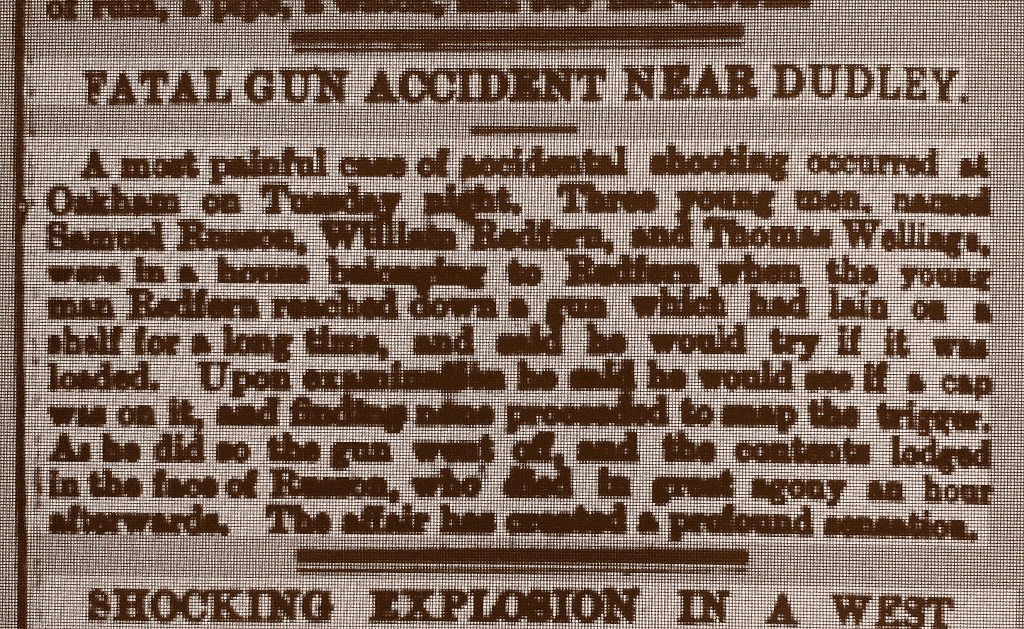
Life was not always without incident in the normally quiet hamlets. A brief report in the Wolverhampton Express and Star on 22 September 1876 tells of a “Fatal Gun Accident near Dudley” and goes on

“A most painful case of accidental shooting occurred at Oakham on Tuesday night. Three young  men, named Samuel Russon, William Redfern and Thomas Wellings, were in a house belonging to Redfern [or more accurately, it transpires, a house on Turner’s Hill and belonging to his father] when the young man Redfern reached down a gun which had lain on a shelf for a long time, and said he would try if it was loaded. Upon examination he said he would see of a cap was on it, and finding none proceeded to snap the trigger. As he did so, the gun went off and the contents lodged in the face of Russon, who died in great agony an hour afterwards. The affair has created a profound sensation.”

Copyright Wolverhampton Express and Star.

Samuel  Russon, aged 16, was buried on 24 Sep 1876 at St John (Kates Hill), his abode given as Oakham. Samuel was born on 20 Feb 1861, and baptised at Dudley St Thomas on 4 Aug 1861, the son of Joseph Russon and Elizabeth nee Poulton, of Cawney Hill. Joseph’s occupation then was given as a glass blower, possibly at Chance’s.

In the 1861 Census, Samuel was with his parents and his older brother William in Cawney Hill, living next to his maternal grandparents Benjamin and Rhoda Poulton. But Samuel’s father Joseph Russon died and was buried on 20 Dec 1868 at St John, Kates Hill, aged only 31.   In 1871 Samuel was living with his mother and brothers, William, and two younger brothers Joseph and Benjamin, still in Cawney Hill and still next door to his Poulton grandparents and his four uncles.

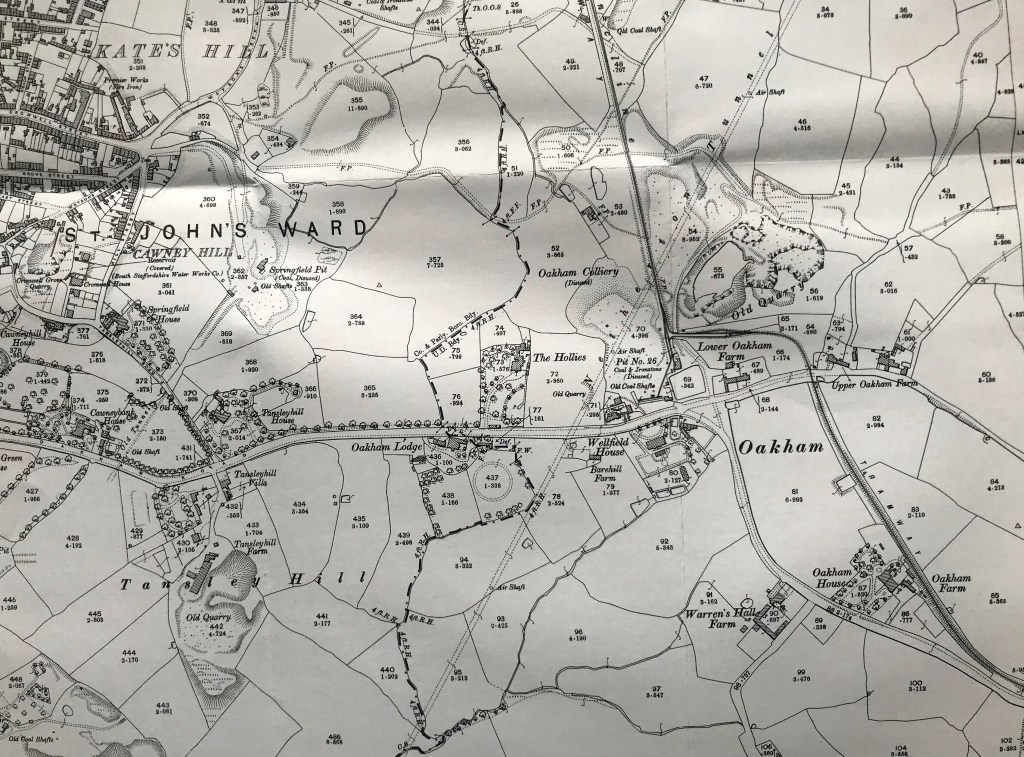
Copyright: Alan Godfrey Maps. Cawney Hill can be seen just under the printed heading St John’s Ward, top left, the map also shows the proximity to Oakham and, just to the right of the map, Turner’s Hill.

William Redfern had been baptised on 27 May 1860 at St Giles, the son of Joseph Redfern and Ann Maria nee Morris of Turner’s Hill. William was one of at least seven children.

Thomas Wellings was the son of Joseph and Harriet Wellings, born in Rowley Regis according to the 1871 Census at which time his family was living in Brades Road, Oldbury.  Although he was named in the newspaper report, he does not appear to have played any part in the incident, except that he was in the house at the time and he does not seem to have been called to give evidence at the inquest.

A longer account of the tragedy is given in the Dudley Herald on the 23rd September 1876 which reported on the Inquest which was held at The Wheatsheaf Inn, Oakham. Emmanuel Whitehall, a miner, gave evidence of identity as Samuel’s stepfather and he confirmed that Samuel was 16 and worked in a mine. He had seen Samuel at about half past five that evening. At about quarter past seven, he had gone to his mother’s house at Gadds Green, and, hearing an outcry he had gone to Joseph Redfern’s house on Turner’s Hill and found his stepson sitting on a chair bleeding heavily from his jaw and face.  He was told that Samuel had been shot by William Redfern.

Afterwards he asked what had happened and heard that Samuel had asked William to reach the gun down and he did, upon which he said he would see if there was anything in it, and through lifting up the hammer the accident was caused. He believed that it was entirely an accident and that William was not aware the gun was loaded. The gun used to hang over the screen and he had seen it there several times.

Samuel had not spoken after the accident. Mr Houghton, a surgeon of Dudley, had been sent for and his assistant was quickly in attendance but by that time, Samuel was dead.

Samuel’s mother Elizabeth gave evidence that Samuel had left home about seven o’clock on Tuesday evening and shortly afterwards she was told that he was dead. She had gone to the house but, although he was alive and knew her, he could not speak. She was also sure that it was an accident as the two boys had been such ‘excellent  friends‘.

William Redfern also gave evidence, saying that he lived at No.3 Turner’s Hill. Samuel had come for him to go out. Both of his parents were out but Thomas Wellings was in the house. As William was going out of the room to wash, Samuel had asked him to reach down the gun which was hanging up. The gun had hung there for a long time, as it was simply for protection of the house against robbers. At first he had told Samuel not to meddle with it but Samuel had said he would get it down himself. Upon that, William had got it down and pulled the hammer up to see if there was a cap on but as he could not see a cap, he let it down with its own force and it went off. At the time he was holding the gun with the muzzle towards Samuel who was sitting down only four or five feet away and the charge entered his right cheek. Neighbours had come to look after Samuel and William had run to Dudley for the doctor but by the time he got back, Samuel was dead.

William said that his father had not known that the gun was loaded but had cautioned his son against taking down the gun, and he said that he would not have taken it down if he had known it was loaded.

William’s father Joseph Redfern, a boat unloader, told the inquest that the gun produced was his and that as a rule it was not loaded. He did not know how it came to be loaded but the previous 5th November he had lent it to his eldest son to fire off [perhaps for Bonfire night] but his son did not remember leaving it loaded.  His son also said that he had not used any shot when he fired it in November.

The Coroner summed up the evidence and the jury returned a verdict of “Accidental death”.

What a terrible accident this was and how deeply affected all concerned must have been. Poor Elizabeth had lost her husband and now one of her sons. Imagine how William must have felt as he ran up and over the hill to Dudley to fetch medical help, though he must already have been in terror for his friend’s life. William, who was only sixteen himself, had accidentally caused the death of a close friend, and one would think that he may have carried a burden of guilt for this for the rest of his life, living as he did, close to Samuel’s family although it was clear from the Inquest that they knew this had been a terrible accident and did not appear to blame him.

William Redfern appears on my family tree in a very remote connection (he was the uncle of the wife of the stepson of my 2nd great-great-aunt Sophia Cole if you are really interested!)  and he married Emma Morris (who has the same surname as William’s mother so may well have been a cousin of some sort) three years later in 1879 and they had ten children. Living in Springfield Road, William was working at the stone quarry. Alas, William did not make old bones either and died of pneumonia in September 1901, aged only 43. He was buried at St Giles on 26 Sep 1901.

There are three family trees on Ancestry which include William, including one by a Redfern so it appears that some of William’s family have researched their family tree. I hope that, if they read this, they do not find it disrespectful as it is not intended to be but to recount the facts of an incident which must have very much affected these close knit local communities at the time.

The fascination of guns, particularly for boys and young men, seems a common theme in accidents of this sort, and such accidents seem to be going on even in the present day. But this was a very local tragedy involving the families of the Lost Hamlets and happening on Turners Hill. It must have remained in local memories for many years.

The Cole families in the Lost Hamlets

Sorting out the early Coles in the Rowley area is a bit like trying to knit with overcooked spaghetti. I think I have them sorted out and suddenly a strand slips and it all unravels.  Repeatedly. It isn’t helped at all that different branches use the same Christian names – Edward, John, Benjamin, William, Sarah, Fanny, ten a penny, they are!  

In the 1841 Census, there are seven Cole households in the hamlets or immediately adjacent. (Bear in mind when looking at these that in the 1841 Census adult ages were rounded down to the nearest five, though children were recorded with their actual ages. Supposedly, because occasionally adult’s actual ages are recorded).

Perry’s Lake

In the 1841 Census, there were a total of fourteen households in Perry’s Lake, of which three were Coles and one a married female Cole sister. It appears from the order in which they were listed that they did not live in a row but were within a very close distance of each other.  This is borne out by maps which show clusters of houses, sometimes appearing to be around a yard or close.

The sons of Edward Cole and his wife Phebe

Edward Cole Jnr, aged 30, was  baptised at St  Giles on 4 June 1811 so he actually was 30, the figure wasn’t rounded down. He was living with his wife Fanny/Frances (nee Smith),who had been baptised 13 Sep 1819 at St Giles, a daughter of William and Elizabeth Smith. Her age in the Census is shown as 20 but she was about 22) they are living in Perry’s Lake, with their two children William, aged 4 (baptised 17 Sep 1837 at St Giles) and Benjamin aged 1 (baptised 8 June 1840).

A few doors away, John Cole, is shown as aged 35. He was baptised on 20 Mar 1803 at St Giles so he was actually 38. He was living with his wife Sarah (nee Willetts), possibly the Sarah Willetts baptised at Dudley St Thomas in 1808 living with their six children. The children are Anne aged 12, baptised 19 Oct 1928 St Giles, Edward aged 10, John aged 8, Hannah aged 5 and Eliza aged 3. None of the children after Anne were baptised at St Giles or any other Anglican church that I can find. It seems very possible that they were Methodists as we know that there was a Methodist Chapel in Perry’s Lake from before 1840, so very possibly there at the time of their births. Although no records have been found for this chapel from this early date, The National Archives have a Non-Parochial Register dating from 1814-1824 showing baptisms for families from Rowley Regis which may have been performed by a visiting Methodist Minister or at Dudley which appears to have been his base.

Again, a few doors away, Benjamin Cole is shown as aged 30. He was baptised on 27 Jul 1806 at St Giles so was almost 35. , with his wife Phebe (nee Smith) and  their three children Eliza aged 8, Joseph aged 4 and Ann, aged 1. (Although Benjamin and Edward both married Smith girls they were not sisters, but may well have been cousins. I still have work to do on that line.)

These three are all nailers and are brothers, the sons of Edward Cole and his wife Phebe, nee Perry.  Edward had died in 1821, so there is no entry in this census for him. Phebe, his widow, remarried in 1839 to Thomas Lane and was living with him in Dudley in 1841, along with her youngest daughter Ann Cole

Edward Snr and Phebe had had seven children in all, four boys and three girls, two of whom had died as children.  In addition to the three sons listed above their daughter Mary, married to Henry Taylor, was also living in Perry’s Lake with their six children.

The family of John and Elenor/Nelly Cole

The Knowle

John (70) and Elenor/Nelly (70) Cole were at the Knowle in the 1841 Census, just round the corner from Tippity Green so not strictly within the Lost Hamlets but included here for completeness and to illustrate how close to one another they all lived.

John and Elenor had had five daughters and five sons, of whom at least three died in infancy, possibly more as I can find no trace of other children at present. 

Their son David was the farmer at Slack Hillock, of whom I have written previously on this blog. It was said at his inquest that David could not read the label on the bottle of mixture which poisoned him because it was the middle of the night and he had not lit a candle. But the important implication of that is that he could read.

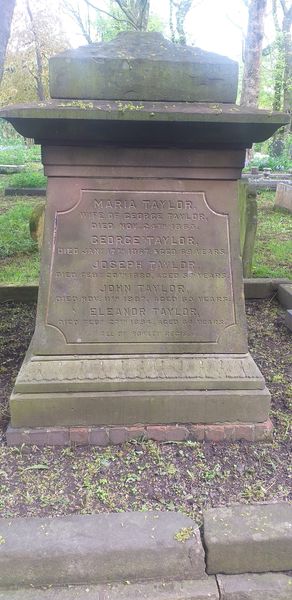
Their daughter Maria married George Taylor and lived in Rowley Village. There is a substantial memorial still in the St Giles churchyard to George and Maria and their children. George was variously described as a nail manufacturer (rather than nailer) and later he became the Relieving Officer for the village, later succeeded by his second son John. Of their seven children, only one William married and had children – although he did have eleven! The other children stayed living together in Rowley Village until the ends of their lives. More prosperous family members.

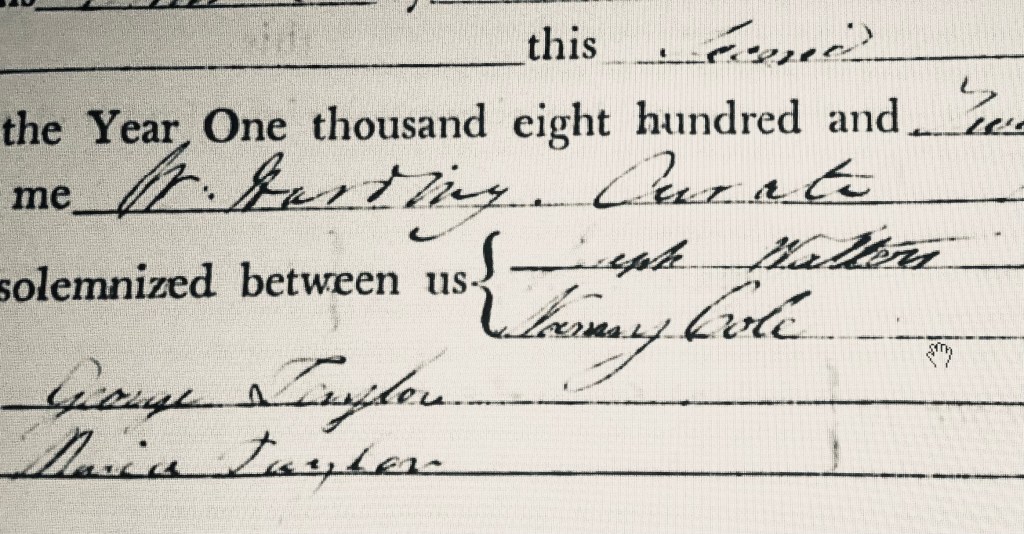
Their youngest daughter Nanny married Joseph Walters of Oldswinford and they lived in Lye, then Slack Hillock where Joseph farmed and kept the Sportsman and Railway pub, (according to Hitchmough) and finally Rowley village again where they both died. Was this the same farm that Nanny’s older brother David had farmed? I do not know but will try to find out. This is another prosperous couple and their sons kept pubs in Rowley Village later.

At their marriage in Harborne, both Nanny and Joseph signed the register and theirs are assured signatures, well practised curves and not awkwardly scribed as is often the case with people who do not write much.  Notice also that the witnesses are Nanny’s sister and brother-in-law George and Maria Taylor, showing that they too had practised signatures.

I wonder how they met? Did Joseph visit Rowley to buy nails through Nanny’s father? There have been previous indications with the Cole family that they may have been involved in shipping nails elsewhere and I think it is possible that they were more than simple nailmakers. Or did Nanny meet him when he rented a farm to her older brother? David died four years after the marriage so he was farming at Sleck Hillock at the time they would have met.

All three of these marriages were apparently to successful people who had known skills and their children often went into business locally. These Cole children were literate.

Freebodies Farm

There is also a single Cole at Freebodies Farm on Turner’s Hill, Sophia Cole, born in 1819. She was the daughter of Joseph Cole who had died of a fever, aged only 24, in Sep 1919 – only three weeks before his daughter’s baptism. Sophia was part of this branch as her father  Joseph was another son of John and Elenor/Nelly Cole. Joseph’s widow Ann (nee Smart) had later married Josiah Parkes in 1825 and Sophia, Joseph’s only child, was living with them at Freebodies Farm in 1841. Although she is marked as a servant, that was not uncommon in such a situation. Sophia went on to marry a John Cole (oh joy!) who was a butcher and they moved to Darby End where they had one son Joseph Thomas in 1851. This branch of the Coles did appear to be mainly on the Lye Cross side of Turner’s Hill.

 The Previous Generation:

John Senior and Edward Cole Senior , the fathers of these families were also brothers,  the sons of William Cole (1734-1784) and Mary Price ((B.1731), it is possible that some of the other Coles may yet link back to them or to William’s parents Edward and Dianah Cole, the ones who married in a Fleet marriage and then returned to Rowley to raise a large family.

The Lye Cross Coles

Up on Turner’s Hill is another Edward Cole, aged 40, also a nailer, son of Edward Cole(70) and Sarah of Lye Cross. He was married to Leah Clift, at Sedgley and it was their daughter Sarah who I wrote about in my blog last week, ‘A wandering Cole’.

At Lye Cross in 1841 are Edward (aged  70) and Sarah Cole, nee Johnson, parents of the Edward above, with their son Henry and two other children.  I have not yet identified Edward Senior’s parents.

At Cock Green , just around the corner from Tippity Green, is another  Benjamin Cole, aged 44, a jobbing smith, with his wife Elizabeth (nee Hadley) and their seven children. I have not yet worked out where this Benjamin fits into the Cole jigsaw!

Summary

The purpose of this article is to give a glimpse of the way that these families tended to remain close to each other and where they were  living in relation to each other and to the Lost Hamlets in 1841. Note, too that almost every name of a spouse listed here is also a well known Rowley family name, naturally enough they married the people around them, adding to the complications of researching our Rowley Roots!

I will update it in future as I show how their families expanded and moved around the area. Because of the constant use of certain common Christian names, it can be difficult to be certain that these relationships are correct but I shall continue to work on this. Still knitting with cold spaghetti here!

A Cole woman to be reckoned with

Not all of the Coles, as I have learned, stayed in and around the Rowley hamlets. And previous posts have noted that women often had to move with their husbands for work and make new homes in distant places. Sarah Cole was one of these women.

Sarah Cole was born, probably, in 1826 and was baptised on the 11th June that year, the third child of Edward Cole and Leah, nee Clift, whose address was given at various times as Oakham, Turner’s Hill, Portway and Lye Cross.  (Leah’s uncommon first name was useful as it enabled me to trace the family later and to be confident that I had the right family.) It is not impossible that all four of these locations are actually the same place, place names did vary with who was making the record and there do not appear to have been any definitive boundaries in this area. Even if they were not the same place, they are all quite close together.

I say Sarah was probably born then (and Sarah’s age does become of particular interest later in this story) because the baptismal registers do not show dates of birth at this period and civil registration had not yet started so there is no way of knowing her actual date of birth. But her older brothers were baptised Joseph in May 1823 and Edward in March 1825(who died in April of that year) so it’s pretty likely that she was born close to the date of her baptism.

Looking at Sarah in the Censuses

In the 1841 Census Sarah was living on Turner’s Hill with her parents and brother Joseph , plus two more siblings Edwin 12 and Mary Ann 11.

A baby Catharine Cole was born in the second quarter of 1843 in the Dudley Registration District, with no mother’s maiden name indicated which usually means that the child was illegitimate. The baby died the following year, aged 1 year and six months and was buried at St Giles on 10 Nov 1844, with her abode given as Lye Cross and the cause of her death as ‘inflammation’.  As far as I can see from the 1841 Census there was only one female Cole of child bearing age in Lye Cross and that was Sarah Cole who I think was her mother. A later child of Sarah’s was baptised Caroline but known as Kate, so perhaps she liked the name. Unless I buy the Birth Certificate, I will not know for certain so perhaps I will, one day!

By the time of the 1851 Census Sarah had married her first husband John Winwood on 29 Jul 1846 at Tipton St Martin. He was a widower, of full age, a Labourer.  And they were living with her parents on Turner’s Hill. Their firstborn child William, abode given as Lye Cross, had lived for only a few weeks but they now had two daughters Hannah, born in 1847 and Charlotte born in 1850. Sadly Charlotte died in June of that year, a couple of months after the Census.  Another daughter Caroline was born in 1852 and another Mary Ann was born in September 1855.

Alas, they did not have long together, John and Sarah. On 12 Apr 1856 John was killed in an accident at work at Rounds Green Colliery. He was on the top of an old pit frame to assist in taking it down when it fell with him, killing him outright, according to a Mines Accident Record.

So Sarah, with her three daughters was left living, presumably, with her parents and with little means of support, although like most women in this area, she was a nailmaker.  Eighteen months later, on 20 Nov 1857 Sarah married Jonas George Walker Holdsworth at St Edmund’s, Dudley. Jonas was a Yorkshireman, a collier.

In the 1861 Census, the family were living in Ashes Road, Langley along with Sarah’s mother Leah Cole, by now a widow, and Sarah’s daughters Hannah, Caroline and Mary Ann Winwood and a new baby, son Joseph Holdsworth, who was 1. So Sarah had already moved from Turner’s Hill/Lye Cross, albeit only a mile or two away, down the Portway.

At some point between this census and the next, the whole family moved to Yorkshire. Looking at family events helps to narrow donw when this happened. Another son William was born in the second quarter of 1862 in Oldbury. And another, John in the last quarter of 1864, both in the West Bromwich Registration District so probably in Langley.

Sarah’s daughter Mary Ann Winwood, from her first marriage and born in 1856, had died in April 1867, aged 12 and was buried in Oldbury Cemetery. Both Death Registration and burial, however, were in the name of Mary Ann Holdsworth, her stepfather’s name but that was not unusual in those days.  So it appears that the family were still in Oldbury in 1867. And Sarah’s oldest daughter Hannah was married to George Holloway in 1868 in Dudley and they had remained in Oldbury so it is possible that Jonas and Sarah moved north after that. But it is also possible that Jonas moved back first while Sarah stayed to see her daughter Hannah married.

In December 1870, Sarah’s mother Leah, who was living with Sarah in 1861, died in Yorkshire and was buried in Rawmarsh which is near Rotherham.

In the 1871 Census Sarah is living in Hall Street, Rawmarsh, apparently in the household of a Thomas Etheridge, aged 24, a labourer who gives his place of birth as Stourbridge. I say apparently because the enumeration is less than clear about where one household stops and the next starts.

 In the same household are Sarah’s daughter Caroline and her husband William Potter or Leather who had been married in the Rotherham Registration District in the first quarter of 1871. William was a Lancashire man, a miner or labourer. He was illegitimate and his birth was registered in 1847 as William Leather, his mother’s name. The following year his mother married Thomas Potter and it appears that William then used the name Potter – sometimes. Up until and including the 1891 Census the whole family were listed as Potter (apart from their daughter Sophia who was staying with Sarah and was listed as Leather. But from 1901 onwards the family were known as Leather.  It is, to say the least, very confusing!

Also in the household in Rawmarsh are Sarah’s youngest son John Holdsworth, aged 6 and another lodger John Henry Smith, aged 18, a puddler born in Oldbury. Puddlers worked in iron foundries, another skill which would enable people to move.

So where was Jonas Holdsworth, Sarah’s husband,in that census? And where were Sarah’s two other sons by Jonas, Joseph aged ten, born Rowley and William aged eight, born Oldbury? I found them listed as Inmates and Scholars in the North Bierley Union Workhouse, in Clayton, Yorkshire, which was thirty miles away from Rawmarsh and under a different Poor Law Union. There is no Jonas Holdsworth listed in the Workhouse and I cannot find a death for him in this period. But immediately above the two boys on that 1871 census page is a George Holdsworth, aged 44, a collier, born in Halifax. Jonas had a second name of George and he was a collier and also born in Halifax. An age of 44 gives a birth year of 1827, Jonas was born in 1825. I think that this is the same man. There is also a Jonas Holdsworth in the neighbouring Bradford Workhouse in the 1881 Census, place of birth not known and described as an Imbecile, which probably accounts for the loss of information over the period, especially as he appears to have moved from one workhouse in the group to another and possibly back again. This Jonas seems to have been chronically ill and died in 1885, aged 60 (so born in 1825, the correct age) after at least 15 years in the Workhouse system and was buried in Clayton St John, with his abode in the parish register entry for his burial marked as the Clayton Workhouse so I strongly suspect this is our man.

The Age Puzzle!

Meanwhile…in September 1871, Sarah Holdsworth, daughter of Edward Cole, was married at Rawmarsh. She gave her age as 43, which was a bit of a white lie because she was nearer 45. But either way, she was considerably older than her new husband Thomas Etheridge – yes, the one whose household she was living in earlier that year in the Census. He gave his age as 24 in the census but that is also slightly uncertain. I have not been able to find his birth registration but his baptism was in March 1848 which would make him 23 in 1871 so this census entry appears to be correct. He gives his age on the marriage record as 20 – four years younger than on the Census, she as 43, quite an age gap. In the 1861 Census, Thomas was living with his family in Parsonage Street, Oldbury but born in Brettell Lane which is in Amblecote, and he was then shown as 12. So it seems likely that in 1871 he was about 22, so it appears that neither the 1871 Census or the marriage show his correct age. Later censuses show him as 40 (in 1881), 45 (in 1891) and 57 (in 1901) – not exactly consistent!  But many illiterate people were not absolutely sure of when they were born.

There are no photographs that I can find of Parsonage Street, which was on the Oldbury/Langley border and which has several connections with Sarah’s family but this is the chapel there which probably gives an indication of the sort of houses which were there, probably of a design and size similar to thousands of other Black Country houses of this era. Copyright unknown but will be willingly acknowledged on supply of information.

Sarah’s ages in the Censuses are even more varied. Up to 1871 her age appears to be shown correctly but in 1881, her age is shown as 45, a drop of 9 years since the 1871 and in 1891 her age was given as 50. It appears that when you are living in a place where no one knows your history you can get away with quite a lot.

Did Sarah and Thomas know each other before they arrived in Yorkshire? How did they come to be living in the same house in Rawmarsh? They had both previously been living in Oldbury. Why did Thomas move from Oldbury to Rawmarsh, near Rotherham? His brother John, two years younger was also in Rawmarsh in 1871, working as a Puddler so probably the brothers moved together for work but we do not know. Their father George Etheridge was a furnaceman and John had been born in Cwmbran where there was a large foundry and steel works, then George’s  younger children were born back in the Black Country so this is yet another instance of men moving to other places for work and then back again. In 1871 George was still in Parsonage Street, Oldbury but his son Pharoah was born in Jun 1873 in Wombwell , Yorkshire which is where two of Caroline’s children were born so George had obviously followed his sons up to Yorkshire quite soon. George Etheridge was born in 1826, the same year as Sarah Cole, I wonder what he thought of Thomas’s marriage?

Why was Sarah separated from her husband and older sons who were thirty miles away in the Workhouse? We do not know.

A bigamous marriage?

How could Sarah marry Thomas Etheridge when it appears that her husband Jonas Holdsworth was alive and would be for another 15 years? Again, we do not know. There are several possibilities. Jonas may have been injured or suffered a stroke which resulted in him being admitted to the Workhouse. If Sarah had no means of supporting all of her children, the two older boys may have had to go into the Workhouse with their father. Perhaps Sarah moved to Rawmarsh to be with her daughter Caroline who was married there. This part of the family appear  to have been in Rawmarsh since at least December 1879 when Sarah’s mother Leah died and was buried in Rawmarsh.

Did Sarah and Jonas separate for some reason after arriving in Yorkshire? Might Sarah have discovered that Jonas already had a living wife in Yorkshire, left behind when he moved to Oldbury to work, so that her marriage was null and void? I have not found any evidence of this but this would have left her free to marry Thomas Etheridge. Or was this a bigamous marriage? This was far more common than you might think at this period where marriages had broken down and divorce was very expensive and rare among working class people. So move to an area where you are not known and tell everyone you are a widow or widower. It is a total mystery but this last marriage lasted nearly thirty years, despite the age difference.  

Later Years

In the 1881 Census, Thomas and Sarah were living in Wath-on-Dearn , near Rotherham in Yorkshire, where Thomas was working as a Forgeman at an Ironworks. He gave his age as 40, Sarah as 45! Also with them was Sarah’s son John Holdsworth, though shown under his step-father’s name, now 16 and a labourer at the Ironworks and also Emma Holloway, aged 13, described as a visitor. Emma was born in Oldbury and was the eldest daughter of Hannah, Sarah’s daughter.

In the 1891 Census the surname for Thomas and Sarah is shown as Hedgewood. Which I suppose may be how the enumerator heard Etheridge. At a pinch – perhaps the Black Country accent strikes again! They were living in Widnes, Lancashire and I only found them because I was searching Sarah’s grandchildren through her daughter Caroline (who was also living in Widnes)and Caroline’s daughter Sophia Leather aged 6 was shown in 1891 living with Sarah and Thomas as a granddaughter. And Sarah is shown there as born in Rowley, Staffordshire and Thomas as Worcestershire so that all fits. Had it not been for the presence of Sophia that night of the census, I would never have found them!

Sarah appears to have died in Widnes in 1900, or possibly in 1887.

There do not appear to have been any children born to Sarah and Thomas Etheridge, which is not surprising given that she was already 45 when they married.

What became of Sarah’s children?

Of Sarah’s children, Hannah Winwood stayed in Oldbury with her husband George Holloway living in Parsonage Street for much of the rest of her life and had ten children there, of whom five survived. She died in 1917, aged 70.

William and Caroline Leather nee Winwood emigrated to Schenectady ,New York as did most of their family, appearing in US censuses from 1920 onwards. Their oldest child William Leather was born in 1875 in the Barnsley area and I discovered from a photograph of his original birth certificate, uploaded to Ancestry by an American descendant, that his birth was registered by Sarah Cole, his grandmother who had been present at the birth, rather than either of his parents. William and Caroline had seven children, the first two born in Barnsley, Yorkshire and the others in Widnes where Thomas was working in a copper  works. Caroline died in New York in 1928, aged 76.

Joseph Holdsworth survived his time in the Workhouse and was married in 1880 in Halifax. He stayed in the Bradford area for the rest of his life, dying in Bradford in 1926, aged 67.

William Holdsworth also survived but he appears to have moved back to the Oldbury area, marrying Annie Smith with whom he had seven children, (very possibly the Annie Smith who was living in Hawes Lane, Rowley in the 1881 Census) and later living in Halesowen Street, Blackheath where he was a hairdresser. If this seems an unlikely occupation for him, it is worth noting that many workhouses trained their young charges in occupations such as tailoring or hairdressing which would enable them to earn their living later.  His date of death is unclear but may have been in 1915.

There are no indications that either Joseph or William were in contact with Sarah, or with each other  but it is not impossible.

John Holdsworth , Sarah’s youngest child, was with his mother and stepfather Thomas Etheridge in Wath on Dearn, Yorkshire in 1881 when he was listed as Etheridge, born Oldbury and, aged 16, working as an Iron Works labourer – the family trade! But in records after that he used the name Holdsworth and on 22 May 1888 he had married Ann Hayfield (born in Oldbury) in Christchurch, Oldbury – both giving their address as 19 Parsonage Street and went on to have a first child in Oldbury and a further three children in Widnes.  John’s half-sister Hannah was living at 18 Parsonage Street in 1881 so they must have been in contact. By 1901 he was back in Watery Lane, Smethwick, working at a Silver Works and a further two children were born there.  He died in 1903, aged only 39.

A Wandering Cole

So, like many wives, Sarah moved for her husband’s work. More than once. And, as with quarries and sett making, the metal working skills and adaptability of Black Country men led them to find work in many other areas where metal working and foundry work were important.

Although Sarah left the Black Country in about 1869 and there is no record of her ever returning, at least three of her children remained or made their way back to the area. And from visiting grandchildren it is apparent that at least some of the siblings stayed in touch with Sarah and with each other too. We know from Shipping Passenger Lists that Caroline made at least three trips back to the UK after moving to New York, though we cannot know where she went on these visits.

There are recurring places – Parsonage Street, Oldbury, Widnes, areas of Rotherham, Yorkshire and Lancashire which crop up in the life stories of various children.  

One Rowley woman, three husbands, nine children, thirty-one grandchildren – (that is to my knowledge, there may have been more grandchildren). And her Cole descendants were scattered across the Oldbury area , Birmingham, Yorkshire, Lancashire and New York.

Sarah Cole, I think, was quite a woman to be reckoned with!

Life on the Edge

As I mention in the introduction to this One Place Study, it was the loss to quarrying of whole hamlets in which my ancestors had lived which prompted me to start this study in the hope of recording information about the hamlets and the people who lived there. Quite a few people have mentioned on the Facebook Page ‘I remember Blackheath and Rowley Regis’ their own memories of living on the edge of the quarries on Turner’s Hill.

Peter Hackett was amongst those saddened by the loss of these hamlets. He said in 2014 “You forget that Perrys Lake was almost a little community of its own. Obliterated. Fair enough you have the new houses now. You would have thought that the planners would have kept its original name….”

Marilyn Holder at the same time said “I took a drive over to see the lost community of Perry’s Lake today and found it rather sad that it has disappeared into history like so many parts of the Black Country.”  Marilyn’s  4 x Great-grandad Isaac Bishop lived in one of these cottages and worked as a nail maker in his late 70s – no pension then, work or poor house! Her father-in-law was born in one of the cottages in Perry’s Lake in 1919. She thought that there were 6 terraced cottages, which according to the 1841 census housed around 75 occupants. No bathrooms and one toilet up the back yard served all the houses.

Growing up and family memories on the edge

Cottages at Perry’s Lake, just prior to demolition, early 1960s. Copyright Linda George.

Perry’s Lake was the biggest of the hamlets and in close proximity to the entrance to Rowley Quarry in an area known as “Heaven”. The Portway Tavern was once the haunt of quarry workers after a long shift. For many years the Portway Tavern was owned by the Levett family, up to 1900, who were also butchers in Rowley and Blackheath for many years. It remained open until The Portway Tavern was demolished in 1984.

Many people have commented that Perry’s Lake was known as ‘Heaven’ though this does not appear on any maps that I have seen.

Sue Cole was born in a quarry cottage up on Turners Hill. It was next to a farm. Her mum told her that she had to fetch water from the farm as they didn’t have running water, or electricity, they had Tilley lamps for lighting. And she had to sleep in the wicker washing basket, because her brother was still sleeping in the cot. She also remembers that she used to play on the top of the quarry, and had to go inside when the siren blew when they were going to blast. When she was about six weeks old they moved to one of the houses round the back of the Tavern. Her Dad worked at the Hailstone quarry.

Carol Adney was born in Number 16 in the row of cottages along the top of Turners hill in 1950 and lived there until she was 4yrs old. 

Shirley Jordan recalled that her aunt Mary had lived in the first house round the corner from the Portway Tavern and then there was the road that was called round heaven. She used to play round heaven at the bottom and there were some horses down there. A lady and family called Onions lived round there as well.

David John Reynolds also remembered that Joe Onions had looked after the quarry horses. When David was a child in the 50’s Joe only had one horse to look after, a white one called Dolly. Geoff Skelton  noted that the field is still there where they kept the horses, the golf course fence is where the fence was to stop people  going to the edge of the quarry. Stephen Hall remembered Geoff Onions whom he had worked with at Albright and Wilson and who later kept the Portway Tavern with his wife Joan.

Eileen Hadley remembered that her great-aunt Kate Faulkner lived across Perry’s Lake, and that it used to be known as Heaven. Other residents included families called Bird and Harcourt . Jus Joan had a Great aunt whose name was Redfern, she lived in the first cottage set back from the road about half way down with a small front garden.  George Webb said that his in-laws lived at the back of the Portway Tavern, aka Heaven in old cottages ,they were Harcourts and Reynolds , both worked in the quarry. He also recalled that Syd and Joe Dowell lived opposite the Tavern . Alma Webb also remembered that she visited the cottages by Portway Tavern. George’s wife Mary used to take her to see her sister who lived there. Her husband worked at the quarry and the cottage was on the edge of the quarry.

Jus Joan had a great-uncle Jesse Plant who was killed in the 1st World war who lived at no. 12 Perry’s Lake.

Tony Holland said that he lived in the Portway Tavern from 1959 to about 1962. (It’s surprising how many people lived at the Portway Tavern at various times! I shall write a separate article on the Portway Tavern and the other pubs in the hamlets at some point!) He also knew the area as ‘Heaven’. At the end of Heaven on the left hand side was a field owned by a chap called Joe, presumably Joe Onions. The children played football there and called it Joe’s stadium. Tony said he hung about with kids from Irish families that lived there. He knew that the houses did not have electricity and relied on gas lighting. The cottages were still there in 1962 and there were about half a dozen then.

Stephanie Pullinger says that her great-grandad was a quarryman. As they lived in Tipperty Green she assumes that he worked at the Hailstone quarry but has very little information and would love to find out more. He and his brother, according to family legend, were characters. Apparently one night he brought a donkey home that he found on the way home from the pub. On another occasion he brought an old gypsy woman back much to her great grandmother’s disgust! Stephanie says that every time she thinks about that donkey she imagines its hooves clattering on the cobbles in the entry between the terraced houses.

Hailstone Quarry workers c.1910. Copyright unknown but will be gladly acknowledged on receipt of more information.

Mention of the entries between houses brought back a memory of his teenage years for David Steventon when he was helping the local milkman with deliveries each weekend. Obviously on such days one would collect payment for the week’s milk from the lady of the house. So at the front end of each entryway I would start singing, “Milk ho, milk ho, milk ho, ho, ho!” And sure enough, when he reached the back door the customer would be waiting with purse open to settle the debt.

Reg Parsons was born at Number2 Turner’s Hill in the bungalow his father had built after demolishing some old cottages which had stood on the site. He recalled Slim’s sweet shop which was the nearest shop and his parents’ shop in Doulton Road. He remembered Vera Cartwright with her milk cart. Amongst the local  boys he had played with were those from the Simpson, Parkes, Robinson and Hopkins families who lived nearby. During WWII the field below the bungalow was used as a fuel dump, which consisted of concrete bases with piles of Jerry cans of fuel, securely fenced! There was an anti-aircraft gun nearby, near the Wheatsheaf Inn, something my late mother had also told me about. Reg’s brother Harry was in the Grenadier Guards and his sister Edna was in the Land Army, based in Evesham.

I have recounted elsewhere that Reg went to Britannia Road school and milked the cows at a farm on the way through Rowley, walking to and from school. From what Reg told me about where the bungalow was, I believe this was later replaced by a much bigger house by a local motor dealer Sid Riley who owned the Garage in Dudley Port, Caldene Motors. His niece Maggie Smith tells that he had a swimming pool in the basement of his house, which flooded the rest of the house, when quarry blasting damaged the footings. 

If I am correct, this would have been the view from Reg and later Sid’s home.

View from top of Turner’s Hill. Copyright Catherine Ann.

Joyce Connop remembered that when she used to walk across Tippity Green (73 years ago!) to Doulton school there was nothing on the right hand side, only Ada’s cafe then she would cross over the bottom of Turners Hill. There  was a row of houses, one had a shop in the front room, on the other side there were the grey looking council houses then and Stiffs concrete works, Portway Tavern and a row of terraced houses lay back where the golf range is now. There were a about half a dozen houses just round the corner from Ada’s cafe at the bottom of Turners Hill which were really old, Joyce remembers her mother saying they had earth floors. There were also about half a dozen terraced houses on the corner opposite the Bulls Head.

Joyce loved Ada’s café, Ada used to serve them with penny cakes on our way to school . She was seven, and remembers that it was lonely across there and no pavement then, noting that 7 year olds don’t walk all that way on their own to school now .

Playing on the edge

There were lots of places for children to play and have fun as with so much  of the derelict land in the area, known as the ‘quack’, the ‘bonk’, the marlholes which abounded in the area.

Many children played around the quarries and some could remember falling over the edge.  Pam Veal said that she fell off the top on to the ledge once. 

Peter Greatbatch remembered in about 1965 when he was about 13, that he fell down the Hailstone quarry from top to bottom after climbing down it after a paper jet. He walked away, through the lorry entrance, with a sprained ankle and a cut at the back of his head, neither of these injuries serious! His brother David Greatbatch was there and also his friend Raymond Knowles who said to him after the incident “I thought you had had your chips there”.  Peter says he will never forget it, the luckiest day of his life. Some years later, he added, he had another incident at the other quarry at Turner’s hill in the 70’s when he hit the big rocks put by the side of the quarry at the bottom of the hill. He was trying to broadside his Ford 1600E there in the snow. If those rocks weren’t there he and his three passengers would have ended up in that quarry. He says he would not have walked away from that one.

There was a pool at the Blue Rock quarry where David Wood and JJSmith used to fish, JJSmith commenting that he fell in more than once – the sides were very steep where the perch were and David Wood agreed that the sides were so steep you were lucky if you got out. Joyce Connop recounted that her brother had fallen in there when he was 10 and another lad got a lifesaving award for getting him out.  Roger Harris remembered that he and his mates used to swim there, they used to make rafts out of old wood. One of his mates had a deep gash on his leg after hitting a sharp rock when he fell off an old bit of wood, noting that these were mad days in the 60s before such places were fenced off. There was little mention of Health and Safety in those days.

Sadly, not everyone who fell in got out. There were tragic memories of two brothers who drowned there, within living memory. It was believed that the younger fell in and his older brother jumped in to help him but neither could swim and both were lost, devastating their family and no doubt worrying legion mothers who urged their children not to go near such pools.

Riding on the Edge

Many people remembered riding lessons at Hailstone Farm. Ian Davies recalled that the Cartwrights ran Hailstone Farm which was off to the left on the way up Turners Hill.  They were his relatives; his Geordie grandfather lived with them at Lamb Farm, near Portway Hall, when he first moved south in the early 1900s. By the 1950s George Cartwright had moved away to a farm near Bewdley and Hailstone Farm had been taken over by their daughter Vera and her husband George Thomas. George taught him to ride. The quarries were already threatening to swallow the farm back then. The narrow track from Turners Hill had quarries close on both sides. The farmhouse and top of the land were later swallowed up by the Tarmac mega-quarry.

Hailstone and Freebodies Farms, on the edge! copyright D Morris

Driving on the edge

The road between Perry’s Lake and Oakham, going up Turner’s Hill also had memories for many people. This was later closed and quarried away. There was a sheer drop on either side within a few feet of the road. Many people could remember walking up that road on their way to visit family. Roy Martin could remember when it was still open to two way traffic when he first drove up there. But being narrow with passing places, it was still dodgy so they made it one-way it uphill. But as John Packer remembered, a few people still used it as a short cut, as late as autumn 1968. Michael Bowater recounted that he just managed to escape serious injury walking up there one night on his way back from Brickhouse. A car coming up the hill was going too fast and he just about scrambled up the bank on the left, it was a close call, he noted, it was a good job he was young ,fit and agile. John Packer hoped the car wasn’t his red Hillman Imp!

This photograph shows the three main quarries with the Turner’s Hill Road, climbing between the top two roads. Note also the steep edge of the bottom quarry immediately behind Tippity Green.

Eileen Herbert could remember driving up Turners Hill with her dad to visit her aunt Rose Kite, Eileen lived in Highmoor Road and the siren before blasting was very loud from there. They always knew what time was as they could hear Lenches ” Bull” as well. “Long time ago but I can still hear them in my head!” 

Angela Kirkham also recalled going to visit her gran, auntie and cousins (Tonks and Madley were the names), they used to visit on Sundays and always went over the quarry. She recalls that she spent most of her early childhood playing round the top of the quarry and the banks, sometimes with her brothers throwing bricks at other kids and sometimes at one another ! Angela’s Kirkham grandfather, father and uncles all worked in the quarries, they lived in Dane Terrace and Angela remembered that the blasts used to shake the house. These were presumably the Kirkham brothers Brian and Clifford who commented on the Facebook page that they all worked in the quarry, bringing the rock to the crusher or as a mechanic. Roger Harris also worked with them and said that, although the work was hard and the money wasn’t good, they had some laughs. Which sounds like a lot of life in the area!

Dropping off the edge

Not only people fell into the quarries. Gardens did too and other things! The map shows clearly that the quarries came right up to the edge of gardens in the hamlets.

1st Edition OS Map extract, Copyright David and Charles.

Graham Evan Beese recounted that his grandparents lived at number 50 Tippity Green until the bottom half of the garden fell down the quarry, pigs chickens and shed too. There is no word on the fate of the poor livestock! Graham’s grandparents were quickly moved to Eagle Close on the Brickhouse Farm estate.

Andrea James had a similar experience and recounts “We used to live along Tippity Green and our garden backed right onto the quarry , with only a tiny wire fence that , as children we could easily climb over. Every time they blasted we would lose a little of our garden.

In those days we didn’t have an inside toilet, ours was at the top of the garden and one morning I went to go to the loo …only to find out it had disappeared.  

To add insult to injury I had a further telling off from mom when I woke her up to tell her the toilet had fallen down the quarry.”

Andrea added that, unlike Graham’s grandparents, her family were not rehoused after losing their loo, they used Mrs Faulkner’s loo next door for years!  They stayed there until the row of terraced cottages were destroyed by a fire that started in the sweet shop . Their roof caught fire and Andrea’s father woke them all up to get out … her  mom said “Oh my God ..where’s the dog ? “

Andrea’s dad said “He’s in the car with my fishing rods”. Andrea’s dad clearly had a good grasp of his priorities. They lost everything in the fire (except the dog and the fishing rods, of course) but her mom refused to move into the horrible maisonette she was offered so they lived in the burnt out shell, with help from local people, until they were offered a better house. Tough Black Country folk, these!

And if your garden didn’t fall into the quarry, it was still a risky place to live! Paul Pearson remembered when the air brake failed (or forgot to be put on) on one of the quarry wagons, and it rolled back down the driveway, across Portway road, down the gardens and into two houses. He said that there are still steel girders out in the front of the houses now that the quarry put up after this incident.

Working on the edge

As can be seen from all these memories the quarry loomed large over the village and especially the hamlets. Many local men and boys worked there, quite a few died there or were injured or maimed.  Sarah Preston recounted that her great grandfather died in an accident there before her grandmother was born, he had done an extra shift to get extra money but didn’t live to see his daughter born.

There was regular daily blasting to loosen rock. Apparently when the blasting happened the workers sheltered under metal containers to save coming up away from the area.  Anyone who lived or went to school within hearing distance of the quarries can remember how the day was punctuated by the regular sound of the siren at 10am and 1pm. Certainly I can remember it from my days at Rowley Hall Primary, although I do not remember it from my days at RRGs in Hawes Lane, perhaps the school there was that much lower down and on the other side of the hill. Recollections may vary, others may remember it from there, too.

Maggie Smith also notes that her son in law’s father owned a cafe in Low Town, Oldbury, called the Polar Bear. The cafe had to be pulled down to make way she thought for the magistrates court. It was taken in one piece and used as the cafe at the Hailstone quarry.

Many members of the ‘I remember Blackheath and Rowley Regis’ Facebook page have told of their memories of the sirens and the blasts. The blasting was not always without incident. Alan Homer recalled a rock coming through the roof of Toyes chippy on Dudley Road. Someone else (sorry, I can’t find this entry now!) remembered a rock coming through the roof of a toilet, just after she had finished cleaning it. Fortunately it was unoccupied at the time!

Kelvin Taylor noted that his family lived in Limes Avenue, a mile away below Britannia Park  and could hear the siren and the blast if the wind was blowing in the right direction.

Graham Lamb remembered that his mother used to go mad because they had metal window frames and the blasts used to crack the glass, nearly every week his dad had to put a new pane in somewhere.

I have tried to gather these memories into a more or less coherent form and hope that people will enjoy reading about the life of the ordinary working people who lived in the Lost Hamlets. They had full, active, hard working and hard playing lives and formed strong communities. Though their physical homes have gone, something of their lives is recorded through these memories.  Please feel free to contact me if there are more memories of family here that you would like to add.

The Granite Connections 1 – The Mountsorrel and Shropshire Connections

I have noted from Census entries for the Lost Hamlets over several decades that while most residents were from the village or the hamlets themselves, some people came from other areas. If a place recurs several times when I am transcribing, I look the place up to see whether I can work out the link and I often find that these places had granite quarries, just like Rowley.  Researching around this theme, I have found so much information that I am splitting the results into three posts.

To illustrate this migratory pattern, I have concentrated initially on looking at one family, the Hopewell  brothers who came to Rowley from Mountsorrel in Leicestershire, fifty miles away, in about 1841. There were numerous other migrant workers but I picked this family because there were three brothers to work on. I do not appear to be related to them, at least so far!

In the 1851 Census Thomas Hopewell (aged 30) and his brother Charles (24) were living in Tippity Green, probably lodging at the Bull’s Head. They both gave their occupation as Stone Cutter and both were born in Mountsorrel, Leicestershire. Thomas had already been living in Tippity Green in the 1841 Census, but the 1851 Census is the first which actually shows the place of birth, usually County and place. The 1841 Census does not show relationships within a household and just says whether someone was born in the County or not. In Rowley’s case, this means that someone could be born as close as Dudley, parts of Whiteheath or Gorsty Hill, Oldbury or Halesowen and still tick No so this is not a good indication of how far people had moved.

Thomas Hopewell had married Mary Trowman on 18 Sep 1843 at St Giles Church. His occupation then was given as a Stocktaker, perhaps at the quarry but there is no way of knowing for sure.  Mary gave her abode at the time of the marriage as Club Buildings and she was the daughter of Benjamin Trowman, a Jews Harp Maker. Thomas signed the Register so he was literate, as presumably he would need to be as a Stocktaker but Mary made her mark as most people in Rowley did at the time.

The marriage registers tell us that the father of the brothers was Septimus Hopewell and his occupation was given as a ‘Frame work slitter’ who does not appear ever to have moved from Leicestershire.  That would have been a very unfamiliar occupation in Rowley, and I think he was actually a frame work knitter. The framework knitting trade was common in Leicestershire and Nottinghamshire, making stockings but, like nailmaking, work at home which was very badly paid which is perhaps why Thomas and his brothers sought other employment. I have put a link at the end of this article to an interesting website about the conditions of Framework knitters.

There was at least one other Hopewell brother in the area, George Hopewell who married Mary Ann Masfield/Masefield in Rowley in 1842. George was also living in Tippity Green at the time of the marriage and was also a stone cutter. He died aged 47 in 1862, leaving his widow with his stepson. They do not appear to have had any other children.

Charles Hopewell, the youngest brother I have found in Rowley,  married Elizabeth Lowe in St Giles in 1852 but died aged only 32 in 1860 leaving his widow with five young children. Lowe is another Rowley name which will recur in this family tree. The children from Charles’s marriage appear to have stayed in the Rowley/Blackheath area although their mother had at least two more children and then remarried in 1870 to John Brooks, living almost next door to the Gadds in Ross. The Hopewell name in this part of the family appears to have been spelled as Oakwell in various records for some time, a hazard to the illiterate (and to the family history researcher)!  If you say Hopewell and drop the ‘h’ you can hear how that might happen. Later some of the children used the name Hopewell and some Oakwell and some swapped between the two…

Both George and Charles Hopewell were buried at St Giles.

In 1861 Thomas and Mary were living in Hawes Lane, Rowley with five children:  Annie, born 1844, Sarah, born 1847, George born 1850, Elizabeth born 1853 and Septimus born 1860, all in Rowley Regis. He was now described as a Stone Cutter.

Living next door to them were Joseph Lowe and his sons including Samuel, then aged 20 and Joseph, aged 18, both of whom feature later in the Hopewell family story. Thomas and Mary’s eldest daughter Annie married Samuel Lowe in Dudley in May 1861 and they stayed in Rowley for some years after her parents moved to Shropshire although her later children were also born in Shropshire.

Mountsorrel in Leicestershire, where the brothers came from, is described even today as ‘The village renowned for its granite quarry, the largest in Europe…  and the local area is built on granite. Organised quarrying of the granite in Mountsorrel Quarry began in the late eighteenth century, and the quarrying trade had around 500 employees by 1870.’ So there was certainly expertise in granite quarrying there.

Clee Hills, Shropshire:

There were apparently numerous granite quarries around the Clee Hills in Shropshire at this time, most of which are long closed now. Interestingly, there were a few Hopewells living in the area in the 1841 and 1851 censuses but I have not been able to link them to the brothers.

This map shows the locations of Mountsorrel in Leicestershire, Bedworth in Warwickshire, Rowley Regis and Cainham in Shropshire, all places which had a notable interchange of workers and their families.

Copyright Google maps.

By 1871 Thomas, Mary and three of their children were living in Cainham (now Caynham), Shropshire, thirty three miles from Rowley.

Most people in earlier censuses in Cainham were involved in agriculture but by 1871 there were many stone cutters, most of them incomers.  There is no mention of a quarry at Cainham in current information online about the village but in the 1871 Census there was a Quarry House and ‘The Stone Inn’ in Cainham, which are pretty good clues that there was a quarry operating then.  Quarry House was occupied by  a Quarry Man, his two lodgers were from Leicestershire – one from Mountsorrel and one from Sileby which is a nearby village, both stone cutters.

Next to the Stone Inn were the ‘New Buildings’, eight or nine houses, presumably built specially to accommodate incoming quarry workers,  as  six of these were occupied by stone cutters or sett makers, mostly born in  the Mountsorrel area  of Leicestershire, one from Bedworth in Warwickshire  plus a Clerk of Works who almost certainly also worked at the quarry. Amongst these were a sprinkling of wives and children from other granite producing areas, including several who gave their place of birth as Rowley Regis.

A few doors along the street from the New Buildings Thomas and Mary had living with them their sons  George aged 20, Septimus aged 11 and Benjamin aged 7. All the children were born in Rowley, plus two boarders.  Joseph Bissell, a familiar Rowley family name, aged 20, listed as from Staffordshire (but in all likelihood the Joseph Bissell who was baptised at St Giles on 26 Sep 1849, the son of Joseph and Mary Ann Bissell of Hawes Lane). Another lodger in their household was a Thomas Baum, born in Leicestershire, the Baum name recurs later in the Hopewell family history, too. Thomas Hopewell, his two older sons, George aged 20 and Septimus aged 11, and their two lodgers were all described as ‘stone cutters’. 

Next door was Thomas Rudkin, also born in Leicestershire and also a stone cutter, with his wife Jane and his daughter Sarah who were both born in Rowley Regis, three further children born in Cainham and his brother-in-law Thomas Parkes and mother-in-law Mary Parkes, both born in Rowley Regis.  Samuel Sharpe, aged 22, a few houses away was also a stone cutter, he was born in Mountsorrel, his wife in Cainham. A real mixture in Cainham of Mountsorrel , Cainham and Rowley Regis origins.

By the time of the 1881 Census, Thomas and Mary, both now 60 , were still living in Shropshire but had moved three miles along the road to Hope Baggott. Their son Benjamin, now 16, was still at home and their son George, with his wife Hannah and children Mary, aged 8, Joseph aged 6 and Anne, aged 2 were living next door. All of the men were stone cutters.

Interestingly, although George had been with Thomas and Mary in Cainham in 1871, his wife Hannah and two older children were all born in Rowley Regis, clearly in the interim George had gone home to Rowley to get married and stayed there for long enough to have two children before they all m oved to Shropshire. His bride Hannah Bissell, daughter of Joseph Bissell, lived in Tippity Green, so still in the Tippity Green area. It took me some time to find the record of their wedding in 1872, as the bridegroom’s name was recorded as Oakwell!  Was Hannah the sister of the Joseph Bissell who was lodging with the Hopewells in Cainham a year earlier? Yes, she was. What you might call close family links!

By 1891 Mary Hopewell was living in Clee Hill, Shropshire, a widow, although I have been completely unable to find a record of the death or burial of Thomas Hopewell in this period. Mary had two lodgers aged 20, Albert Varnham (her grandson by daughter Elizabeth) and James Masefield, both stone breakers.  The Masfield/Masefield/Macefield name has occurred in this family before, too – Mary’s brother-in-law George Hopewell was married to Mary Ann/Maria Masfield in 1842 so it is possible that there is a family connection here too. 

In 1901 Mary was still living independently in Cainham, still with two (different) lodgers, one of whom was born in Rowley Regis, sadly I cannot read his name but he was, as you might expect, a stone cutter.

Mary Hopewell, nee Trowman, died in March 1907, aged 88 and was buried at St Paul’s, Knowbury.

I have created a family tree for the Hopewells on Ancestry; if anyone has connections and would like to see it do let me know and I will give you a link. At present the tree is private.

I have not yet been able to trace all the Hopewell descendants although I know that Septimus Hopewell moved to Pistyll, near  Pwllheli, where he was working as a sett maker in 1881 and lodging with Daniel Baum and his family, (in 1871 a Thomas Baum had been lodging with his parents). Septimus appears to have been with his brother Benjamin in the Bradford area by 1901, both working as sett dressers. He returned to Cainham later and was living with his sister Elizabeth and her family there in 1911. He had then returned to Rowley Regis by 1921, still single, when he was living at 1 Tippity Green, as a lodger and working as a quarryman, full circle for this Hopewell! He appears to have died in the Dudley Registration District in 1930.

There are some connections with the Bradford area where some of the family worked as sett dressers at one point but I have not done a great deal of research on that. Again, the granite dressing skills, this time used in road making, are the connecting factor.

Several of the Varnham family, children of Elizabeth Hopewell, later moved to the Alnwick area of Northumberland, where most of them were sett makers! Follow the granite…

A moving pattern

So there is a pattern in the mid-1800s of stone cutters moving from Leicestershire, in particular the Mountsorrel area, to Rowley Regis, marrying local girls and having children there and then moving on to other quarrying areas.  The family patterns felt rather like ribbons intermingling on a maypole at times when I was trying to sort them out. Suddenly a familiar name would pop up again!

 It was obviously very common, even for families with several children , to accommodate and living in what were probably quite small cottages, for young single men to be taken in as lodgers, though it appears that in the case of the Hopewells they were often related or in close friendship groups.

Stone cutters were clearly not simply labourers, there are other entries in the censuses for labourers, both general and agricultural but stone cutters and sett makers, wherever their origins, are listed by their skill.

This photograph (brought to my attention by Ronald Terence Woodhouse) shows workers in the Hailstone Quarry and shows the size of some of the rocks they were working with. Imagine the effort needed to manually reduce that very hard rock down to small evenly shaped setts. Hard and dangerous work. It is also used on the front over of Anthony Page’s book on Rowley in Old Photographs and he notes that it was from the Ken Rock Collection: the photograph itself refers to BlackCountryMuse.com. Whichever owns the copyright, due acknowledgment is made!

Whether these movements of workers happened because the quarries sent recruiters to particular areas which had the skills they needed is not clear or whether word was spread by the men themselves that work was available or a combination of both. Some of these skilled workers settled in their new areas and many moved on again to another granite quarrying location where their skills would have been at a premium. If you have ancestors in Rowley who you know came from Leicestershire, or who subsequently moved to Shropshire, this may well account for it!

I will do another post about the Nuneaton/Bedworth connections to Rowley.  

And there was another migration wave, a little later on in the century , which I will write about in another piece – The Threlkeld Connection, to follow soon!

Other resources:

The Hailstone

The scene our ancestors would have known in and around Rowley village would have been very different a couple of hundred years ago, it changed enormously during the Industrial Revolution and has changed again, almost beyond recognition, since I grew up there in the 1950s and 60s. One sight which would have been familiar to local people in the past was ‘The Hailstone’ on Hailstone Hill and I do not mean the modern pub bearing that name!

The Hailstone was a curious natural rock formation, comprising blocks of Dolerite stone, and was probably left with large boulders tumbled around it due to Ice Age erosion when the Ice Age retreated. It was at one time thought to be a meteorite. The Hailstone was on Hailstone Hill, above Tippity and Cock Greens and could apparently be seen clearly from Clent before the contours of the hills were destroyed by quarrying. An impression of the size can be had from the sketch  below which is based on an engraving by W W Baker in 1845.

Copyright Glenys Sykes.

Whites Directory of 1834 has this description:

“On the western side of the hills, and not far from the town, a compact mass of this stone, about 7 or 8 feet square, rises to the height of 8 or 9 feet above the summit, and from 50 to 60 feet from the base of the hill, which, from time immemorial, has been called the Hail Stone; the upper surface, though from its extreme hardness impenetrable to any tool, is worn perfectly smooth by time and the action of numberless feet of persons who have climbed upon it.

In removing one block near the Hail Stone, about 40 years since, an earthen vessel nearly full of Roman silver coins, some of which were of Antoninus and Faustina, was found deposited in the foundation of the wall. “

It was reported at the time that the pot had an opening at the top to allow coins to be posted in – a Roman piggy bank! Sadly the pot and the Roman coins were apparently removed for safekeeping and no trace of them can now be found. 

Various stories were told locally of the Hailstone, including the legend that it could not be destroyed without the spilling of Anglo-Saxon blood, or so I was told by Reg Parsons who grew up on Turner’s Hill. And when the Hailstone was destroyed in 1879, as part of quarrying operations, two workmen were killed during the process, and local people thought that they were anglo-saxon by blood, thus fulfilling the old prophecy.

Dr. Plot, in his History of Staffordshire published in 1688, describes the rock on the Rowley Hills as being “as big and as high on one side as many church steeples are.” He relates that he visited the spot in the year 1680, accompanied by a land-surveyor, who, ten years before that time, had noticed that at this place the needle of the compass was turned six degrees from its due position. The influence which the iron in basaltic rocks has on the needle was not known at that period, and the Doctor makes two conjectures in explanation of the phenomenon observed. First, he says, ” there must be in these lands that miracle of Nature we call a lodestone;” and he adds, ” unless it come to pass by some old armour buried hereabout in the late civil war.” The sonorous property of the rock led him to conjecture “that there might be here a vault in which some great person of ancient times might be buried under this natural monument; but digging down by it as near as I could where the sound directed, I could find no such matter.”

The following description appeared in “A description of modern Birmingham” by Charles Pye , supposedly in 1908. I have included some of his less flattering comments about the church and the village itself.  

“You proceed towards Kidderminster, until you arrive at the toll gate, two mile and a half distant, when the right hand road leads to this village where in all probability there are more Jews Harps manufactured than in all Europe beside.

The admirer of nature, (for no art has ever been practised here) may be gratified with various extensive and luxuriant views. There is not anything either in the church or in the village deserving of notice, but there is, not far distant, a rude rugged, misshapen mass of stone, which is situated on the summit of a hill, and projects itself several yards higher than the ground adjoining; it is by the inhabitants denominated Rowley Hail-Stone and when at a considerable distance from it, on the foot road from Dudley, it has the appearance of some considerable ruins.

From this spot the views are more extensive than can be easily imagined over a beautiful and romantic country, Birmingham being very visible.”

It seems rather odd that this description should have been published in 1908, as the Hailstone was removed in 1879. It is not often that one sees descriptions of this area as ‘beautiful and romantic’ or luxuriant by 1908, though extensive is undeniable. (The view over the valley from the top floor of the classroom building at the Grammar School below Hawes Lane was truly awe-inspiring and there were still some foundries operating at that time.) But other observers report, by 1908, the huge amount of industry, mines, quarries, furnaces, canals, railway lines and spoil heaps which despoiled most views in this area so I wonder whether this account was actually written much earlier, perhaps in 1808.

Another account appears in Stone Pillar Worship (Vol. vii., p. 383.) Date not known.

—The Rowley Hills-near Dudley, twelve in number, and each bearing a distinctive name, make up what may be called a mountain of basaltic rock, which extends for several miles in the direction of Hales Owen. From the face of a precipitous termination of the southern extremity of these hills rises a pillar of rock, known as the ” The Hail Stone.” I conjecture that the word hail may be a corruption of the archaic word holy, holy ; and that this pillar of rock may have been the object of religious worship in ancient times. The name may have been derived directly from the Anglo-Saxon Haleg stan, holy stone. It is about three quarters of a mile distant from an ancient highway called “The Portway,” which is supposed to be of British origin, and to have led to the salt springs at Droitwich. I have no knowledge of any other place bearing the name of Hail Stone, except a farm in the parish of West Fetton in Shropshire, which is called ” The Hail Stones.” No stone pillars are now to be found upon it: there is a quarry in it which shows that the sand rock lies there very near the surface.

This picture of the Hailstone gives a better impression of the size and appearance of the Hailstone within the landscape and accompanied the article above.

The artist for this drawing is unknown, Hailstone Farm is shown in the distance.

There are some other snippets about the Hailstone which I have found online, sources unfortunately not credited but included for interest.

“If you stand on the site of the Devil’s Footprints and look towards the Rowley Hills, Hailstone Hill comes into view. The Hailstone itself is long gone, demolished in 1879. The Hailstone was also associated with the Devil and was said to be cursed, there is a story that the Devil threw stones at the Rowley hills from Clent which landed on Hailstone Hill and formed the mighty Hailstone, a huge outcrop of basalt rock from which he could survey his kingdom. There are also tales of the Devils footprints being found in the vicinity of the Hailstone and the local quarries; some said it had to be destroyed because of its evil associations. When it was finally destroyed by dynamite in 1879 two men died in the process, fulfilling the curse of the Hailstone”

Here is another account of a similar phenomena.

“In the Black Country, in January 1855, cloven hoofmarks, similar to those of a deer, were found on the vertical walls and roofs of a number of pubs, starting with The Cross at Old Hill in Rowley Regis. Elizabeth Brown, landlady of The Lion pub, suggested a supernatural explanation for the mystery, telling a public meeting that ‘her house was mainly frequented by quarrymen and the tracks were nothing new to them. Similar hoofmarks were to be seen burnt into the rock at Pearl Quarry, on Timmins Hill, and trails of them led from that place to the Hailstone.’ Since the Rowley hoofmarks appeared nowhere but on the walls and roofs of pubs, however, it seems at least as likely that the Lion marks were made by local chapel ‘ranters’ who wanted to make a point about the pernicious effects of alcohol “.

So the name ‘Hailstone’ may have been a corruption of Holy Stone, it may have been used as a perch by the Devil and was regarded with awe and great superstition by local people.  Anthony Page says in his book on Rowley that it had been removed by the summer of 1879 with festivities to celebrate the event. Frederick Wright of Hawes Lane, aged 30, was killed in February 1879 in the process of uprooting the rock and Benjamin Bate, of Cocks Green, aged 41, one of the last men to bore shot holes, was killed in December 1879. After the removal of the rock, a tramway incline was made in 1880, connecting the Hailstone quarry to the canal at Windmill End.

This photograph of the Hailstone Quarry, taken in the mid-1950s, gives an impression of how the Hailstone must have looked.

Copyright : Anthony Page and Irene Harrold

What an imposing sight the Hailstone must have been, how many millennia it towered over the local landscape, it is no wonder that there were so many stories about it – but at least we have drawings to help preserve the memory of it.

The Tippity Green Toll Road – an update

Further reading on this subject has brought me to a paragraph in J Wilson Jones’s book, published in 1950. He talks about the early road system around Rowley and says

“Let us consider the early roads from the early enclosure and pre-enclosure maps, knowing that a Manor of Rowley would be connected by the earliest of roads, being the all-important demesne. Then locate the toll gate houses, not the turnpike of the busy roads, but houses where toll or tax was paid, often situated near the Lord’s Mill [which was at Tippity Green]. We have the Rowley-Dudley Road through Knowle and Powke Lane as the only marked roads, both converging upon ‘Ye Brickhouse Estate’ [which Jones thought was located at Cock Green which was between Tippity Green and Knowle] . The Toll houses are again on Powke Lane at Yewtree Gate and near Tippity Green as Tippity Green Gate. The only other land marks on the 1821 map being Freeberry’s, Hailston Hill, Perry’s Lake and Hawes Hill.”  

So my surmise in the last article that the Toll related to the new road from Perry’s Lake to Portway seems to be wrong. If Jones is correct, the Toll Road ran from an area known as Yew Tree on Powke Lane to Tippity Green, up what was then called Dog Lane, subsequently known as Doulton Road, (though I have been told that the canal bridge there is still called the Dog Lane Bridge on canal maps).

I have not been able to identify the map dated 1821 to which Jones refers.  What is now called Yew Tree Lane and the public house called the Yew Tree is much higher up Powke Lane than the road Jones describes, but Yew Tree is clearly marked at the bottom of the lane on the map below . This extract from the first edition OS map, surveyed in the 1830s, shows the road which Jones says was a Toll Road and which I have marked in red.

Copyright David & Charles

The road to Portway may well have been built later by the quarry operators to facilitate the movement of their stone, and they did, after all, have plenty of material to build it with.

Always learning…

Reference: A History of the Black Country by J Wilson Jones, published c.1950.