In our generally comfortable living conditions today, it can be quite difficult to imagine the conditions in which our ancestors lived and worked. These are some memories which relate to Rowley and Blackheath, so technically may be considered outside of the area of the Lost Hamlets but I am sure that many of them apply also to the houses and residents there. Some of my own memories of growing up in Long Lane and Uplands Avenue are also included.
What the Vicar thought…
The Reverend George Barrs, who was Curate of St Giles from 1800 to 1840. He did not seem to have a high opinion of his parishioners and he wrote in the 1830s:-
“In 1831 the number of inhabited houses in the parish was 1366, the number of families occupying them 1420 made up of nearly 7500 individuals, an equal number of each sex, within a very few, the males predominating by only 7 or 8. 82 homes were then without inhabitants and only 5 building. Since then the state of trade has considerably improved, many houses have been built or are in progress but few unoccupied.
Of the above number of families 140 were occupied in agriculture and 909 in manufacture, trade etc. Many however who are ranked as agriculturists are frequently engaged in some branch of trade or manufacture. A very large proportion of the manufacturers are nail makers and nearly all the women and girls; that being the chief pursuit of the operatives in this and surrounding parishes. Here chains of various descriptions and the making of gun barrels especially in time of war, find work for many hands. Here also the manufacture of Jews Harps is carried on and sometimes employs a considerable number of persons.
A great many of the manufacturers are very poor and their families frequently appear clad in rags, and as if they could obtain but a slender pittance of life’s comforts or even necessities. This however is not to be attributed to their being destitute of the means of procuring these comforts in a degree unknown to other manufacturers but in their want of frugality, domestic economy and good management. Their work is laborious but they can generally earn good wages, which, if discreetly applied would furnish them with a comfortable competence. Unhappily however many, from their very youth contract habits of idleness and prodigality and these are a certain and fruitful source of rags and wretchedness. Since the national pest the “Beer Act” came into operation in 1830 their manners have become more dissolute, their morals more corrupt, their habits more idle and unthrifty and of course neither their personal appearance nor their domestic comforts has much improved.
Such is the degraded and grovelling condition into which many of the nailers are sunk that during the late war when wages were high those who could make a miserable living by earning 2 shillings a day would not earn another 2 pence when they might by no great exertion have earned 2 shillings a day. Of all descriptions of individuals these appear most anxious to observe to the very letter that maxim of holy writ “take no thought for the morrow for the morrow shall take thought for the things of itself” The wretchedness that results from their conduct is indeed an undeniable proof of its criminality and of the enormous evil of such perversions.”
[Note: It is likely that this statistical information is taken from the 1831 Census which is not generally available and did not include as much detail as later censuses. This information relates to the whole ecclesiastical Parish, including Old Hill, Cradley Heath, Whiteheath and Tividale, not just the village of Rowley.]
It is evident that Barr was a man of strong opinions and a striking contempt for his working class parishioners. He had married into the Haden family and apparently lived at Haden Hall, rather than in the village. The resistance he met from local people in his campaign to build a new church may have contributed to his dislike for his parishioners, but surely there must have been a few decent people? Excessive drinking was undoubtedly a general problem in those times, though not limited to the Black Country and certainly the non-conformist churches were strongly against alcohol because of the problems it gave rise to in society. And I suspect that non-conformism, particularly amongst Methodists and Baptists was already strong in the area, perhaps even encouraged by the contempt of clergy such as Barrs.
A visitor’s view of Rowley Regis
Walter White, a traveller from London, visited the Black Country in 1860 and wrote about his observations in his book ‘All round the Wrekin’ . He walked through the village of Rowley Regis and along Hawes Lane and noted the numerous quarries producing ‘Rowley Rag’. He would have seen the breathtaking view over Old Hill from Hawes Lane, a view I later gazed out at from RRGS many a time. Later he went through Tippity Green, Perry’s Lake and over Turner’s Hill to Oakham, right through the Lost Hamlets, a long walk! He also noted, echoing round the village, the click-click and thump-thump of hammers, finding that nearly every cottage had a workshop with a forge in place of a washhouse. In each workshop he and his friend observed the same scene, three or four women hard at work together, sometimes with children helping.
He noted “The fire is in common; and one after another giving a pull at the bellows, each woman heats the end of two slender iron rods, withdraws the first, and by a few hammer strokes, fashions and cuts off the nail, thrusts the end into the fire and takes out the second rod and gets a nail from that in the same way. So the work goes merrily on.”
For the women working thus, it may not have been quite as merry as he found it.
Memories recorded by Wilson Jones
In his book The History of the Black Country (now available as a reprint) J Wilson Jones recounts that he, born in Walthamstow, had moved as a boy to Rowley Regis in 1921, following the death of his mother. He was often taken by his father to visit elderly relatives on Sundays – one born in 1839, one in 1844, one in 1845 and one in 1847 so their memories went back a long way. How fortunate we are that Wilson Jones listened to and remembered their tales and recorded them for posterity.
He tells that “One old lady had been sold as a bond servant at Halesowen Cross and had received three pence per day wages; another had been employed down the mines, harnessed like a horse and drawing tubs. They had all been nailers and had walked three miles to fetch iron, laboured 109 hours weekly for a penny halfpenny an hour, raised 11 children and saved enough to be owners of three houses. Recreational hours were unknown and children did part time work from seven years of age, school was voluntary and the majority could not read. “
Black Country houses were mostly of a pattern, and I recall that my first family home in Long Lane, my grandfather’s house in Park Street and my great-aunt’s house in Darby Street all exactly fitted this pattern. Built in terraces there was a long entry from the street to the back of the house (because the front doors were never used!) At the rear there was a scullery or kitchen, in later years sometimes using what had been a nailshop or Brewhouse joined to the house with a bluestone or blue brick yard. There were usually two rooms up and down with a cellar below. The lavatory was also in the yard at the rear – luxury was having a separate one for each house, often two or three or more houses shared one and people have commented on Facebook, remembering this arrangement in cottages in Tippity Green, Perry’s Lake and Gadds Green. And a garden where vegetables could be grown and perhaps room for pig and some chickens was a bonus and not always provided. My grandad Hopkins produced wonderful pickled shallots and grew beautiful flowers, in his garden and allotment. To this day I think of him when I see drumstick primulas which I remember him wearing in his buttonhole, in a tiny silver holder, when he visited us on Sundays.
Later, when nailmaking at home ceased, many workshops or brewhouses were linked to the house, sometimes with a glass roof and became the scullery or kitchen, often with bathrooms or toilets later added on at the back. My grandfather’s Victorian house in Park Street, Blackheath and our 1930s house in Uplands Avenue still had cast iron ranges in the 1950s with a lovely coal fire and a kettle that could be put on it. The range in Uplands Avenue even had a little oven and I can remember my dad cooking some little lamb chops in there, they tasted wonderful. And toast made in front of the fire, using a wire toasting fork and slices of bread, fresh from the bakery in Bell End, lavished with tub butter from the shop at the top of Mincing Lane, (this was Danish butter, I think, I can remember it was cut from the block in the tub in front of you, according to how much you wanted. The shop owner could judge perfectly how much to carve off, showing long years of experience.) That toast was glorious! Toast made now with mass produced bread and toasted with electric devices doesn’t taste the same at all.
My grandparents had rag rugs on the floor, no fitted carpets in those days – from memory these were made of rags clearly from old suits and any other sturdy fabric available, hooked into pieces of sacking and warmer on the feet than lino or brick floors, though the floor in the entry and in the link from the house to the scullery was made of blue bricks. The range in our house was taken out at some point in the late fifties and replaced with a fireplace with a posh gas fire with a Baxi Bermuda boiler behind it which made the whole house warmer and undoubtedly less dusty. And yes, like many people of my vintage, I can remember ice, exquisite ferny patterns, on the insides of the (unheated) bedroom windows in bad winters, hot water bottles were an essential and when it was really cold my dad used to put his army greatcoat over the bed, it was very heavy.
When we moved from Long Lane to Uplands Avenue in about 1957 we had an indoor bathroom for the first time – at Long Lane the bath was a tin tub which hung on the wall, filled on bath nights from the copper in the outside washhouse. There were still gas brackets on the wall at Uplands Avenue, (though disused) which had provided the lighting originally, and I remember we had a gas fridge, not something you hear of today with a tiny freezer section which just accommodated a little metal ice-cube tray. Not that we got ice-cubes out of it very often, as the freezer box accumulated frost around itself so that it usually became a block of ice itself. And your fingers stuck to the metal tray if you tried to extract the cubes. The trick was to hold it under the tap and hope the ice-cubes came out before they completely melted! If the little gas pilot light on the fridge went out, as it did periodically, my dad had to crawl into the space under the sink with a taper to relight it through the tiny hole at the back with a distinct ‘whoomph. Funny memories!
In most houses, including my home well into the 1960s, the front room or parlour was rarely used. In Victorian times it might have had an aspidistra, hard uncomfortable horsehair stuffed furniture, and a glass display cabinet. Perhaps a harmonium or a piano – my grandad Hopkins loved playing piano and had a white one! I can remember my great-aunt’s middle sitting room in Darby Street had a dining table with a deep red velour cloth with a fringe I loved playing with as a child, with a lace-edged white cotton table cloth over that. My aunt could remember visiting the same house in Darby Street when she was a child in the 1920s when her grandfather still made nails out in the workshop and she could remember that she was sometimes allowed to work the bellows for the forge for him. Despite being asthmatic, he walked regularly to the bottom of Powke Lane with a little cart to collect iron rod and coke for his forge from the Gas works, and to take his completed nails to be weighed.
On one occasion, Aunt Alice remembered, while ‘helping’ her grandfather, that she had got some ashes on her white pinafore and, realising that her mother would be cross with her, my great grandmother washed, dried and ironed it before she went home. In the days before washing machines, tumble driers and electric irons, this was no mean task and speaks volumes of her kindness. My aunt also remembered that her granny was a wonderful cook and she remembered freshly baked cakes and particularly custard tarts set out to cool on the window sill. Is it coincidence that my father, myself and my son all loved custard tarts? Who knows, perhaps there is such a thing as genetic memory!
Black Country dress remained the same, probably until the 1920s. Women nailmakers wore black lace-up boots, woollen stockings, long black skirt with a shawl , sometimes a man’s cap. Men wore checked shirts and sturdy leather belts. The photograph here shows my great grandmother Betsy Rose and my great aunts, taken in the doorway of their shop in Birmingham Road probably in the early 1920s or thereabouts, and her dress fits this description although her daughters are more fashionable! Old photographs from the time of chapel gatherings show that many of the older ladies appeared to be still wearing their ‘Sunday best’ outfits and hats from some decades before. ‘Sunday best’ was definitely a feature of life in those days and even in the 1950s with new outfits for children for the Anniversary each year and I can remember that the men in church always wore smart suits and ties, the ladies dresses or costumes and often hats – no dressing down!
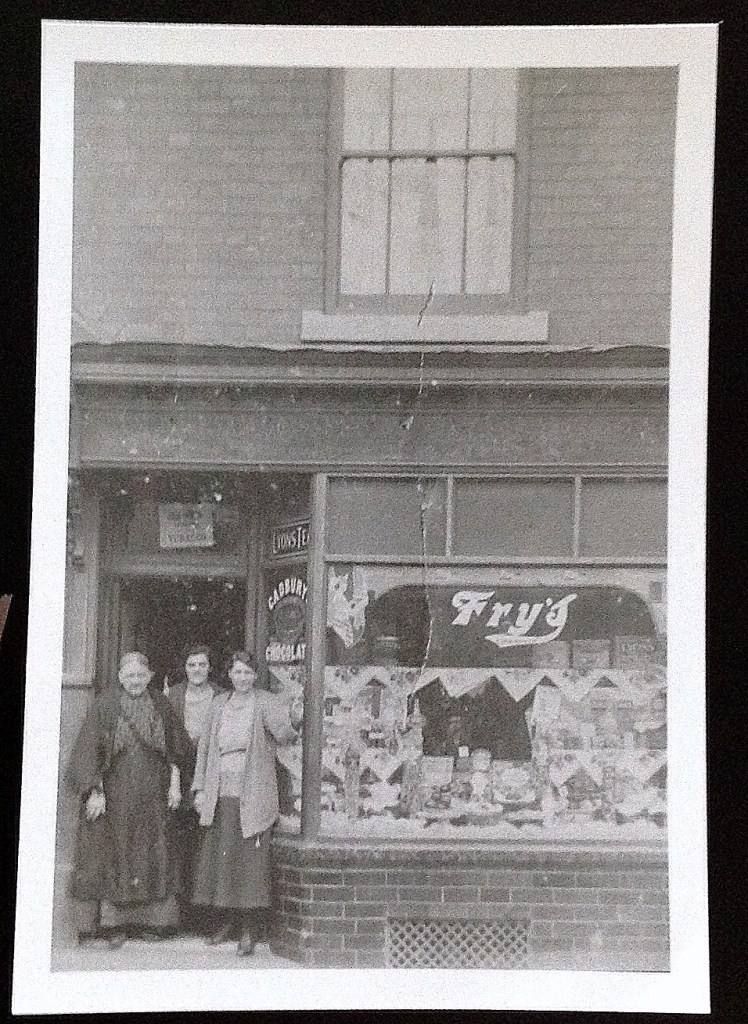
My great-granny Rose with her daughters. Copyright: Glenys Sykes
Weekly routines
Each week in earlier times apparently had routines. Monday was washday and nailmaking , Tuesday brewing and nailmaking, Wednesday and Thursday house cleaning and nailmaking, Friday ess-hole and grate cleaning, knife polishing and nailmaking, Saturday Window cleaning and nailmaking, Sunday – preparing the Sunday dinner, church, chapel and Sunday school – no work, not even sewing! The days were long, starting at six and often not ending until 10pm. For women, all of this on top of bearing children, caring for and feeding them, there was little time for rest. Men often worked during the day at outside jobs, in the quarry, mines or farms but also made nails when they got home.
Meals also followed a routine – Sunday, the joint, Monday cold leftover meat, Tuesday broth, Wednesday boney pie, Thursday stew, Friday faggots or tripe. What they would have thought of our supermarkets, online shopping and ready meals I do not know!
But Wilson Jones notes also that, in his words,’ Black Country people had “hearts as big as buckets”, they would laugh with the merry and weep with the sad. Neighbours would share the duties of a sick woman, share their meals, deliver each other’s babies. There was never any knocking at the door, they lifted the latch and walked in. They would draw a pint of home brewed beer for the visitor, be he a vicar or insurance agent. Brewing reached an art that no other district shared. Each home had its ‘secret’ upon how many hops or what kind of malt was to be used. The fermentation had to be produced by no synthetic yeast but from the ‘barm’ passed from one relation to another. The visitor would be handed the glass of beer after it had been inspected for clearness and he had to express his opinion that it was better than ‘so-and-so’s’ – their beer was too muddy, too sweet or too sour’.
Looking back
So – living in tiny overcrowded houses with earthen floors, no running water or sanitation, big families, polluted air, deadly diseases when no cures were available leading to high infant mortality and often early deaths, men working in dangerous jobs in mines and quarries or in the constant heat and grime of factories and the nailshop, children working in nailshops, mines, quarries and factories from the age of seven or so, few shops, little money, little or no healthcare provision, plenty of hard work – our ancestors had tough lives, and few luxuries but often a strong faith and caring communities. I am deeply proud to be descended from them.
 rowleyregislosthamlets.co.uk
Oh my. Another fabulous article Glenys. Thank you so much.
LikeLiked by 1 person
Thank you for this article – my maternal grands were Joseph and Martha Ruston. They had, I think, 16 sons and 2 daughters. You can find online folklore suggesting that Joseph and his sons were responsible for one of the St. Giles fires. I don’t think that is true – but reading here the Vicar’s sneering and condescending opinion of the citizens of Rowley Regis, I suggest here that might have angered someone sufficiently to do the deed. I am very fortunate to have photos, stories, and sermons from those days. (many visible on my personal Facebook page)
LikeLiked by 1 person
Thank you, David, I enjoyed writing this. These may seem like trivial matters in the history of the village, but I have always wanted to know about my ancestors as people and what their lives were like. As to the 1913 fire, I had also heard that story, David and with sufficient small but significant detail to make me think it might have been true. No other realistic probable cause has ever emerged and, I suspect, a stranger wandering around the village (with a can of oil or paraffin) would have been noticed by someone so the possibility of it being someone local with a grudge must be considered. And Joseph would have been able to enter the churchyard from the back of his house or the chapel without many people seeing him. . From what I have read about him, Joseph was certainly a man who had a strong mind and a determination not to compromise in his church ways. We shall never know for sure! We have a duty to preserve those stories, our descendants can learn about those lives from us! I shall send you a Facebook request, if I may, so that I can read some of those stories.
LikeLike
I enjoyed reading your blog Glenys and can remember my own memories of my childhood from your descriptions.
LikeLiked by 1 person