A cobbler in the family – my granddad Rose
It gives me particular pleasure when my research for my One Place Study throws an unexpected light on another part of my family. And that has happened recently when I was looking at part of the Alsop family.
The Bootmaker
I had discovered that Edward Alsop Jnr’s branch of the family had moved from the bottom of the village to the expanding new town of Blackheath, which was, admittedly, not very far – barely half a mile, and had set up a boot and shoe making business next to the Shoulder of Mutton on the corner of the Birmingham Road and the Market Place.
Boot and shoe making and mending must have been a pretty secure job in those days gone by. Working men – especially in quarries, mines, furnaces – needed sturdy boots – no safety wear was provided by employers in those days as can be seen from photographs of quarrymen and men often had to walk quite long distances to work before public transport was developed. And no doubt people would also have had their footwear repaired as long as possible, no ‘throw-away society’ then. Though undoubtedly often people would have mended their shoes themselves if they could. But it seems quite likely that even a small town would support several of these shops, some perhaps concentrating on mending and others on making and selling new boots and shoes.
I had noticed that, in the course of his working life, Edward Alsop, who I was looking at as part of the Alsop Family Study, changed from being a cordwainer in the Bell End area to a ‘Boot and Shoe manufacturer’ by 1881, a step up from being a simple shoe maker. I have, since starting to look at this branch of the family, learned from Dennis Allsopp, who manages the Allsopp Genealogy website and One Name Study, that many Allsops were cordwainers or shoemakers so Edward was not starting in an unknown trade but picking up one of the family trades. Possibly he was even apprenticed to another part of the family to learn his trade, perhaps in the Walsall area where there were many Allsops and also a vigorous leather trade.
I was also interested to note from census returns that at one time the Alsop family had a bootmaker’s (or cobbler’s shop) in Oldbury Road, Blackheath, in addition to their main business. From the census return it appears that it was in a row of other shops, probably on the same side as the Handel hotel which was on the corner of Oldbury Road and Birmingham Road, on the Oldbury side, opposite the Shoulder of Mutton. There were several other shops in the same row – a tailor, a harness maker, a grocer, a shoe shop and a corndealer and beerhouse –day to day necessities of life. I also noted, looking at several censuses that there were several other shoe makers living in the immediate area, a load of cobblers in fact…. Were they all working for the Alsops? Possibly.
The cobbler in my family
The reason for my particular interest is that my maternal grandfather William Rose (1886-1966) was a cobbler, a shoe maker and mender and I can clearly remember visiting him where he lived behind his shop in Birmingham Road, next to the Handel Hotel. Even after he retired, his machinery and lasts, tools etc were still in the spare bedroom many years later.
My mother’s memories of her father’s cobblers shop
My mother’s memoir says, of her childhood:
“My earliest memories are of about 1921 or 1922 [my mother was born on Christmas Day 1919 so I suspect it might have been a year or two later – it is unusual for people to have memories from barely two years of age] when dad had a lock-up shop at the top of Oldbury Road, Blackheath. We lived in a slightly larger house in a block of four , near to Station Road, half a mile from the lock-up shop.
Our home near Station Road was one of a row of four houses, each with a ‘brewhouse’ across a blue brick yard. Here family laundry was done and the main and only water supply was for each house. [At one time, of course, many families brewed their own beer, too – hence the brew house. And such brewed ale was considerably safer to drink than water, because the water would have been heated for the brew which would have killed off a lot of the bacteria which was a common source of poisoning from contaminated sources.] The boiler had a fire underneath. It was a nice place for children to play in on cold and wet days. Opposite the house were hedgerows all the way to Whiteheath, above a mile away. The fields stretched from my home a long way up the slopes to Rowley Hill.
Bell End was a curving road, reputedly called this after the bell on a hunting lodge at the Rowley end of the road, supposedly owned by King John.
This was all a mining area when I was a child. There were many pits, giving work for local men – Bell End Pit, Ram Rod Pit was near where I live now. All were eventually worked out [in fact most were flooded during the General strike and never re-opened but mum didn’t realise this] but leaving slag heaps and debris piled high in banks for a long way. But, as we found out later these banks were playgrounds for us children where celandine and coltsfoot and bluebells grew and we could run and climb up high above the fields. Small streams, after rain, – marshy places where we found Marsh Marigolds. Banks of Rose Bay Willow Herb growing tall and straight. There are no banks now in the whole of this area, from Uplands Avenue and Rowley Hill down to the Oldbury Road is one great housing estate, with a senior school and grounds [now also gone]. The outer edges are private estates.
At the bottom of Rowley Hill, my friend Amy Jones lived in a very old dilapidated farmhouse. We used play and wander from her house right up to Bell End and down to Oldbury Road. We wandered over the banks of pit waste, we paddled little streams and roamed the fields picking wild flowers – coltsfoot, buttercups and daisies, Ladies Smock. With the older leaves of coltsfoot we rubbed away the woolly coat and made ‘picture frames’. We often came home with muddy or very wet shoes and feet. We used to eat sorrel leaves and hawthorn leaves which we called Bread and Cheese – I wonder how we lived to tell the tale!
[The paragraphs above are not strictly relevant to this piece but I have included them because I simply find it lyrical and it paints a picture of a Blackheath and Rowley long gone, almost exactly a century ago. My mother goes on:- ]
The Cobblers Shop [in Oldbury Road]
Our shop was long and narrow and ‘barny’, all the shoe repairing machines, shop window, counter and bench were at the front end – at the back there was stock, bends of leather stacked, boxes of rubber heels and soles. Even now I can smell that leather! Dad made me a swing there hanging from the exposed rafters – I spent a lot of time with him and how I loved that swing – how high I went! There was also a black iron fireplace in the shop. Dad used to make me roast (baked) potatoes and all black and dusty chestnuts which cracked open at a touch.
I realised at this early age that cobblers shops were ‘canting’ shops as mom used to say. But later on when our shop and house were in one premises, mother indulged just as happily as dad! I do remember one middle-aged man who wore a cap with a shiny peak; another, Dick Bird, a fruiterer, was a daily visitor, as did some others, especially in winter. A good coal fire was a great attraction. I remember arguments about football – Dad and Bill were loyal West Bromwich Albion supporters and some customers favoured Aston Villa.”
In about 1923, yet again my parents moved house, having bought a detached house and shop in Birmingham Road. It was an old property, I believe an old iron warehouse, with some red and blue quarried floors – which I sometimes had to scrub as I grew older. The rugs I remember as a child were ‘podged’. All the old coats and skirts and trousers were cut up into ‘thrums’ and, with a special hook, attached to sacking – they were very thick and warm.
The house [Later known as 59 Birmingham Road] had six large rooms. Dad’s shop was at the front obviously and it was a long house, with rooms behind each other.”
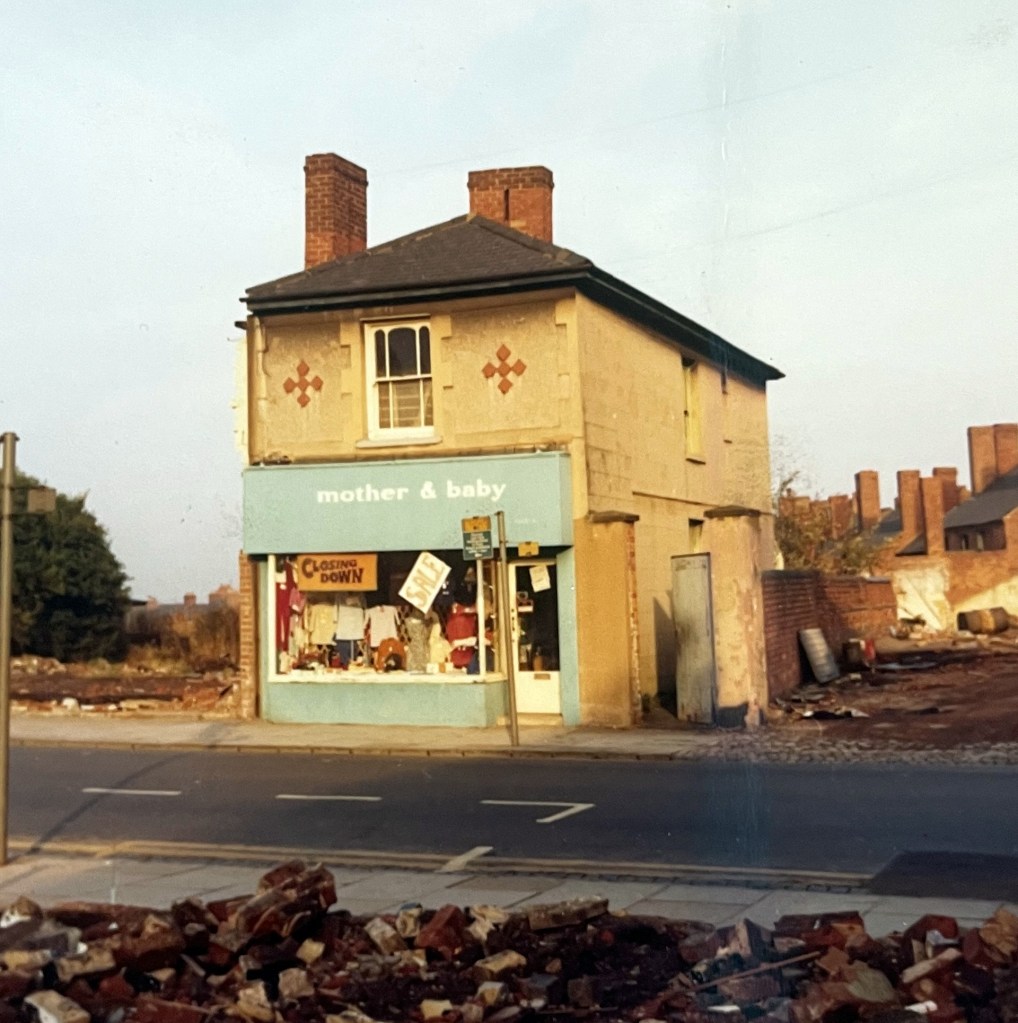
Copyright unknown. This was the house and shop bought by my grandfather, where he had his shoemender’s shop and where my mother grew up, just prior to demolition. I remember as a child in the 1950s visiting and we went in through the tall gate at the right hand side of the shop and walked down an entry paved with blue bricks, past the front door which like many Black Country front doors, was never used and in through the lean-to kitchen/scullery which still had the upright water pump, later superseded by a cold water tap!
My mother’s memories continue:
“We had a cellar. Our pantry shelves topped ten brick steps down to a full room sized cellar with a blue brick floor and a yard wide brick sill all the way round. There was a small well in the cellar floor which got troublesome in times of heavy rainfall. Later Dad invested in a pump.
Our garden was quite small, made smaller by the added building of a downstairs bathroom and adjoining coalhouse which Dad and Bill (my uncle) built. But flowers we had. And I would still love a root of Solomon’s Seal which dad used to grow so well.
Mother and Dad had friends in the road. Mrs Bertha Adams had a shop almost opposite and was Mom’s very good friend. The Adams family were all members of our church [Birmingham Road Methodist]. Emily Ingram and Lily Hancox are the surviving members of the family. Mr Adams had a forge where he made nails and rivets – in the Nail Shop for Thomas Gadd’s factory.”
So these were my mum’s memories of the time the family lived in Oldbury Road and Birmingham Road. This was written during the late 1970s, I am hugely grateful that my mother did this before she succumbed to dementia, as there are so many precious glimpses of my mother’s life here. My mother noted that at one time they lived in High Street in a shop which later became Lloyd’s Bank. At the time of writing she still bought her vegetables and fruit from Birds who were, as she put it “an old Blackheath family who my people knew very well.” Even in the 1970s, descendants of that family were still trading in fruit and vegetables under the same name.
Why did my granddad become a cobbler?
I have often wondered how my grandfather came to go into the cobbling business, as he was the first to do so in a family of rivet makers. It was relatively unusual until then for boys not to follow their fathers into the nail or rivet making trade, and many of the Rose men were rivet makers. But the hand made trade was drastically reduced by then as mechanisation took the trade from more expensive hand made nails and rivets and William didn’t become a rivet maker. His father Absalom Rose was a rivet maker, working for Thomas Gadd’s, but William was not. And this is where the two threads begin to come together!
In 1881 Edward Alsop, aged 42, was living at No.42 Birmingham Road which is listed next to the Shoulder of Mutton. And in 1885 my grandfather was born at 45 Birmingham Road, three doors away. The two families, although with no direct connections that I have been able to discover, remained close neighbours for many years. What a coincidence, isn’t it? Edward Alsop was expanding his business and there were several boot and shoe making workers living very close. Did the Alsop family take my grandfather as an apprentice. I noted also that the Alsops had had a cobblers shop in Oldbury Road, was this shop the one that my grandfather took over at some point before he moved to premises of his own? I have no way of knowing but it does seem possible.
The ‘Rose and Adams families and shops’
Now in Anthony Page’s first book of Blackheath photographs there is a picture of a family outside two shops in Birmingham Road, which the caption says, is of the Rose and Adams families. Since the photograph came from my second cousin on that line, I have no reason to doubt that is accurate and that this group connects in some way to my family. The caption continues ‘These two shops stood a few doors away from the Shoulder of Mutton, and belonged at various times to the Rose and Adams families. Behind the shops, through the archway, was the original mill belonging to the Sturman family (part of which remains today as a food outlet, behind Barclays Bank). The goods on display in the windows included fresh fruit and vegetables and home-made lemonade.”
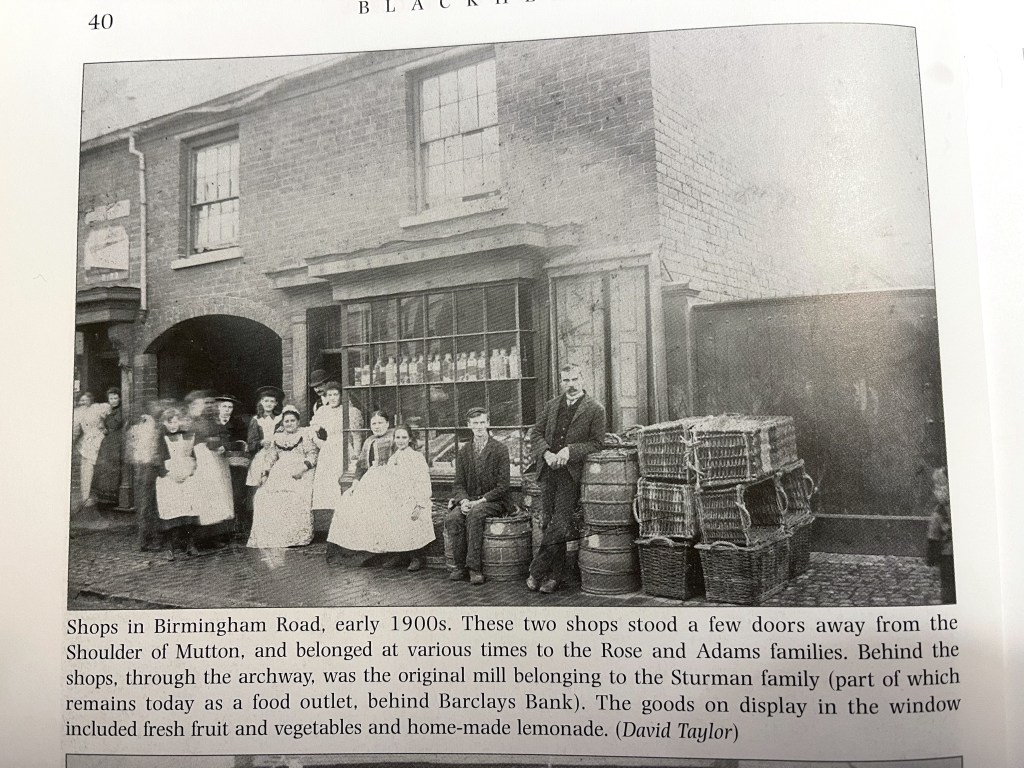
Copyright: David Taylor.
Hmm. My mother remembered Mrs Adams as a friend of her mother but does not mention her being related. So can I find a connection through my family tree? And how long were the Rose family and the Adams family associated with that little group of houses on the corner of Birmingham Road and the Market Place?
Looking at the censuses
1841: The 1841 has very little detail or indication as to where people actually lived so I have not been able to identify who was living in the Birmingham Road area and the same has proved ture of the 1851 Census.
The 1861 Census is not a great deal more helpful, except that by now James Payne is listed as a ‘Butcher and Beer Shop’. Yet again, we have a butcher combining his trade with that of the publican, just as Joseph Bowater was doing at the Bulls Head in Tippity Green, at this time and both pubs derive their name from the butchery trade. Next to the beer shop in Birmingham Road was John Homer, a breech pin maker who was also there in 1871 and then James Bissell, a gun barrel grinder and his family, next along was Thomas Jennings, a bricklayer – plenty of work in Blackheath for him, at this time – and then William Adams the butcher. Not very different to the line-up in 1871.
But looking at the premises on the other side of the beer shop, there were two households of nailers – Jesse Robinson and Mary Adams – that Adams name cropping up again. And then there is a draper – an incomer, too – from Somerset, by the name of William Collard and his wife Mary. That Collard name will come up again before long. So it appears that there was already a draper’s shop facing on to the market place, almost next to what would be the Shoulder of Mutton, as can be found in later censuses.
1871: The development of shops in Blackheath town centre must have followed the sale of the church glebe lands and the huge number of new houses built on the old glebe lands. James Payne was a licensed victualler at the Shoulder of Mutton which was, according to Hitchmough, first licensed in about 1854. Next to that in Birmingham Road is Edward Alsop, listed as a cordwainer with his family. Then there is John Homer who is a (former) gun breech forger, aged 59, and then Ezra Homer, aged 35, also a gun breech forger, with his family, all of whom are either rivet or nailmakers or still at school. Next there is the first time I can find the Roses in that area with Joseph Rose with his mother Ann and siblings Agatha and Absalom. Absalom, a nail maker was my great-grandfather. Ann Rose’s maiden name was Adams so perhaps that was the Adams connection mentioned by my cousin and Anthony in the book. Next door was William Adams, a butcher. However, I have not yet found a connection between Ann Rose, nee Adams and William Adams the butcher. After William Adams is a Noah Barnsley, who was a Blacking manufacturer – I wonder whether this was the premises with a large yard and a wide opening from Birmingham Road?
1881: By the time of the 1881 Census, the Alsop family are at No.42, next to the Shoulder of Mutton. There is a Hannah Preece, a widow at Number 43 and Ezra Homer and his family still at number 44. Joseph Rose has married and moved away to Malt Mill Lane. Absalom Rose, a rivet maker, has also married but is still living there at 45 Birmingham Road (the first time house numbers are shown in the census) with his widowed mother Ann who is shown as the Head of the household, his wife Betsy and eldest daughter. Also at 45 Birmingham Road is William Daniels, son-in-law of Absalom, the widower of Absalom’s eldest sister Matilda or Tilda Rose and with their four children. Next door at 46 is Henry Sturman who at that time was a General Labourer. No shops are mentioned at this time. There are no Adamses in the row. But, if you remember, the caption on the Adams/Rose family photograph noted that ‘the original mill belonging to the Sturman family’ was behind these houses so obviously they held at least some land there.
1891: In 1891, the Alsop family have moved round the corner to what is called 122 Halesowen Street in the census but which is later called 2 Market Place, the shop shown on later photographs. Next door to them, at 123, between the Alsop’s shop and the Shoulder of Mutton is Henry Bennett who is a General outfitterwith his family (although I have been interested to note from censuses that many members of his Bennett family around the Rowley area were cordwainers or shoemakers). Absalom, still a rivet maker, is to be found at 43 Birmingham Road, with his wife and three children, plus his wife’s niece Clara Harvey who is described as a servant , (relative has been crossed out). At 44 is a John Priest with his family, at 45 James Chatwin who was a Journeyman Boot maker and at 46, Henry Sturman. So it looks as though the Roses moved two doors along. Still no sign of any Adamses living there.
1901: In 1901, which is close to the time the photograph of the shops was taken, Absalom, with his wife and two of his children, is still at 43, Birmingham Road, still a rivet maker. No occupation is shown for his wife Betsy, there is no mention of a shop. His son William, my grandfather is a Boot and Shoe finisher. At No.42, previously occupied by the Alsops, there is a note that the occupier slept away so we do not know who was usually there. Next door to Absalom at 44 are Jesse and Mary Ann Law, Mary Ann is Absalom and Betsy’s daughter. No 45 is empty. James Chatwin is still at No.46. But there has been a change at No.47, it is now occupied by Thomas (a carpenter) and Elizabeth Hadley, there is a note that there is a Fried Fish Shambles between 47 and 48.
1911: In 1911 – aha! At number 42 is Bertha Adams, a widow with her two daughters and one son, there is no mention of any occupation. At number 43 are Absalom and Betsy Rose, at 44 is a John Horton who was a waggoner, and at 45 is Matilda Sturman, aged 36 and single, who is described as a ‘sweets and general dealer’ and her brother Edward Sturman, 21 who was a ‘fish, fruit and potato salesman’, both said to be ‘working in own account’, ie self-employed.
And next along at 46 is William Bird, with his family of seven children. William, who was then 40, is also a Fish Salesman, again working on his own account and his son William Walter Bird, aged 17 is assisting in the business, and working from home. The next son Leonard at 15 is a grocer’s assistant but not working from home and with a different occupation code so presumably working elsewhere. Since both Edward Sturman and William Bird are fish salesman, does this relate to the ‘Fried Fish Shambles’ mentioned which was situated between numbers 47 and 48 in the 1901 Census?
At No. 47 is James Wharton, aged 65 and a labourer at a colliery with his three sons who are an Insurance Agent, a boilermaker and an Electrical Engineer so all working in better jobs than labouring and all requiring literacy which was probably not available to their father. And at 48 is a John Johnson, chainmaker working at home.
1921: In 1921, the last of the historic censuses available, the census form for number 42 is labelled on the cover sheet as being the home of Lucy Bennett, widow of Henry Bennett who had until very recently been the draper at 123 Market Place, next door to the Alsop’s shop on the other side of the Shoulder of Mutton. But she does not appear on the actual census page. The head of the household listed as head of the household is Bertha Adams, aged 40, with her sister Dorothy Violet Bennett and Bertha’s three children also listed. Bertha has no occupation shown other than household duties and Dorothy, aged 27, is a Pen worker. Both Bertha and Dorothy give their place of birth as 123 Market Place. Bennett – I checked for Bertha’s marriage, Bertha was a Bennett, she and Dorothy are two of the daughters of Henry Bennett who had died in 1897 – Lucy Bennett was Henry’s widow and presumably owned or rented number 42. But in 1921 Lucy herself was living with her other daughter Florence Bennett who was a pawnbroker in Halesowen Road, Netherton, Florence again working on her own account.
Absalom is still at 43 Birmingham Road with his wife Betsy, in 1921, still described as a rivet maker, for Thomas Gadd at the Ross Rivet Works, although also marked out of work. Perhaps he still hoped to return to work there at some point although he was now 65. Also in the house were two lodgers who were unrelated to them (I think!).
At number 44, is Benjamin Billingham, aged 64 who was a roadman, with his wife Maria and step-daughter Sarah Aston, aged 41. Sarah, who was unmarried, was born in Lye (incomers!) and was a Stationery and Fancy Goods dealer, working on her own account and presumably from home though the place of work is only shown as Blackheath.
At 45 is William Tromans, who was 56 and an Out Porter at the GWR Rowley Regis Station. His wife Matilda, aged 46, is shown as a General and Hardware Dealer. Also listed is their daughter Alice Bertha Kathleen Tromans, aged 4 years and 8 months. Is this Matilda the same Matilda Sturman who was living at 45 in the last census? Yes, of course it is! Matilda had married William Tromans in the last quarter of 1914 and Alice’s birth registered in the last quarter of 1916. I wonder whether Alice’s second name of Bertha was for Bertha Adams who was just a couple of doors away?
At Number 46 is still William Bird with his wife Annie and seven children. William is a ‘Fish Fruit Poultry shop Keeper’ with the place of work shown as High Street, Blackheath. The four eldest children are also employed in the fish business, including two boys Leonard (26) and Thomas (21) working from home as Fish Salesmen and Annie (19) working as a shop assistant in the High Street shop, whereas Arthur (16) is shown as ‘assisting father in general’ and working from home. Looking back to my mother’s memoirs of family friends and visitors to her father’s shop, she referred to the Bird family who were fruiterers with a High Street shop who must surely be this family. And although she remembers a Dick Bird, who does not appear in this family, might this not be a nickname – Dickie Bird? I searched the 1921 Census for a Dick or Richard Bird in the area, there was none of any age so I am sure that this family, living almost directly opposite my cobbler grandfather (and whose shop was in the High Street, is the family that my mother remembered.
After this entry, the 1921 census sheets do not shown house numbers but the houses are occupied by families with unfamiliar names so I think that they were rented out and occupants changed more often than the group of houses, shops and business premises between the Shoulder of Mutton and Number 47.
Absalom Rose died in 1922 and his wife Betsy in 1926. By that time their children were all established elsewhere so presumably other occupiers moved into number 43.
Unfortunately, although there was another census in 1931 this was destroyed by fire in 1942 (not bomb damage, just a fire), no census was taken in 1941 because it was wartime and the next census was in 1951 which will not be released until 2051 – I doubt I will be around to see it! There was the 1939 Register which was taken to organise identity cards and rationing which includes some useful information but no relationships. Bertha Adams was still in Birmingham Road in 1939, indeed she lived until 1979. Her Probate record gives her address as Harvest Road, Rowley Regis so even Bertha moved away from Birmingham Road eventually. Most of the shops were demolished to make way for a shopping centre and a multi-storey car park which was never built.
The Market Place/Shoulder of Mutton/Birmingham Road group of premises
So I have identified that there is a group of business premises, shops and houses which wrap around the Shoulder of Mutton and the residents of these premises appear to move between the different houses or shops over a period of at least fifty years. And most of those houses and shops which I have investigated so thoroughly, have now gone, although I remember them from my childhood in the 1950s. And some of them are shown in the photograph of the Adams/Rose families, and also in this picture taken, apparently in the 1930s, looking from the Market Place towards Rowley, which appeared on a different Facebook page.
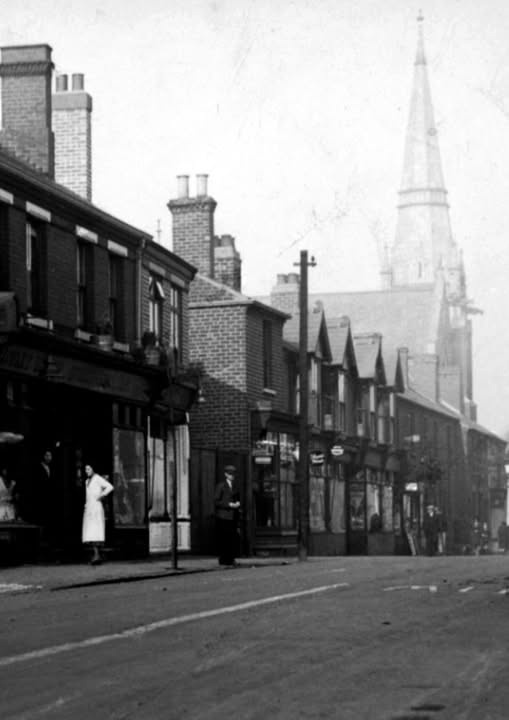
Copyright David Morris.
Most of them can be placed fairly accurately on this extract from the 1902 OS map, mainly from the yard entrances and covered entries which also appear on the map.
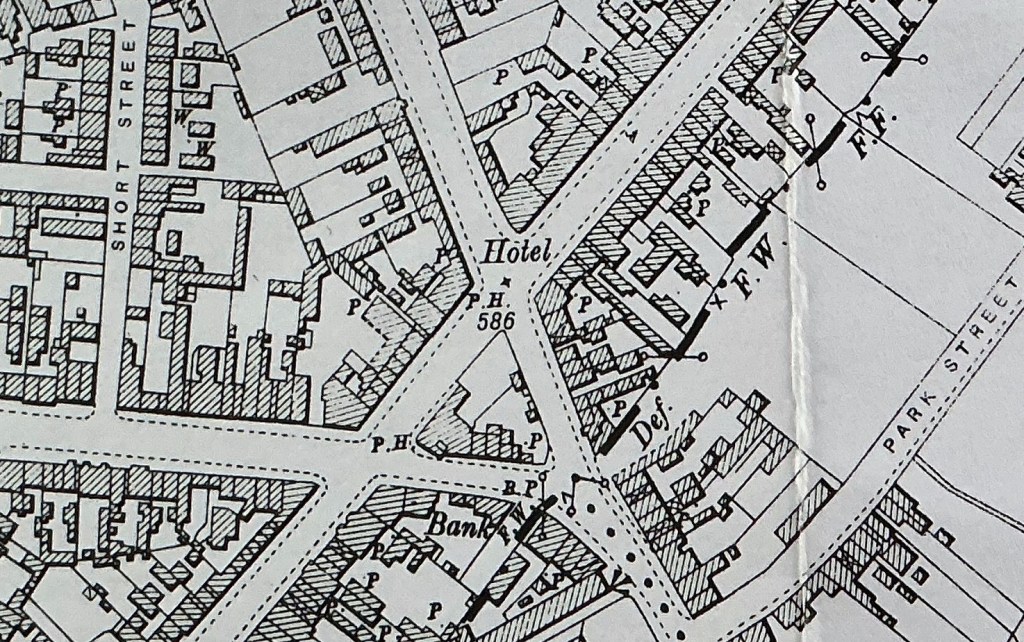
Whether all or some of these properties were owned by the Allsops or by the Sturmans or by someone else, at this point in my research, I could not tell.
Certainly one of the shops, over a long period was run by Bertha Adams and it seems likely that Betsy Rose also operated a shop. A friend of my mother gave me a photograph a few years ago which she said was of my great-grandmother Betsy Rose standing with two younger women in the doorway of a shop which was supposed to be in Birmingham Road and which I think from the fashions was probably taken in the 1920s. Was this Betsy Rose? I am told so and perhaps the young ladies are my great-aunts!
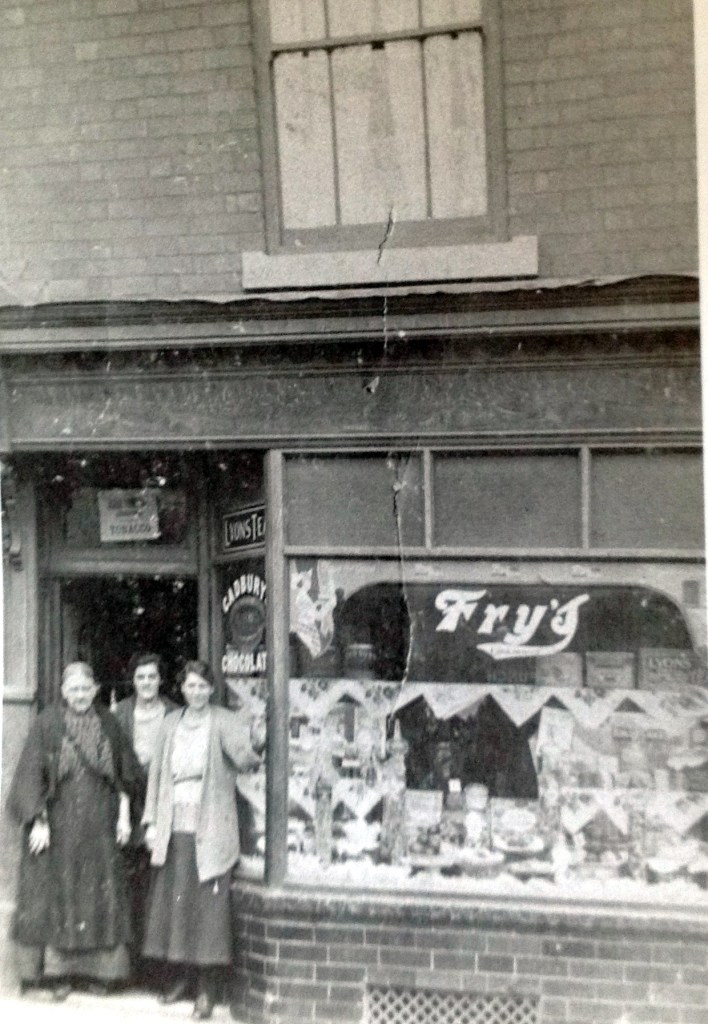
Copyright Glenys Sykes.
Front room shops
I believe, regardless of these business arrangements not being recorded in censuses, that it was quite common for women to run small shops from their front rooms which sold basic items and sweets, etc, as my mother mentions elsewhere in her memoir, visiting her mother’s aunt Mary Ingram (Fred’s granny) in Bell End which, after the pits had closed was now all fields with a row of small terraced miner’s cottages where Great-aunt Mary lived. My mother described it like this –
“There was a tiny pantry with a front facing window. Aunt Mary made it into a little shop with sweets and chocolates, lucky bags and pop. I suppose she sold groceries too but they wouldn’t have interested me! Oh, yes, I remember blue paper bags of sugar.”
I think that those little cottages in Bell End survived into the 1960s as I remember them, almost opposite to where Fred and Emily Ingram lived! And again, these were the sorts of shops, like Bertha’s in Birmingham Road, which sold useful day-to-day necessities and pop! Home made lemonade, somewhere local people, even children, could pop in for a few items without having to go too far.
The Adams connection
I had been unable as yet to find any link my mother mentioned between the Emily Adams who became Emily Ingram and the Charles Eli Adams to whom Bertha Bennett had been married. However, just to stir the mix, Charles Eli was a first cousin to Alfred Adams who married Mary or Polly Alsop, daughter of Edward Alsop who lived and traded in this cluster of houses and shops. So perhaps the Alsop family allowed the widowed Bertha to take over their shop when they moved round the corner.
It appears that another apparently unrelated Adams family lived in Mott Street, later called George Street off Birmingham Road, and moved into Birmingham Road in the early 1920s and it was this family which had, amongst others, the daughters named Emily and Lily who my mother remembered.
And then I found another of those intertwining threads that keep emerging in this game. Both of these daughters of the Adams family married at Birmingham Road Methodist church with which my family was closely connected on my mother’s side. Emily Adams married Fred Ingram and they were well-known to anyone connected with Birmingham Road Methodist church, real stalwarts. They lived in Bell End when I first knew them but then moved to Olive House in Halesowen Street, formerly the home of Miss Estelle Hancox, another stalwart of Birmingham Road and a great friend of my mother’s. Lily Adams married Cecil Hancox, whose address at the time of the marriage was Olive House in Halesowen Street. Yes, Cecil was the brother of Stella Hancox. And Cecil ran the confectionary and sweet shop at the Kings cinema, to which my grandfather Rose used to take me as a child to buy sweets on Saturdays! So the Adams/Hancox/Ingram connection to Olive House becomes clear to me. Many chapel events were held in the lovely garden there over many years.
And Joseph Adams, the father of Emily and Lily was certainly a rivet maker working from a forge behind his house so this was probably the Mr Adams mum remembered, but nothing to do with Bertha!
And looking for items to illustrate this piece I found a map which appears to show Blackheath at the time when the Glebe lands were about to be sold and there were very few houses in Blackheath. But, off what became the Birmingham Road, there was an unnamed road leading off to the right, almost opposite the Causeway. It appeared to have only one building in the road. But the name Wm Adams appears against that house or houses.
Very probably the same Adamses who lived in Mott Street which was in the same area fifty years later. So those Adamses were in that area for a long time too and may well have been connected to the William Adams who was a butcher in Birmingham Road in 1861 – I have not built that family tree any further back from Emily and Lily and their father to check!
The Gloucestershire/Somerset/Blackheath Connection
Another diversion then emerged.
While I was researching the Bennett family who were drapers in the Market Place, I found that Lucy Roberts (who married bootmaker Henry Bennett) had been born in Chipping Sodbury which is a delightful little town in Gloucestershire only a few miles from where I live now. So I knew from the census entries for her family there exactly where she lived, as those houses are still there today. Her father Joseph Roberts was a publican, he had married three times, each of his wives was named Ann (that took some meticulous working out as most of the trees on Ancestry think he had only one wife!) and he remained in Chipping Sodbury until his death in 1902.
So I was a little surprised, when checking out Lucy’s earlier life, that Lucy (aged 18) and her younger brother William (aged 13) were already living in High Street, Blackheath by 1871, living with and described as the niece and nephew of William Dudley, aged 39, born in Wednesbury, who was a ‘Pawnbroker & Draper & Local Preacher’ – an interesting combination! Lucy at that time was an assistant in the Drapery, William was a scholar. Pawnbroking was something of a family trade for William’s Dudley family and he had had a pawnbroker’s shop in Oldbury before he moved to Blackheath. Also in his household with Lucy and William Roberts was a Constantine Lovell, an assistant pawnbroker who was also said to be a nephew, his place of birth was not known, given as either Gloucester or Somerset (now known to be Clifton, Bristol).
Constantine was not difficult for me to track, he had been living next door to Lucy in Chipping Sodbury in 1851 and his mother and Lucy’s were sisters. Constantine’s father had died in 1852, and it seems likely to me that Constantine and his two siblings were sent away from Chipping Sodbury then or soon after, as in the 1861 Census, his older brother was in the navy, his younger sister was in the workhouse in Somerset, in the parish of her Lovell grandparents and Constantine was working as a Worsted spinner, near Halifax in Yorkshire. It was not uncommon for boys of his age to be sent from workhouses in the south of England to mills in the North to work. However, somehow he had been brought back to his family in Blackheath by 1871 and Constantine went on to become a Pawnbroker in Smethwick for the rest of his life. His sister was also in West Bromwich within a few years and married there so they appear to have kept in touch with their wider family.
The maiden name of the two sisters who were the mothers of these youngsters was Collard, yes, they were the daughters of the very same William Collard who had a drapery shop in the Market Place in 1861– he was grandfather to all three of these youngsters.
Lucy and William Roberts’s mother had died in 1868 and their father re-married in 1869, so it appears that the Roberts children had moved to be with their grandfather. Their aunt Mary Collard, his youngest child, had married William Dudley in 1863 and that was how they had come to be described as his nephews and nieces.
Was it coincidence that Lucy’s eldest daughter Florence later became a pawnbroker? I wonder whether the draper’s shop in the Market Place also operated as a pawnbroker? It seems that Henry Bennett was originally a boot and shoemaker (yet another!), and he had come into the family drapery business when he married Lucy so most of the business experience of drapery – and pawnbroking – was on Lucy’s side.
So the premises at Market Place, later occupied by Lucy and Henry Bennett had actually been originally occupied as a drapers by Lucy’s Collard grandfather, as early as 1861 and appear to have been operated as such over a long period.
To summarise:
So this was my convoluted attempt to trace the movements of people and families around the houses and shops in this very small area of Blackheath in the late 1800s and early 1900s and to relate them to my mother’s memories of growing up there. This very long tale may not be of great interest to anyone else but has been an interesting exercise in research for me.
It does appear that there were close-knit networks of families who owned or occupied houses, shops, mills and warehouses, who moved around each other, swapped houses and shops, intermarried, employed their own and neighbour’s children in their businesses and ran a wide variety of small businesses which helped Blackheath become the busy and thriving little town it became. But also that the burgeoning ‘new town’ of Blackheath also attracted traders and shopkeepers from outside the immediate area.
I still do not know quite who owned which land or houses or when or how those yards at the back interconnected and I may at some point investigate through land taxes but that is another rabbit hole for another time!

