This piece looks at the next four children of Mary Ann Alsop and William Vaughan, the remaining four will be in the next piece.
Charles Vaughan 1849-1912
The birth of Charles was registered in 1849 in West Bromwich Registration District, and later in life he gives his place of birth as Oldbury or Rounds Green. But he does not appear in the 1851 Census with the rest of the family and nor does Joseph Edward, the eldest child.
By 1851 the rest of the family were living at Handley Street, in Aston, Birmingham. With William aged 31 (shown as a garden tool maker, employing 11 men) and Mary Ann, in addition to their two younger sons William and Richard, is Richard Vaughan, aged 24, listed as Partner and brother of William. Only William James, aged 3 and Richard Henry, aged 3 weeks were with their parents who must recently have moved to Birmingham. I think that the two older children must have been staying with other family members to help Mary Ann, certainly Joseph Edward was staying in Tipton in 1851 with two of his Vaughan aunts but Charles is not listed with them.
But Charles who would only have been two in 1851 is nowhere to be found, either in 1851 or 1861. He is not with his family in those censuses. I cannot find him with any of his numerous aunts and uncles nor on a general search of the censuses. I cannot find a death for him in those early years, the rest of his siblings grow up in the family home but it seems not Charles.
I have gone through all the Charles Vaughans who were born within two years of 1851 in England and all the Charles Vaughans of that age who appear in the censuses and accounted for all the others, except him. Very frustrating and puzzling because the Vaughans at least were a pretty close family and I would have expected a baby and child of that age to be looked after within the family.
But then, just when I had concluded that he might have died in infancy, in the 1871 Census, a Charles Vaughan of the correct age appears, living at 1 Shut Lane which was near Moor Street, Birmingham. He was living with a widow Jemima Cooper, aged 52 who was head of the household but described herself as a House Keeper, and her daughter Sarah H Cooper, aged 22 who was apparently a Professor of Music. There was also a female general servant aged 25. And Charles and two other young men of a similar age (20, 23 and 23) all described as Assistants, though it is not clear to whom they were assistants. The House Keeper? The Professor of Music? Why would such a youthful Professor of Music require three young male assistants? I confess my mind boggles slightly… but nonetheless, it does appear that this might be the missing Charles.
And only three years later, this Charles married Emmeline Mary Lucinda Jeyes at St. Philip’s – Birmingham Cathedral now – but the parish church for part of the city – on 10 June 1874, giving his occupation as a hosier, (a dealer in knitted goods particularly stockings), his address as Aston Street and his father’s name as William James Vaughan, a Garden Tool Maker. No doubt then, this is the right Charles and what is more, William James Vaughan was one of the witnesses, so this implies at the very least that there was some positive contact between them. On 23 March 1875, a first daughter Adelaide Amelia was born to Charles and Emmeline, followed by Clara Emmeline in 1877.
By 1881 Charles and his family were living in Upper Sutton Street, Aston where he was described again as a hosier but out of business and Emmeline was still a milliner. With them also was his brother Lewis, aged 19, a clerk, a Caroline Radenhurst, 56, described as an aunt (perhaps Emmeline’s aunt as the name is unfamiliar), Esther J Vaughan, a cousin and domestic servant and a Henry Strange, a commercial traveller who was a Boarder. Again, the presence of a brother and a cousin in Charles’s household, seems to imply a familiarity and goodwill within the family.
By 1891, Charles, now 42 and his family were living at 123 Bloomsbury Street, Aston and he was still giving his occupation as a hosier, and Caroline Radenhurst (now 66 and identified as ‘wife’s aunt’, living on her own means) and Esther J Vaughan, cousin, aged 43 and a domestic servant – it is not clear whether Esther is a domestic servant to Charles’s family – are still living with the family. Emmeline is still a milliner, Adelaide at 16 has become a School Teacher’s Assistant while Clara, 14, is still at school.
But by 1901, things have changed. Now aged 52, Charles’s occupation is shown as Iron Caster (malleable). The parents, daughters and Esther Vaughan are now living in Pritchett Street, Aston and both daughters are now teachers, although there is no mention of any occupation for Emmeline nor Esther. So at last Charles appears to have moved into the metal working industry, like so many of his family. Caroline Radenhurst had died in Aston in 1899, aged 75 so it seems likely that she had stayed with Charles and his family until she died.
The 1911 Census finds Charles, Emmeline, Clara and Esther living in Legge Street, Birmingham . Charles now describes himself as a Malleable Iron Founder, Clara is teaching in a Council School and Esther is a General Servant.
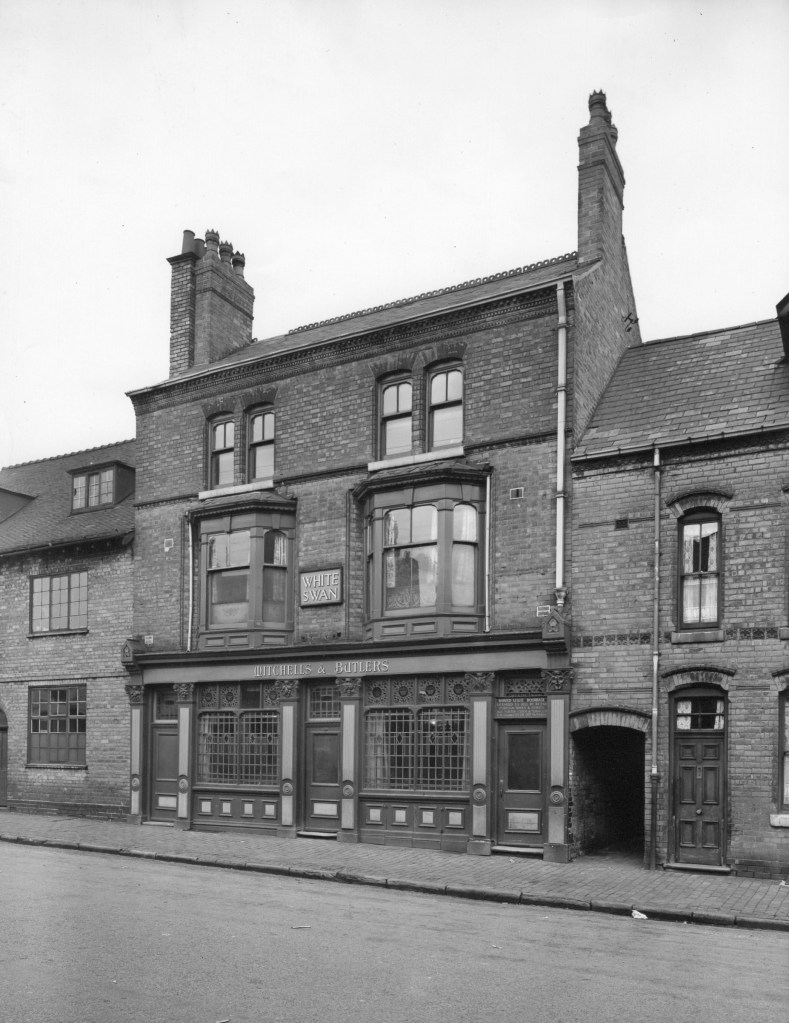
Copyright unknown. However this 1957 photograph shows that some parts of Legge Street survived in good condition for some time. The 1911 census shows that the house that Charles and his family were living in had eight rooms which was an unusually large house for that area, so it seems he had room for various relatives to live with the family.
Charles died on 22 Nov 1912, aged 63, his probate record shows, and he was buried in Witton Cemetery, as was Emmeline when she died in 1922. The 1921 Census shows Emmeline and Clara living in Rotton Park with Adelaide and her husband Alfred Loach who was a manufacturer of Gold Gem Rings, and their three children.
Esther Jane Vaughan, who lived with Charles and his family for upwards of fifty years, died in Rotton Park in December 1929, leaving her estate to Adelaide and Clara, and was buried – like so many of the Vaughans – in Witton Cemetery.
Esther was indeed a cousin to Charles Vaughan, a cousin once removed – her parents were James Vaughan and Rebecca (nee Barnsley).
James was the considerably younger brother of Joseph Vaughan, the grandfather of Charles. He had not followed Joseph and his family to Aston but had stayed in Rounds Green where he and his wife Rebecca had seven daughters and two sons, including a Charles Vaughan who had been born and died in August 1845. Charles, the son of William and Mary Ann, and Esther, daughter of James and Rebecca, were born only a year apart, both in Oldbury and it seems slightly unusual for there to be this close relationship over a long period. Although he does not appear in any censuses with James and his family, I wonder whether Charles did spend time with this part of the family as he was growing up, which might account for a closer connection. But there is no way to know for sure.
But the decade or more that Charles is missing from the censuses continues to irritate me! I suspect that he was staying with a married female of the family somewhere and that possibly his surname may have been wrongly transcribed or entered in error as that of her husband. For now, I can only keep an eye out for a Charles of the right age with some part of the (very prolific!) family, as my research continues.
Richard Henry Vaughan 1851-1928
Richard Henry Vaughan had been born on 13 March 1851 – the census was taken on 30th March so he was quite a new baby. He was with the family in 1851 and 1861 but by 1871, he was living at 78 Bull Street, Birmingham, where he was a Draper’s Clerk.
Bull Street, Birmingham, for those who are not familiar with it, is an old street in the centre of the town, only a few yards from the cathedral. It runs from the old Snow Hill Station down to the High Street, crossing where Corporation Street was later built. In my days living in Birmingham in the late 1960s and early 1970s, it was home to Grey’s Department Store and Lewis’s was on the other side of the road. I have been able to ascertain that 78 Bull Street was on the corner of Temple Row and Bull Street, not far from the Cathedral.
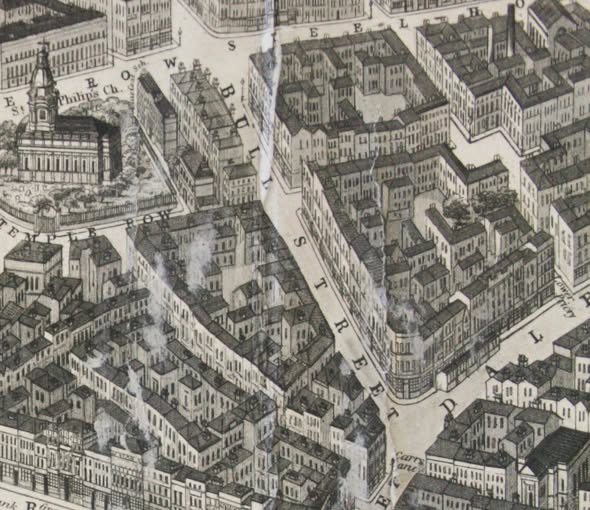
Copyright: Paul M Hayes
The census, unfortunately, does not give the name of his employer but it was clearly no small establishment as there were thirty seven members of staff, living on site, which was not unusual for larger or department type stores then. There were seven porters, five clerks and twenty-seven draper’s salesmen, almost all of them in their early twenties or younger. Although a few were local others came from a very wide area, as far away as Hackney, Cambridge and Devon. What an interesting place it must have been to work, for a lad from a family of metal workers in Aston, how much he must have learned from those strangers from other parts of the country.
Whilst I was checking out 78 Bull Street, I was able to find some old photographs of that corner and was interested to see that in later years it was occupied by Rackhams, before they built their large new store. I wondered when they opened and an enquiry on the Midland Memories and More page on Facebook brought me almost instantly the information that Rackhams had opened on that site in 1881, so ten years after Richard Vaughan was there. How interesting! And yet, the two shops must have been in a very similar trade – I wonder whether they changed their name?
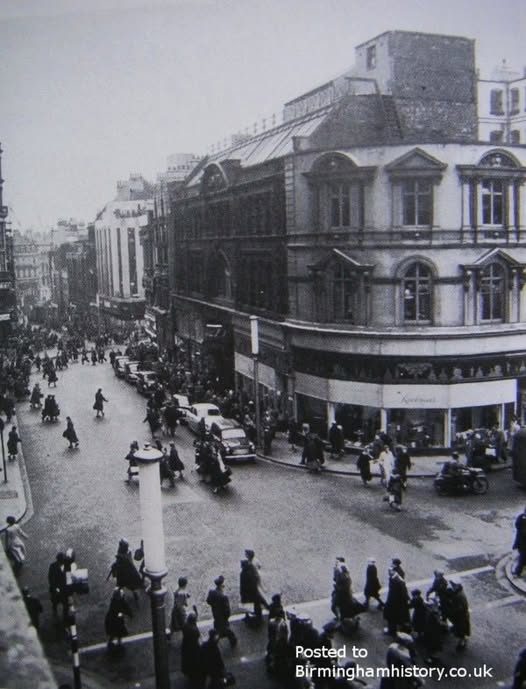
Copyright: Paul M Hayes. Looking down Bull Street, towards High Street, with Temple Row coming in on the right. The Rackhams shop on the corner was at 78 Bull Street, where Richard worked and lived in 1871. I think this would be in the 1950s or thereabouts.
In the 1881 Census, Richard was in Hulme, Lancashire where he was still a clerk to some sort of trader. In 1886, Richard was the executor to the Will of his younger brother Thomas so was in the country then. Perhaps the death of Thomas, at such a young age, unsettled him. Whatever motivated him, Richard was to be one of the few Vaughans who ventured abroad. In 1888 he arrived in New York, USA and it appears that he married Anne Maria Wray in Colorado in 1889. They settled in Denver and he was a bookkeeper there, becoming a naturalised citizen in 1921. Although he and Anne Maria were married in Colorado, Anne was a Birmingham girl, born in 1858 in Aston. Their son Harry Wray Vaughan was born in Denver, Colorado in February 1890, their daughter Doris was born in West Bromwich, England in February 1893 and was baptised at St John, Perry Barr in March of that year. Both Harry and Doris were still in Denver in 1940, both unmarried and living together.
Richard died in Denver, Colorado in 1928 and Anne Maria in 1938, also in Colorado. Doris died in 1967 and Harry in 1969, both in Colorado.
So Richard and his family appear to have made a complete break with the metal-working traditions of the Vaughans and with the Midlands and England.
Thomas Vaughan 1853-1886
Thomas Vaughan was born in 1853 in Birmingham and was with his family in the 1861 and 1871 censuses, in the latter he was a Jeweller’s Assistant, another slight variation in the metal working tradition! By 1881, however, he was in Newhall Hill, Birmingham as a visitor in the household of Sarah Howling, a confectioner as was her daughter Emily, 26. His occupation was a toolmaker but I note that one neighbour was a Jeweller’s Toolmaker and this area was in or adjoining the Jewellery Quarter so it is possible that Thomas was still associated with the jewellery trade.
Thomas died young, however, in Rhyl, Flintshire, Wales, on 19 August 1886, aged 33 and his Will states that he was a bachelor, of Newhall Hill, Birmingham. His death certificate shows that he was a fitter and that he died at 11 Queen Street, Rhyl and that he died of ‘Diarrhoea Syncope’ His brother William James registered the death and was present when his brother died, although his own address was given as Victoria Road, Aston so he must have travelled to Rhyl, for holiday or because of Thomas’s illness, unless he was also on holiday there. I cannot find a definition now which quite matches this cause of death but it was certified by a doctor so it was clearly an acceptable cause of death to the Registrar and it may be that dehydration led to physical collapse.
It is possible that Rhyl was a favoured holiday destination for the family, many Midlanders holidayed there and along that coast and it was the height of the holiday season. There were also a considerable number of Vaughans living in Wales, too who may have had family connections in the past.
Thomas was buried in the family grave at Witton Cemetery.
Amelia Page Vaughan 1855-1939
Amelia Page Vaughan was born on 15 February 1856 in Aston and was with her family in 1861, 1871 and 1881. She never married and her Will refers to her as a spinster. In 1891, she was living, described as Housekeeper, with her widowed eldest brother William James in Victoria Road, Aston. After that she seemed to move around the family.
I cannot find Amelia in the 1901 census but in 1911 she was a visitor in Clifton, Bristol with her niece Mary Catherine Fleming, nee Vaughan, (the daughter of Amelia’s oldest brother Joseph Edward and Marian), and her husband John Fleming and their four children.
By 1921, Amelia was living in 6 Twyning Road, Birmingham with her married niece Adelaide Amelia Loach, daughter of Amelia’s brother Charles who had died in 1912. Also living with Adelaide, in addition to her husband Alfred and their three children, were her mother Emmeline and sister Clara. From google street view, it appears that 6 Twyning Road is a Victorian Terraced house of no great size so it must have been fairly crowded!
It appears that Amelia continued to live with or near her two nieces as she appears in the 1936-1937 Electoral Roll at the same address in Rotton Park, Birmingham as Adelaide and Clara, although alas, Amelia died on 28 June 1939 at her niece Clara’s house, just a few months before the 1939 Register was taken. As with her cousin once removed Esther Jane Vaughan, her nieces Adelaide and Clara were named as executors in her Will. She was buried at Witton Cemetery.
Summary
So these were the next four children of William Vaughan and Mary Ann Alsop, all with something of interest about them and most of them showing a close association with the Vaughan family and their businesses, although some were further afield, in Bristol or the USA. Spinster daughters seem to have remained mostly with their brothers or with nephews and nieces, looking after or being looked after and still clearly cherished members of the family. But again, few links lead back to Rowley Regis and the Alsops, although the Vaughan links to Rounds Green and Oldbury seem to have persisted for some years.
The next piece will look at the remaining Vaughan children – Mary Ann, Emma Eugenie, Lewis Ralph and Septimus and should follow shortly.

